NORIS DRILLREX UNI (left) and
NORIS DRILLREX C UNI (right)
REIME NORIS recently expanded its product portfolio with a new segment and will offer core hole and thread production from one source from now on.
More and more difficult tasks in the production of threads require constant further development by both the user and the manufacturer of the tools. In order to create an optimal basis even at the beginning of this demanding process, REIME NORIS presents its two newly developed twist drill types NORIS DRILLREX UNI (DIN 6537 L) and NORIS DRILLREX-C UNI (DIN 6537 K with countersunk chamfer).
These reliable solid carbide twist drills with internal coolant supply cover a wide range of applications with their universal geometry, which increases the economic efficiency through reduced tool costs.
NORIS DRILLREX UNI (left) and NORIS DRILLREX C UNI (right)
The perfect interaction of the proven TIBLU coating, optimised tungsten carbide substrate and ultra-smooth flutes enables the best possible chip removal with excellent surface finishes without hardening – the ideal basis for threading.
The portfolio is based on the common core hole dimensions for tapping and thread forming of the thread types M, MF, UNC, UNF, MJ, and G – starting with Ø 2.8 mm to Ø 20.0 mm.
For more information, please contact Duncan Macdonald – Tel: 011 444-4345.
REIME NORIS presents a new internal thread mill cutter for universal use in a great variety of materials; it can be used for a wide range of range of thread pitches.
The profile design of these single-row thread mills provides a maximum pitch for the production of metric standard threads and also covers the pitches of common metric fine threads. Furthermore, it is possible to machine all intermediate pitches for any thread with 60° profile angle, such as the American UN threads.
The tools are available for M1 to M16 in 2xD and 3xD usable lengths. With shank diameter 8 mm and above, they have a coolant bore.
Made from an ultrafine grain carbide grade and refined with a TICN (titanium carbon nitride) coating, the tools show excellent performance in almost all technical materials. The process reliability and flexibility of these thread mills are absolutely convincing, especially for materials that are difficult to machine or for eventually required deep and deep-set threads.
Noris EIR HR
For more information, please contact Duncan Macdonald – Tel: 011 444-4345.
ULTRA COMPACT SIMULTANEOUS 5-AXIS HIGH PRECISION VERTICAL MACHINING CENTER FOR THE MEDICAL DEVICE MARKET
Kitamura Machinery, the premier manufacturer of precision horizontal, vertical and 5-axis machining centers, adds to its 5-axis line up with the MedCenter5AX vertical machining centre. This ultra-compact 5-axis VMC brings with it the largest work envelope in its class and offers unparalleled precision, accuracy and speed for expanded machining capability in the machining of highly complex, multi-sided parts in one setup.
The MedCenter5AX employs an X, Y & Z axis, and additional tilting A-Axis (+/-120 deg.) and a rotary C-Axis (360 deg.) with a 0.001 deg. minimum indexing command. Machining of high precision, complicated parts like orthopedic implants or aerospace parts can be completed in one operation, reducing the overall machining process. The maximum work piece size (Dia. xHeight) of Ø220mm (8.7”) x 175mm (6.9”) and maximum table load capacity of 20Kg (44lbs) allow for incredible flexibility and versatility in the machining of smaller highly precise, highly intricate parts.
Standard high speed, direct drive 4th and 5th axis rotary tables offer smooth simultaneous 5-axis movement for complex cutting applications. Rigid in design and equipped with high resolution optical scale feedback on all axes, the MedCenter5AX offers the precise accuracies needed (positioning accuracy of ±0.002mm (±0.000079”))/full stroke for a wide variety of small part machining.
Kitamura’s standard high speed 30,000minˉ¹ 18kw (24.5HP) direct drive, HSK-E40 spindle offers superb rigidity an ultimate stiffness in spindle construction and function while allowing for super fine finish capabilities. Ideal for small diameter tools and hard milling, the MedCenter5AX offers a standard air through spindle feature for dry cutting and is also equipped to handle up to 1000psi coolant thru the spindle for deep hole drilling requirements.
The MedCenter5AX may be compact but it is equipped with a large 40 tool magazine – a great benefit when machining more complex parts. Tool changes are a lightning fast 1.5 seconds. To assure optimum operator access and convenience when setting up tools or performing routine maintenance, the tool magazine is located toward the back side of the machine.
For increased productivity, Kitamura offers an optional 12-station automatic pallet system for running long hours of unmanned operating in the machining of both highly mixed or highvolume production parts.
Kitamura combines many standard features in our feature-rich Arumatik-Mi control. With a 5-times faster processing speed, the Arumatik-Mi CNC Controller offers a super-smooth control process for super-fast machining of complex work pieces. Featuring the latest in advanced, ultra-intuitive touch screen technology, dedicated 5-axis control functions and advanced 5-axis NC simulation and verification software, the Arumatik-Mi is your solution for easier programming, part setup and operation of complex components.
For More information, contact WD Hearn – Tel: 021 534 5351
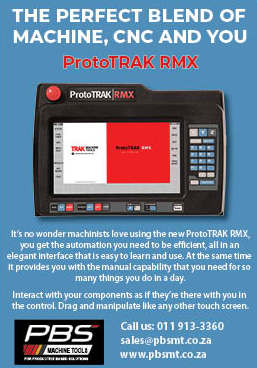
Next generation ProtoTRAK redefines machine tool controls, making them independent of operator skills. XYZ Machine Tools’ new RX ProtoTRAK controls, available on mills and lathes, deliver significant programming efficiencies thanks to its new 15.6” touchscreen and the capacity to store defaults of regularly used machining operations.
The new ProtoTRAK control touchscreen puts all of ProtoTRAK’s advantages at the users’ fingertips. New features, such as Enhanced ProtoTRAK Assistance (EPA), provide instant access to in-depth help for users at any point in the programming/operating procedure and are aimed at improving the ease of use of XYZ ProtoTRAK controlled machines.
The EPA system addresses the change in skill sets that businesses are facing, where traditional mechanical skills with limited technology knowledge are being reversed, with the next generation having possibly lower levels of engineering/metal cutting experience, but higher acceptance of computer technology.
Our RMX control includes an Auto Geometry Engine (AGE) with built-in machining strategies that deliver advanced performance benefits. The AGE function is effectively a CAD capability within the control allowing users to overcome issues when data is lacking from drawings by automatically calculating missing dimensions during programming.
Touchscreen capability takes AGE to a new level, with the new “Tap to Guess” feature. Simply tapping the screen where the intersection or tangent point is unknown, the AGE software calculates the dimension data. AGE is also used in both profiles and pockets and enhances the RMX capability to machine pockets with an unlimited number of islands located within their boundaries.
Aligned with pocket machining, a range of machining strategies can be called on with the new RMX ProtoTRAK control and include a new Adaptive Toolpath feature which can drastically reduce cycle times on complex milling cycles; this feature is more commonly found on high-end CAD/CAM systems.
ProtoTRAK RX controls retain the option for a DXF Converter and here the touchscreen technology delivers substantial advantages with the ability to mix DXF and manual programming during program generation, giving the user total flexibility facilitated by the touchscreen.
The latest generation of ProtoTRAK RX controls continue the evolution with new, innovative ways of reducing programming and cycle times yet, maintaining the original concept of ProtoTRAK to make things as simple and easy to use as possible.
“This concept has seen ProtoTRAK controlled machines continue to make up a high proportion of our sales,” says Nigel Atherton, Managing Director of XYZ Machine Tools. “While at the start of the development process, we spoke to customers and asked what they wanted to see from ProtoTRAK, 95 per cent of what was listed has come to fruition in the RX ProtoTRAK controls.”
To see just how the new ProtoTRAK control can assist your productivity simply request a demonstration from PBS Machine Tools to highlight its ease of use.
For more information please contact PBS Machine Tools – Tel: 011 914-3360.
The VTX-II series is the latest version of VTX series that belong to the TapMill range of machining centres and are renowned for their high production efficiency and compact floor size.
In this new generation, the VTX-II series provides two models for satisfying different machining demands, namely the high torque type and high efficiency series.
The VTX-II high torque type not only provides the machining torque equal to a medium-sized machining center, but also keeps its originally outstanding rapid traverse performance of 60m/min.
The VTX-II high efficiency type on the other hand has outstanding spindle acceleration/deceleration performance, which provides fast spindle orientation to the tool changing point and dramatically saves cycle time and additionally, making it suitable for tool room applications.
Compared with conventional belt-driven spindle machines, the VTX-II series is standardly equipped with a direct-drive spindle for better rigid tapping performances and furthermore, solving the problem of short usage life of the spindle belt.
The A-shape column design and roller type linear guideway ensure dynamic stability under rapid traverse of 60m/min with the 1.2G acceleration force.
High Torque type
The new VTX-II high torque type has an 84Nm torque output, and its performance is higher than the conventional tapping centre making it a true, high performance milling centre.
High Efficiency type
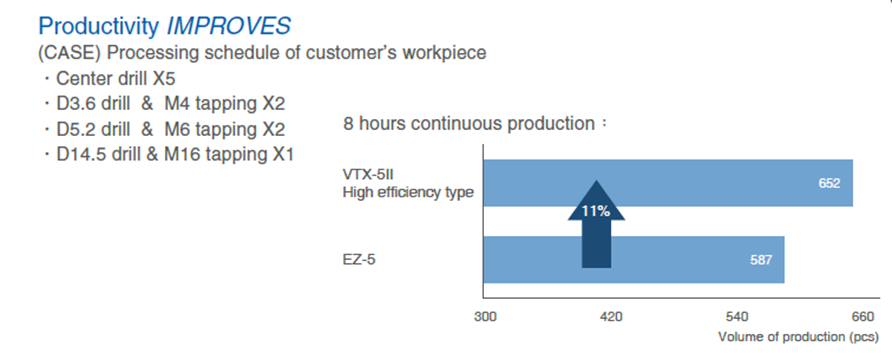
The new VTX-II high efficiency type has a spindle speed of 9,000 rpm making it suitable for high speed machining applications. After a test, the saving in cycle time compared to the previous model is up 11%.
Additional features included in this new range of machines are designed to make them independent of operator skills.
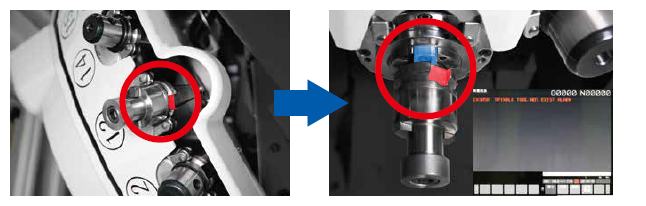
By example, the VTX-II is equipped with a clamping error inspection function to avoid tool damage caused by human operating errors, while guarantying machining quality.
Clamping error inspection
When the tool doesn’t clamp completely, due to incorrect placement and if the drive block does not locate correctly into the drive slot of the holder, the clamping error inspection function informs the control, which in turn displays an alarm message.
For more information please contact PBS Machine Tools – Tel: 011 914-3360.
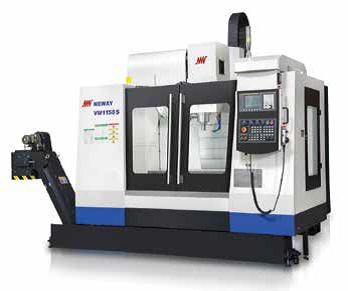
Neway CNC Equipment Co offers a cost effective range of vertical machining centres, which are manufactured at the company’s modern manufacturing plants in Suzhou China.
Neway’s excellent manufacturing and quality control capabilities are maximized by the use of latest equipment from well-known international brands including Zayer, Kellenberger, Starragheckert, Swiss SIP, Renishaw and Shenck. They hold ISO and CE certification.
Neway’s Chinese manufacturing operation is supported by the group’s head office in Texas USA and a sales and support centre in Germany.
Neway CNC Equipment currently offers a range of moving table vertical machining centres which range in table size from 750 x 420mm to 1800 x 800mm. This range is available in the following table sizes, VM740 – 750 x 420mm, VM950 – 950 x 520mm, VM1150 – 1100 x 520mm, VM1260 – 1200 x 600mm, VM1360 – 1350 x 600mm, VM1580 – 1500 x x800mm, VM1780 – 1700 x 800 and VM1880 – 1800 x 800mm.
The VM740, VM950 and VM1150 models are fitted with BT40 spindle tapers. These three models are available as a lower specification S series with a Fanuc 0i-Mate-MD controller or a higher specified H series which are supplied with a Fanuc 0i-MD controller. The VM1260 and VM1360 models are fitted with BT 40 spindle taper as standard and can be supplied with a BT50 spindle taper as an option.
The VM1580, VM1780 and VM1880 are only available as H series specification with Fanuc 0i-MD controllers and have BT50 spindle tapers as standard. With the exception of the VM740, which has a 20 tool magazine, all models in the range come with a 24 tool magazine and arm type tool changer.
The complete series of models from VM740 to VM1880 in the S and H range have linear guideways on all three axis. The additional HR series which is available in sizes from VM950 to VM1780 feature box guideways as opposed to linear guideways. Full enclosure guarding and chip conveyors feature as standard equipment across the entire range.
Factory fitted optional equipment includes 4th axis rotary tables, through spindle coolant, workpiece measuring and toolsetting probes systems. Spindle oil cooling systems and coolant water/oil separators are available on request.
To complement the range of vertical machining centres, Neway CNC Equipment offers the VM640D drilling and tapping machine. This machine has a table size of 650 x 400mm, a 16 position cam type tool changer with a 1.6 second tool change, a spindle speed of 15 000 rpm, X and Y axis rapid feed rates of 48 meters per minute and a Z axis rapid feed rate of 60 meters per minute. They come fitted with the Fanuc 0i MD controller.
For more information, please contact Machine Tool Promotions – Tel: 016 931 1564.
Easy to use NC Merge feature in Hurco’s conversational control software means CAD/CAM is only needed for programming complex 3D contours
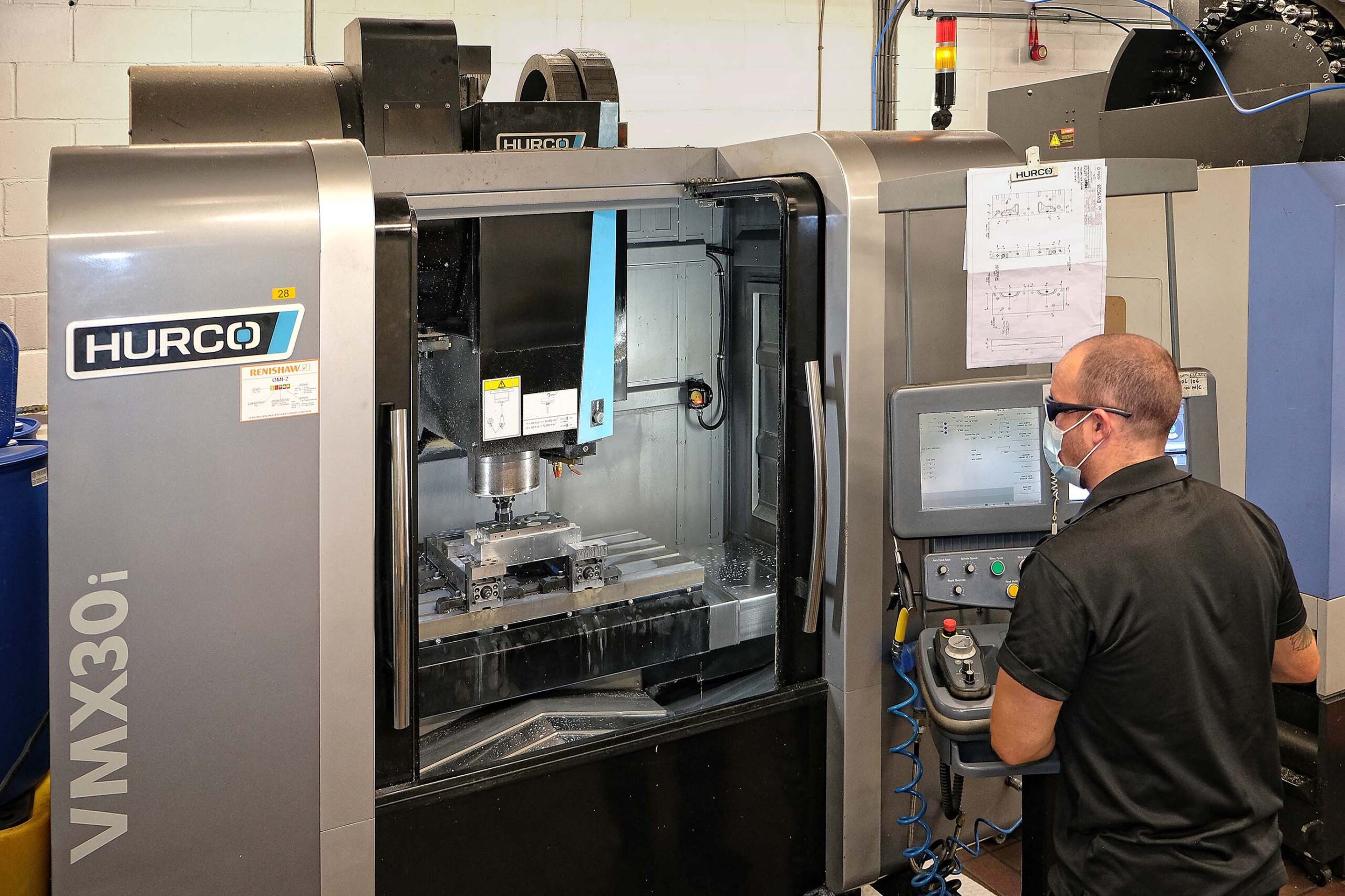
Six Hurco 3-axis VMCs carry out a majority of prismatic machining in the toolroom at the headquarters of plastic packaging manufacturer Berry M&H in Beccles, Suffolk. Although the firm dates back to 1973, the first Hurco machines, a VM10i and a VMX30i, did not arrive until 2015 when the assets of another toolmaking company were acquired, including its machines.
Prior to that, manual knee-type mills were followed by 3-axis CNC milling machines and then a succession of machining centres with automatic tool change. All of the CNC machines, although of various makes, were fitted with the same G-code-based brand of control system to provide commonality for the convenience of the staff.
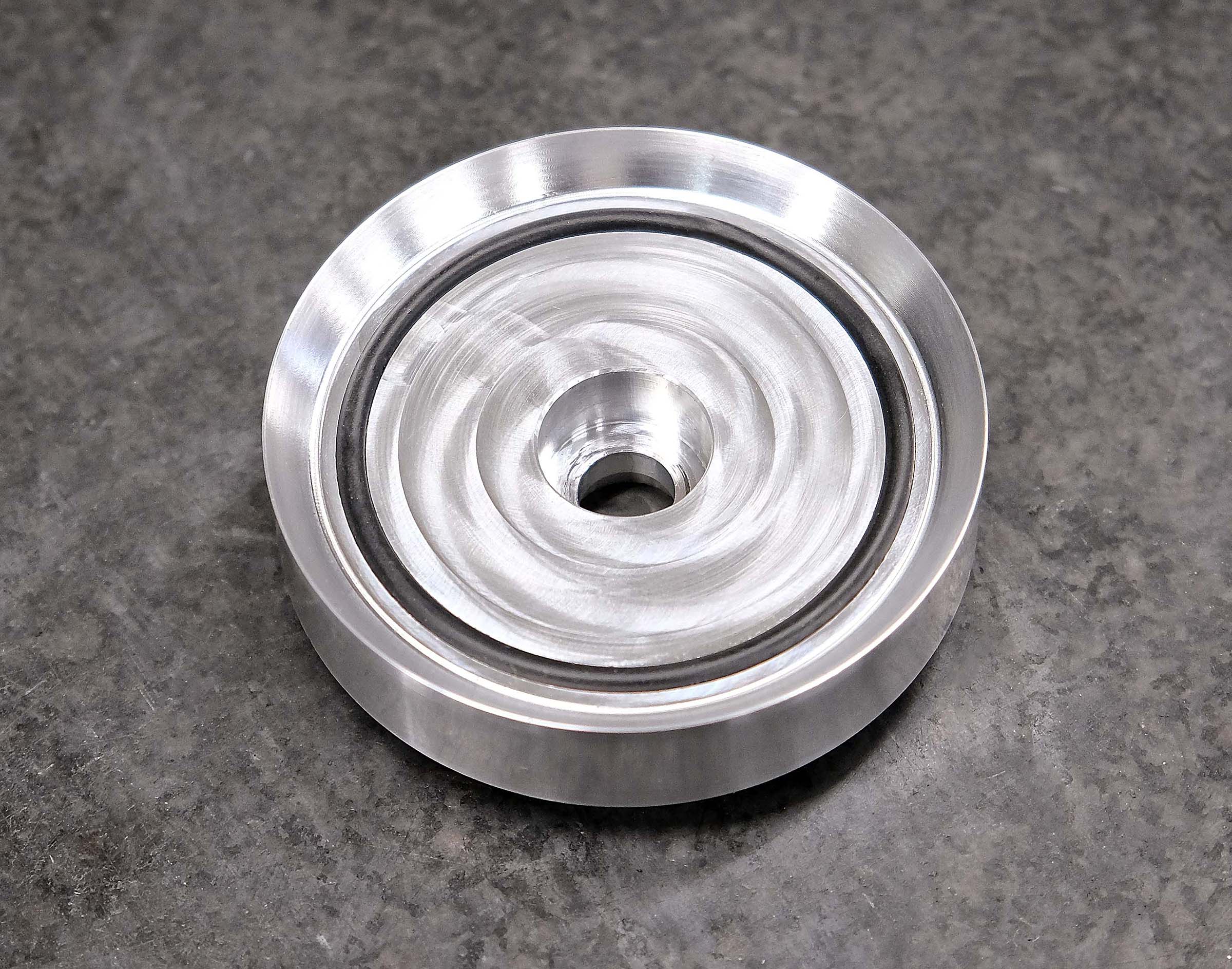
Aluminium chuck for Berry M&H’s printing department
Berry M&H’s toolroom manager Kurt Knights, who has been with the company for over 20 years advised, “When we started using WinMax conversational software in the Hurco control, it made shop floor programming far easier and quicker for our operators – and it also simplified training new people.
“Most programs we prepare take advantage of the Hurco’s NC Merge feature. Complex parts of a cycle for contour-milling 3D mould surfaces are output from either NCG CAM or SolidWorks CAD/CAM systems in our design department and the file is imported directly into the control.
“Conversationally programmed blocks prepared at the machine using WinMax are then automatically merged in the control with the offline content into a single program for milling the block parts of our moulds.”
Offline code generation for a mould takes typically 10 hours, while the shop floor element is completed in around two hours, much faster and more simply than is possible on a machining centre driven by a G-code control. It quickly became apparent that the Hurco/WinMax combination was perfect for Berry M&H’s requirements, which centre mainly on fast-turnaround production of moulds from 170 mm wide Alumec 89 billets. Most moulds comprise neck, body and base blocks manufactured from this high strength aluminium alloy, held together by a steel back plate.
Two new Hurco VM5i 3-axis VMCs were purchased for machining these moulds, as well as for new tool development that was formerly the province of the CNC mills, all but one of which have now been sold. The VM5i was chosen as it has a generous 457 x 356 x 356 mm working volume in a compact 1.6 x 2.9 metre footprint. It suited the toolroom space and layout well and was correctly sized for machining the company’s moulds. Four halves at a time are fixtured, each of which takes about three hours to machine. The resulting 12-hour cycle is more than sufficient for a full light-out shift overnight.
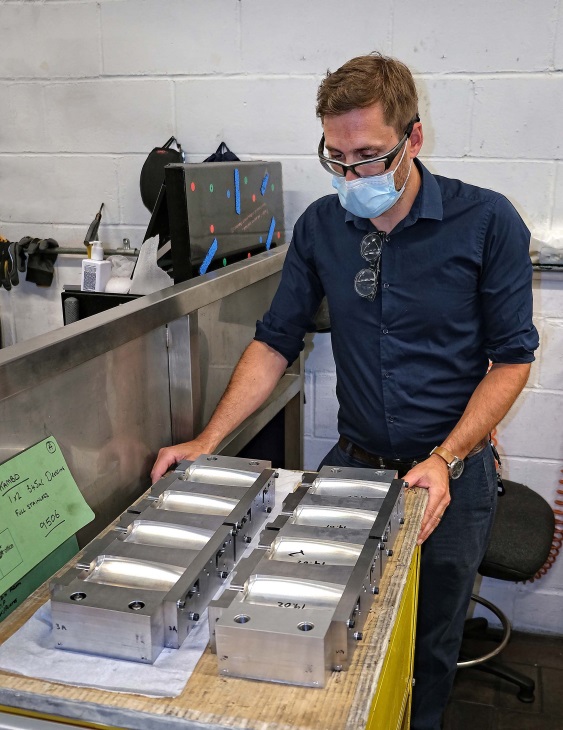
Kurt Knights with a set of SS Moulds
As the size and performance of the two VM5i machines were ideal, the decision was taken in 2019 to buy a third, this time for producing items such as printing chucks, bracketry and other general, non-mould items for different departments across the Beccles site. It brought in-house a lot of previously subcontracted milling, delivering considerable financial savings.
In November 2020, a larger Hurco VM30i with a 1,270 x 508 x 508 mm working volume was purchased that Knights described as “a superb machine and excellent value for money”. The investment was down to Berry M&H’s decision to move more strongly into the production of bigger moulds up to 700 mm wide and with up to six cavities.
There had always been a requirement for this size of tool and their production was previously subcontracted out, so this expense is now also saved. Both Alumec 89 and 1.2316 stainless steel are used, the latter as it has good thermal conductivity and wear resistance and is also magnetic, allowing a mould to be clamped conveniently on the bed of a grinding machine.
Berry M&H designs, develops, produces and prints to British Retail Consortium standards a large range of plastic bottles, jars, tubs, flexible tubes, closures, caps and dispensing systems. The packaging solutions are sold into the personal care, healthcare, pharmaceutical, nutritional, pet care, automotive and household product markets.
The company has an extensive range of almost 5,000 standard products and also offers bespoke design, prototyping and moulding services. There are 12 manufacturing sites across the UK, mainland Europe, America and Australia, Beccles being the headquarters. Knights’ department produces blow moulds and injection moulds for all of the group’s factories, except for the Australian site.
For more information, contact Hurco – Tel: (011) 012 259 1375
Exceptional rigidity, accuracy and dynamic performance are the key features of Takumi’s high-speed portal machines.
The H series machines operate with outstanding accuracy and achieve an exceptional surface quality thanks to their sophisticated measuring and sensor control systems. Absolute direct measuring systems, internal coolant feed through the high-speed spindle, direct drives on all axes and electronic temperature compensation come as standard. Despite their relatively low procurement costs, the technical performance characteristics and values of Takumi’s H series machines are all top of the range.
Fast and accurate: the Takumi H7 and H10 models
These two machining portals have the shortest travel paths in the H series. The H7 and H10 models focus on the high-speed applications involved in tool-making, mould-making, medical technology, and the aviation and aerospace industries. They are designed to work with exceptional precision to create the optimum surface finish even in the very tightest spaces. The robust and stable portal design and resistance to high temperatures are the cornerstones of the machines’ operating excellence.
The designers have made a lasting improvement to load distribution on the spindle head by designing the portal frame as a ladder-type structure. The H7 and H10 machining portals can handle maximum table loads of up to 500 or 800 kilograms. All of Takumi’s H series models come equipped with a Heidenhain control system as standard. Together with the Heidenhain components integrated in the machining centers, they make a huge contribution to the accuracy of the result. The control systems allow programming in dialog and in parallel mode. They also have functions for freely programming contours and options for ISO-NC programming.
For more information, contact 600 SA Machine Tools – Cell: 072 157 6003.
VC series vertical machining centres are fast, three-axis linear guide machining centres designed for customers doing batch or production work.
To meet the requirements for fast cutting, the 3 axes are equipped with linear guide-ways for quick responses in acceleration and deceleration and high rapid traverse of 48 m/min.
The machine features travels of 1,060 x 520 x 610 mm and comes with a table size of 1,160 x 520 mm. Supplied with a machine net weight of 5,900 kg, the VC1052 can accommodate a maximum table load of 650 kg.
While featuring a spindle speed of 12,000 rpm and motor power of 7.5/11 kW, the Takumi VC1052 provides a magazine capacity for24 tools. Rapids are 36 x 36 x 24 m/min.
Providing a perfect combination of fast cutting and high stability, the machine is designed and built for mould machining with pre-tensioned ballscrews minimizing thermal growth and improving accuracy.
An ergonomically designed table simplifies setup, while the swivelling control panel optimizes floor space utilization.
A robust, precision-machined casting, hand-scraped contact areas and an integrated wash-down chip management system add to the highlights of the Takumi VC1052.
The spindle chiller maximizes heat dissipation and direct-coupled ballscrews increase accuracy, while the absolute encoder ensures a fast start-up.
For more information, contact 600 SA Machine Tools – Cell: 072 157 6003
In a market where skilled artisans are becoming more and more scarce, it has become necessary to look at alternative ways of machining, whether it be for general engineering, tool-making or production work CNC machining is quicker and certainly more accurate than conventional milling machines and there is no need for constant monitoring while in use. Taking this into account, MJH Machine Tools have a solution to suit customers’ needs.
Featuring an entry level CNC control, our Ctek CNC milling machine is the first step to CNC machining. As long as the operator has basic knowledge on using a DRO, he can, within a few hours, be taught how to program and run the machine. There is no need for G code knowledge as the control is conversational, using a question and answer format. The software is simple to use with graphic input in basic machinist language. The control has options for standard operation modes such as drill, tap, bore, contour and pocket programming, which is ideally suited to general engineering work without a need for external programming packages. The latest Ctek’s come with linear guides on all three axes for better accuracy and speed, as well as a direct spindle drive motor and an improved Z axis motor with inline break which eliminates the need for a counterbalance. The Ctek can be fitted with a 4th axis within a matter of hours and programmed from the standard Ctek control.
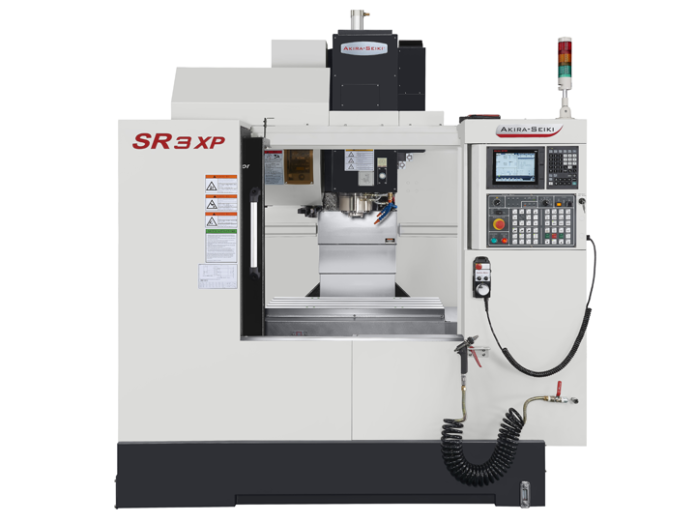
The Ctek range has six x-travel sizes, 800mm, 1 000mm, 1 500mm, 1 800mm, 2 000mm and 2 500mm. These machines are available in open type or fully enclosed depending on the customer’s requirements. All spares are available ex stock at a fraction of the cost compared to other controls. With hundreds of these machines sold throughout South Africa since 1997, it is not surprising that Ctek CNC milling machines have been the first step to full CNC machining in many workshops. Should there be a requirement for a high performance machining centre for super fine finishing and accuracy, the Akira Seiki is the machine to consider. Spindle power ranging from 15HP on the Junior series to 42HP on the Super Vertical range and spindle speeds from 9 000rpm to 15 000rpm guarantee high quality surface finish. Akira Seiki machines come standard with spindle oil chillers, inner spindle air chiller, coolant through spindle, pneumatic counter balance, chip screw conveyor, quick change ATC and 4th axis preparation.
JR
SR2
SR3
CONTROL SYSTEM
AKIRA M:845 (Fanuc G code compatible)
TRAVEL
X Axis Travel
mm/inch
410 / 16.1
550 / 21.7
762/30
Y Axis Travel
mm/inch
430/ 16.9
430 / 16.9
430 / 16.9
Z Axis Travel
mm/inch
460 / 18.1
460 /18.1
460/18.1
Spindle Nose to Table Surface
mm/inch
75~535/ 3-21
75~535 /3~21
75~535/3~21
Spindle Center to Column Cover
mm/inch
435/17
435/17
435/17
TABLE
Table Size (L x W)
mm/inch
560 x 380 /
22 x 15
700 x 380 /
28 x 15
910 x 380 /
36 x 15
T Slot
mm/inch
16 x 80 x 4 slots /
0.63 x 3.15 x 4 slots
16 x 80 x 4 slots/
0.63 x 3.15 x 4 slots
16 x 80 x 4 slots/
0.63 x 3.15 x 4 slots
Max. Loading
kgs/lbs
432/952
576 /1270
792/ 1746
Standard Loading
kgs/lbs
360/794
480 /1058
660/1455
SPINDLE
Max. Motor Power (Peak)
HP
12
15
15
Max. Speed
rpm
9,000
9,000
9,000
Spindle Taper
ISO 40
BT40
BT40
BT40
FEED
Rapid Feed X/Y/Z
M/min rpm
30 /30 / 24
1181 / 1181 /945
30 / 30 / 24
1181 /1181 /945
30 / 30 / 24
1181 /1181 /945
Cutting Feed X/Y/Z
M/min rpm
10 /10 /10
394/394 /394
10/10/10
394/394/394
10/10/10
394/394/394
ACCURACY
Positioning
mm/inch
0.01 / 0.00039
0.01 /0.00039
0.01 /0.00039
Repeatability
mm/inch
±0.003/±0.00012
±0.003 / ±0.00012
±0.003 / ±0.00012
ATC
Tool Storage Arm ATC
–
16T
20T
20T
Max. Tool Diameter
mm/inch
75/3
75/3
75/3
Max. Tool Diameter
(Without Neighbor Tool)
mm/inch
150 / 5.9
150 /5.9
150 /5.9
Max. Tool Length
mm/inch
250 / 9.8
250 /9.8
250 /9.8
Max. Tool Weight
kgs/lbs
7/15
7/15
7/15
Tool to Tool Time (60hz)
sec.
2.2
2.2
2.2
GENERAL
Tank Capacity
liter/gal
150 / 39.6
150 / 39.6
150 / 39.6
Chip Disposal
–
Drawer
Drawer
Drawer
Air Pressure Requirement
Mpa/psi
0.5/72.5
0.5/72.5
0.5/72.5
Power Requirement
KVA
20
20
20
Floor Space
mm/inch
1900 x 1935 /
75x 76
1900 x 1935 /
75x 76
2100 x 1935 /
83x 76
Weight
kgs/lbs
2850 /6283
3250/7165
3480 /7672
For further information, please contact MJH Machine Tools – Tel: (031) 705 7514.