Home Blog Page 84

Cutting Tools: Endmills With Coolant Channels Expand The ECKI-H4R-CF Chatterfree Family

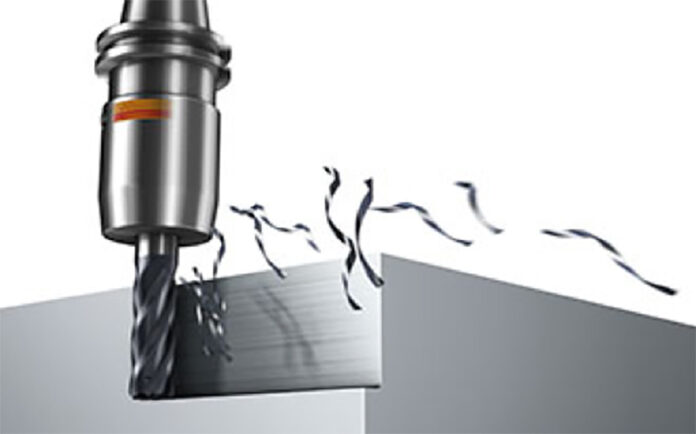
ISCAR is adding new endmills with coolant channels to the CHATTERFREE family for machining titanium with high removal rates.

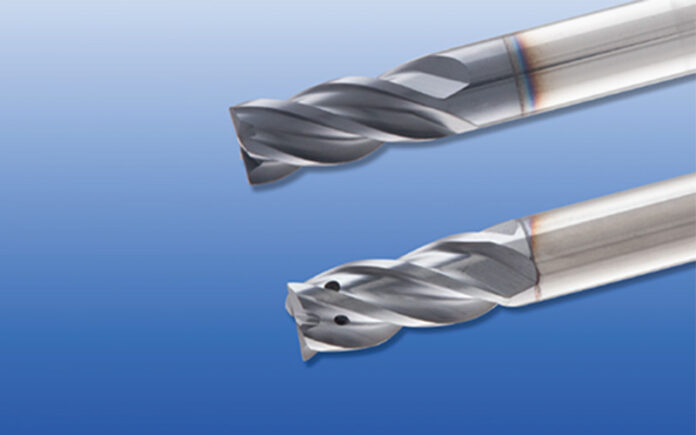
The family of ECKI-H4R-CF endmills is expanding with the addition of tools that feature coolant channels with outlets directed to each cutting edge. These new endmills are available in .250, .312, .375, .500 and .625 inch diameters.

Featuring unique geometry and 4 flute endmills with different helix, variable pitch and coolant channels, the ECKI-H4R-CF endmills improve performance, process reliability and tool life; they represent the best chatter free tools for high removal rates when machining titanium.


For more information contact Iscar South Africa – Tel: 011 997 2700

Cutting Tools: High-Technology Simplicity

A new standard of indexable inserts: a carefully designed complex shape for effective cutting action.

While cemented carbide indexable inserts are an integral part of cutting tools today, cemented carbide inserts were first introduced in the early ’60s and have substantially changed tool designs, putting tools with brazed carbide tips on the back burner. Mechanical clamping of the indexable inserts provided significant advantages in productivity, efficient use of carbide and tool maintenance.

Advances in technology and metallurgy have facilitated the development of indexable inserts that are far more advanced than their predecessors, and complicated shapes which have replaced the simple forms that characterized inserts in the past.

The shape of an insert is a key factor for cutting geometry of a tool as a whole. For example, when milling, geometry variation by means of changing the position of the insert in the tool is very limited, and the results are far from optimal. Effective machining demands constant rake and relief angles along the cutting edge, which in turn necessitate complicated contours of the top of the insert (and also bottom for double-sided inserts) and its periphery. A land that strengthens the cutting edge and a minor edge for better milling by ramping further increases the design’s complexity.

The insert must ensure precise control of the flow of chips produced by the cutting action, and so the chip breaker on the rake face adjoining the cutting edge must be specifically shaped. This is particularly important for turning, especially if a machined material produces long chips; here, the chip breaker controls the direction of the chip flow so that the chip overturns and breaks into smaller segments.

Finding the optimal insert shape for efficient cutting and chip control is not a simple task and tool manufacturers have leveraged new technologies to develop successful solutions.

Indexable inserts are sintered products

Integrating dedicated automated and computer controlled systems into the tool fabrication facilities ensured both stability and repeatability in the powder metallurgy processes. As a result, pressing complicated forms became possible without fear of cracks and a technological base for forming challenging geometries of inserts was developed.

A surface that ensures satisfactory chip control, particularly chip breaking, is a combination of concave and convex elements: grooves, bosses, etc. Manufacturing this surface by grinding is both very limited and expensive. This is one of the main reasons why the first generations of the indexable inserts featured flat forms. In contrast, with the use of powder metallurgy the rake face of an insert can be configured as desired.

Today, cutting tool design engineers have at their disposal advanced working tools such as computer-aided design (CAD) and modelling, which have essentially changed the process of insert development. The new methods have opened up the possibility of simulating various processes, such as chip formation and chip flow. Consequently, an optimal geometry may be designed on a computer by changing various parameters of the virtual insert.

Progress on both fronts – manufacturing technology and design methods – has led to important breakthroughs in the production of indexable inserts.

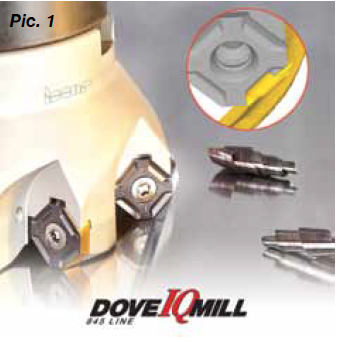
ISCAR’s insert IQ845 SYHU 0704 for face milling cutters is a good example of how computer modelling and advanced pressing have resulted in a successful product (Pic. 1).
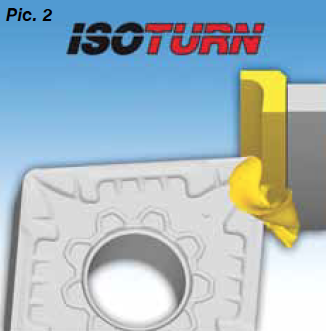
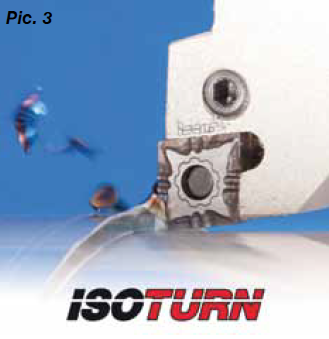
Computer modelling the chip flow has contributed significantly to optimizing the rake face shape for the family of ISCAR inserts CNMG-F3M (Pics. 2, 3) that was designed especially for the finish turning of ISO M materials (austenitic, precipitation hardening and duplex stainless steels).

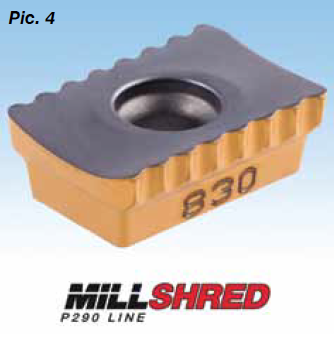
Powder metallurgy is applied to the face of the insert as well as its cutting edge. For example, the inserts P290 ACKT of the ISCAR MILLSHRED family possess serrated cutting edges (Pic. 4) that are used as sintered. The serrated cutting edge shreds the chip and so greatly improves milling results in unstable conditions.
The concept of a cutting tool with mechanically clamped inserts pushed aside brazed cutting edge applications once the industry learned to produce sintered inserts with acceptable accuracy and dimensional stability. However, for high-precision cutting, rotating solid carbide and also brazed tools still retain the lead. A one-piece integral cutter, ground with strict tolerance limits, always has the advantage in accuracy in comparison with an assembled tool with inserts. There is a viable indexable alternative that not only overcomes the lack of accuracy but improves the tool by making it both versatile and economical: an innovative yet simple modular cutter that can incorporate various replaceable solid carbide heads.
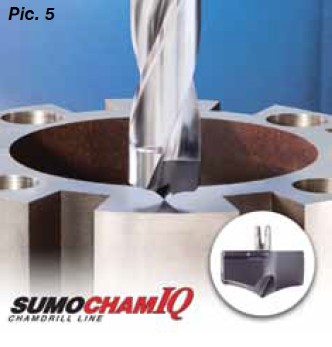
ISCAR’s tool families target different types of machining: MULTI-MASTER (milling and drilling); T-SLOT (milling slots and grooves); SUMOCHAM, CHAMIQDRILL and CHAMDRILL (drilling); BAYO T-REAM (reaming). Manufacturing replaceable heads for the tools is based on technologicallyadvanced pressing and sintering processes. There are two kinds of heads. One is a tool of decreased length usually made of solid carbide, whereas the second head features a specific pre-sintered shape that is brought to final dimensions by fine grinding. Advances in powder metallurgy have influenced the second type of head, while technological progress has succeeded in producing highly specific shapes for improved cutting action and chip control that are very difficult or even simply impossible to reach by using grinding operations (Pic. 5).
The growth of modern technology opened the door for producing both the indexable inserts and the replaceable heads from cemented carbide in diverse shapes. This reflects the outcome of years of research and development in the field, and further illustrates ISCARs commitment to the development of machining performance. Essentially, an indexable cutting tool comprises only three components: the tool body, the insert or the head and a clamping element.
The carefully shaped cutting area of this modern tool removes material directly despite its small dimension and uniform structure. ISCAR’s research and development division is committed to the evolution of smart cutting tool solutions and technologies to improve production processes in metal cutting.

For more information contact Iscar South Africa – Tel: 011 997 2700

Battery Production Goes Industrie 4.0

Imagine you’ve had a hectic day and then, to cap it all, you find that the battery of your electric vehicle is virtually empty.

This means you’ll have to take a long break while it charges fully. It’s a completely different story with capacitors, which charge in seconds. However, they have a different drawback: they store very little energy.

In the FastStorageBW II project, researchers from the Fraunhofer Institute for Manufacturing Engineering and Automation IPA in Stuttgart, together with colleagues from the battery manufacturer VARTA AG and other partners, are developing a powerful hybrid storage system that combines the advantages of lithium-ion batteries and supercapacitors. “The PowerCaps have a specific capacity as high as lead batteries, a long life of ten to twelve years and charge in a matter of seconds like a supercapacitor,” explains Joachim Montnacher, Head of the Energy business unit at Fraunhofer IPA. What’s more, Power-Caps can operate at temperatures of up to 85 degree Celsius. They withstand a hundred times more charge cycles than conventional battery systems and retain their charge over several weeks without any significant losses due to self-discharge.

Large-scale production with minimum risk

The Fraunhofer IPA researchers’ main concern is with manufacturing: to set up new battery production, it is essential to implement the relevant process knowledge in the best possible way. After all, it costs millions of euros to build a complete manufacturing unit. “We make it possible for battery manufacturers to install an intermediate step – a small-scale production of sorts – between laboratory production and large-scale production,” says Montnacher. “This way, we can create ideal conditions for large-scale production, optimize processes and ensure production follows the principles of Industrie 4.0 from the outset. Because in the end, that will give companies a competitive advantage.” Another advantage is that this cuts the time it takes to ramp up production by more than 50 percent.

For this innovative small-scale production setup, researchers cleverly combine certain production sequences. However, not all systems are connected to each other – at least, as far as the hardware is concerned. More often, it is an employee that carries the batches from one machine to the next. Ultimately, it is about developing a comprehensive understanding of the process, not about producing the greatest number of products in the shortest amount of time. For example, this means clarifying questions such as if the desired quality can be reproduced. The systems are designed as flexibly as possible so that they can be used for different production variations.

Making large-scale production compatible with Industrie 4.0

As far as software is concerned, the systems are thoroughly connected. As with process clusters, they are also equipped with numerous sensors, which show the clusters what data to capture for each of the process steps. They communicate with one another and store the results in a cloud. Researchers and entrepreneurs can then use this data to quickly analyze which factors influence the quality of the product – does it have Industrie 4.0 capability? Were the right sensors selected? Do they deliver the desired data? Where are adjustments required?

Fraunhofer IPA are also applying their expertise beyond the area of production technology: they are developing business models for the marketing of battery cells, they are analyzing resource availability and they are optimizing the subsequent recycling of PowerCaps.

E-Turn: In-Process Right-Hand And Left-Hand Bending


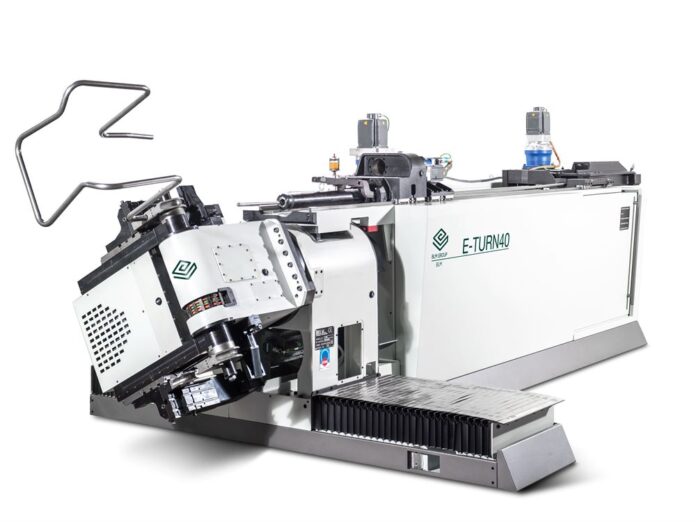
E-TURN is the BLM GROUP family of all-electric tube bending systems known for their flexibility, speed and accuracy in making complex shaped parts.

The family of machines comes in four models, for tubes up to 30, 35, 40 and 52 millimetres in diameter and inprocess right-hand and left-hand bending: the systems are all-electric with fixed and variable multi-radius capabilities and integrated loading and unloading systems.


The E-TURN stands out among the BLM GROUP bending systems for the variety of applications it can successfully tackle to bend complex parts fast and accurately. Inprocess right-hand and left-hand bending, 15 All-Electric axes, integrated to automatic loading and unloading systems, the VGP3D programming system and the B_Tools and B_Right functions to get it right from the first part. These are the strengths of a system which can often succeed when the others simply give up.

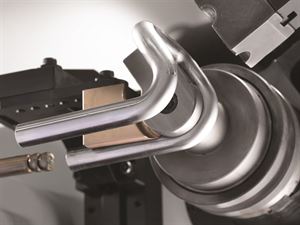
Each of the two bend heads for in-process right-hand and left-hand operation can mount up to four tools for creating various fixed and variable bending radii. In many cases, this means that a variety of jobs can be performed without the need to change the tools between each one.

The clever bend head design is capable of applying up to 2000 kilograms of pressure making it possible to bend complex radii less than 1D, on tubes ranging from 6 to 52 millimetres in diameter. Being able to modulate the torque during bending according to the clamping force means creating unblemished parts with perfect quality.

All machine movements, including the clamps, are controlled via CNC by means of electric axes to guarantee accuracy and repeatability. The tools are calibrated automatically using pre-stored parameters. This drastically saves setup and job changeover times.

The powerful 3D visual graphic programming system, VGP3D, is a key element of the E-TURN and, all BLM bending systems. The programmer can see the 3D simulation of the part being created simply by entering the bent tube’s geometric data. Once the data is entered, the part can be simulated to calculate real processing times and accurately check for collisions prior to bending the first part. The B_Import option can be used to directly import 3D models in IGES or STEP format.

No rejects – the first part is good. With the B_Tools option the E-TURN system can store the elastic characteristics of a material to compensate for spring back and tube elongation automatically ensuring that the part is right from the first go. B_Right is a tool for automatically measuring spring back and tube elongation while processing. These values are stored and applied to the tube being processed.

The E-TURN bending system can be integrated in an All-In-One process with a Lasertube system to generate accurate laser cut and bent parts. Data is exchanged between the systems to resolve and correct for the issues inherent to each technology such as tube elongation caused by bending.

Automatic tube loading and unloading are functions included in the E-TURN system operating logic. Loading or feeding systems can be positioned to either the right or left side of the machine. Finished parts can be unloaded by releasing them onto an exit conveyor.

The environment impact is very low. The E-TURN electrical consumption is less than one tenth of a conventional hydraulic bender. It only draws electricity when the axes are actually in use. The elimination of the hydraulic system means no need to dispose of waste oil and ensures very quiet operation.

High performance, extreme flexibility and high accuracy means that E-TURN can satisfy the demanding bending needs of a variety of industries: metal furniture components, complex automotive parts (such as exhaust manifolds), system components, bicycles, motorcycles and all sectors in general.

For more information, contact First Cut – Tel: (011) 614 1112

Makino DA300 VMC Reduces Machining Time For Complex Aluminium Components

Makino’s latest full 5-axis machine solution, the DA300 vertical machining center, provides the ideal blend of speed, precision and flexibility for complex part applications.

Inspired by the best design characteristics from both vertical and horizontal machine platforms, the DA300 delivers the highest productive capabilities for multi-axis workpieces in the smallest of machine footprints.

“The DA300 integrates numerous features that increase productivity and efficiency by providing significant reductions in noncut time,” said Bill Howard, VMC product manager at Makino. “The machine provides a 50 percent reduction in spindle acceleration time, 15 percent reduction in positioning time, 40 percent reduction in tool-change chip-to-chip time and includes a standard vision-type broken-tool sensor [Vision B.T.S.] that optically checks tools outside the work zone to ensure tool consistency and part quality while simultaneously reducing non-cut time during tool changes by 80 percent. Individually, each element reduces part cycle time and increases productivity; however, when all of these time savings are combined, the result is a dramatic advantage in reduced part-production times and increased profitability.”

The DA300 worktable is an integral, 340mm by 300mm table, accommodating workpiece sizes up to 450mm in diameter, 400mm tall and weighing 250 kg. The machine provides X-, Y- and Z-axis travels of 450mm, 620mm and 500mm, respectively, at feed rates of up to 60,000mm per minute. The direct-drive, motor-driven A-axis table offers 150 degrees (+30 to -120) of tilt capability at 100 rpm. The rotary C-axis has full 360-degree rotational positioning at 150 rpm. Combined, these rotational axes have the range and speed necessary to achieve the highest productivity in complex five-face or full 5-axis machining application. Equipped with scale feedback on all axes, the DA300 also offers a rare blend of speed and precision.

The DA300 comes equipped with a 20,000- rpm HSK-A63 spindle, delivering the speed and flexibility to tackle high-speed, highly productive machining of various workpiece materials, including aluminium, die-cast, steel and titanium. Acceleration and deceleration to and from full speed can be accomplished in a mere 1.5 seconds, reducing chip-to-chip times. Additionally, the machine’s standard configuration includes a 60-position ringtype tool magazine with capacity for a wide variety of tooling as well as a Vision B.T.S. to verify the integrity of the tooling prior to use.

With a perfect blend of the proven stability of the FANUC hardware and Microsoft Windows Embedded Standard 7OS, the state-ofthe- art Professional 6(Pro6) control helps move operators fluidly through machine setup, empower them with easily accessible information and protect them with enhanced safety. Cycle-time saving and dynamic-control capabilities have been added to the control’s GI functions to help lower costs per part.

Included is GI Drilling, a unique G-code drilling cycle that enables the spindle and tool to arc from hole to hole instead of following a square path. This simple change reduces non-cut time by as much as 15 percent on common hole-pattern drilling.

On complex 2-D paths, testing has reduced cut time up to 35 percent. While not every tool can make use of these functions, advanced motion control GI is proven to reduce overall cycle time by 3 to 8 percent in typical production components. This reduction saves substantial cost in both high-volume and low-volume production environments by reducing the number of spindles required and freeing up machine availability to take on more work.

Other intelligent machine functions include Inertia Active Control (IAC)designed to further speed up machine motions based upon system dynamic attributes and Collision Safe Guard (CSG), a real-time crash-avoidance feature that has a look-ahead function and takes real machining conditions into consideration to prevent collisions.

Designed to eliminate interferences in accessing the pallet, the DA300 can be configured using several approaches, including direct part handling as a standalone machine, manual handling using a table chuck and pallet, one of the workpiece pallet systems (WPS)or third-party automation using an EROWA chuck and pallet system. The DA300 can be field modified to add multiple pallet magazines, starting with a seven-pallet workpiece pallet system (WPS- 7), and up to a 19-pallet workpiece pallet system (WPS-19). These configurations deliver the highest productive capabilities using minimal floor space.

With Makino automation integration services manufacturers are able to combat fierce pricing pressures from low-labor-cost countries by providing complete automated cells and systems. Whether demands call for simple machine tending or complex, highvolume robotic cells, Makino’s automation integration services offer the equipment, skills and manpower necessary to reduce labor costs, increase throughput, ensure and enhance part quality, all while retaining the flexibility to adapt quickly to changing volumes or new parts.

For more information, contact Rothco – Tel: (011) 970 1930

Volkswagen Group South Africa – Passenger Car Market Leader

Volkswagen Group South Africa, the country’s leading passenger car manufacturer continues to grow market share, despite the tough economic climate and a declining new vehicle passenger car market.

Volkswagen has been the passenger car market leader for the last 7 consecutive years and continues to lead the market in 2017. Overall the Volkswagen Group has a market share year to date of 22.8%, with Volkswagen alone enjoying 19.8% of the local passenger market and Audi accounting for the other 3%. The two locally produced cars from its Uitenhage factory, have been instrumental in this success, with the Polo Vivo consistently being the best-selling car in the country which is closely followed by the Polo in second place since their launch in 2010.

“This means that nearly a quarter of all cars sold in South Africa come from our stable, something we are very proud of and plan to continually build on” said Chairman and Managing Director Thomas Schaefer. “This success does not come on its own, but is due to having the right products built by a great workforce, a loyal and dedicated dealer network providing outstanding sales and aftersales back up, good residual values, outstanding advertising and a compelling cost of ownership proposition,” added Schaefer.

2017 has also been a watershed year for Volkswagen Group South Africa with the local company being named as responsible for the 4th fully fledged region in the Volkswagen World, namely Sub Saharan Africa. This comes hot on the heels of the opening of the first assembly operation outside of South Africa in Kenya in December last year.

“We are now working on an integrated mobility solution which we will pilot in Rwanda, this would include an assembly operation together with car sharing offerings exclusively from Volkswagen. This would be the next step in our expansion into Africa” commented Thomas Schaefer.

Volkswagen believes that there is great potential in Africa going forward. The middle class is growing at a fast pace as many of the economies in Africa start to grow and the need for mobility will increase dramatically in the coming years. This presents a great opportunity for Volkswagen South Africa to develop its own markets and reduce its dependence on the local market and the current right hand drive export markets.

Some 18 months ago Volkswagen announced a R4.5 Billion investment in new product and technology and this investment is now nearing completion, with the already state of the art factory in Uitenhage being transformed into arguably the most modern and efficient motor assembly plant in sub Saharan Africa. Customers both in South Africa and internationally will see the benefits of this investment in early 2018.

Weaker Rand Will Further Reduce Margins Of Metal And Engineering Companies

Manufacturers continue to face serious headwinds despite the recent decision by the South African Reserve Bank to cut the repo rate by 25 basis points, which was an expansionary monetary policy move to reduce costs and stimulate demand, Steel and Engineering Industries Federation of Southern Africa (SEIFSA) Chief Economist Michael Ade said recently.

SEIFSA Economist Marique-Mari Kruger

Ade was commenting on the latest seasonally adjusted Absa Purchasing Managers’ Index (PMI) which declined by 3.8 points to 42.9 in July 2017, with all five of the PMI subindices performing poorly. This is a second consecutive monthly decline from 46.7 in June, and also the weakest since the second half of 2009. The seasonally adjusted business activity sub-index performed the worst, declining to a low 39.3.

“The data point is largely driven by souring of sentiment, including low executive, business and consumer confidence. These feed into poor month-to-month changes in demand and factory activity. A further consequence of the generally low confidence is a depreciation of the rand against the dollar, despite a strong performance in July,” he said.

Ade said the poor PMI data and the weakening of the rand against the dollar would increase input costs and add pressure on the bottom line of companies in the metals and engineering (M&E) sub-component.

“This does not augur well for business, especially given that the M&E sub-industry is at a crucial phase of wage negotiations. Businesses are in a very dynamic environment of increasing costs and diminishing returns, which heightens the level of uneasiness,” he said.

SEIFSA Economist Marique-Mari Kruger said the PMI reading, which came well below the 50 mark, signaled a contraction in the manufacturing sector. “This is disappointing when compared to the performance of our important trading partners in the Eurozone and the US, with the countries generally scoring PMI indices of above 50,” she said.

However, Kruger said there was still hope because, while the PMI index dropped in July 2017, compared to June 2017, the movement was better than the downward 4.8 index points recorded from May 2017 to June 2017.

Ade and Kruger said next month’s data could improve, provided there was increased focus on the Government’s economic policy implementation, improved business and market sentiment, continued positive inflation outlook and a speedy resolution to the wage disputes in the metals and engineering industry.

Export Competitiveness In The Metals And Engineering Sector Is Pivotal For Economic Growth

Our review of the State of the Metals and Engineering sector in the first quarter of 2017 reaffirmed the lowgrowth scenario, which saw a second consecutive contraction in GDP technically catapulting the South African economy into a recession.

Dr Michael Ade, Chief Economist of the Steel and Engineering Industries Federation of Southern Africa (SEIFSA).

However, the latest prediction by the Steel and Engineering Industries Federation of Southern Africa (SEIFSA) captures an adjusted annual economic growth trajectory, highlighting a moderate turnaround in GDP growth this year of 0.8%, which is generally congruent with a global positive outlook.

The recovery – albeit slowly – of some economic fundamentals provides some comfort and basis to argue that the South African economy is gradually weathering the depression. Indications are that the trough in the current business cycle may have finally been reached and a rebound is eminent.

There is optimism that second-quarter GDP figures will provide a mild impetus for slightly robust growth from the second half of 2017 onwards. This is possible given the generally improving international economic environment, underpinned by moderate recovery of investment and exports.

Moreover, developments in key external markets – such as the SADC, the rest of the African continent, Europe, Asia (particularly China) and the USA – for locally-manufactured products are important in gradually improving demand conditions regionally and globally. These should be beneficial to local exporters over the medium to long term.

Also, it is expected that an improvement in the current socio-political environment (including a clearer government economic policy stance) and international commodity prices will translate into better business opportunities and improve the financial positions and performances of local companies. This is potentially good news for the manufacturing industry at large and the metals and engineering (M&E) subindustries in particular.

SEIFSA’s first-quarter revised growth outlook for 2017 specifically simulates the M&E subsectors benefiting from these developments and expanding by 0.9% in the second quarter, thereby contributing to a revised predicted annual outlook of 1.2%. This figure was revised downward from 1.4% due to the weaker-than-anticipated first-quarter results and deterioration of the outlook in 60% of the sub-industries.

Although there is confidence for mediumto- long-term economic activities in the M&E sub-sectors, the short-term figures are cause for concern. SEIFSA is of the view that increasing pessimism about current business conditions and poor performance of key economic indicators does not presently bode well for production activity. Both the ABSA Purchasing Managers Index (PMI) and the Producer Price Index (PPI) reduced by 4.8% and 1% respectively from May 2017 to June 2017. This was accompanied by a reduction in the Unit Value Index for exported commodities from 2.2% in April to -2.8% in May 2017.

Additionally, an oscillating rand does not provide confidence to businesses. A weak rand translates to high cost of exchanging currencies, resulting in increasing import costs (including costs of inputs). Input costs are a fundamental component of manufacturing input cost inflation and a trade-off between rising input cost inflation and the reducing PPI (including the PPI of stage of processing) impacts negatively on the margins of companies. SEIFSA closely monitors these indicators as their performance at the moment is cause for concern to the M&E sub-sectors.

A consistently poor performance may dampen the outlook and present a basis for further revision of our estimates. Contemporaneous to the need for improved economic indicators towards economic growth is exports competitiveness in the M&E industry. SEIFSA strongly believes that export competitiveness will ensure that output growth is consistent and sustainable, generally translating to better employment opportunities as companies rally to boost productive capacity in anticipation of higher-than-expected demand for their products.

Indeed, an imperative need exists for all companies in the M&E sub-sectors to be both inward looking (that is, sell within SA, in addition to intra-company transactions to upstream local companies) and outward looking (that is, sell beyond our borders and reduce dependence on the local economy) in order to benefit from an expectant economically buoyant aura.

In our first-quarter review of the State of the Metals and Engineering sector, we noted that the M&E production capacity expanded by 0.5% in Q1 2017, against our forecast of 1.3%. Total exports decreased by 8.4% in real terms. Despite a stronger rand in Q1, imports also decreased by 7.9% (real), which is indicative of a weak domestic economic environment. The table of export-to-output ratios of the metals and engineering subindustries shows that 87% of demand for plastics, 77.5% of demand for electrical machinery and 67% of demand for metal products is derived domestically.

An interesting observation is that those subindustries with the most significant exposure to the domestic economy experienced the most severe contraction in output, while the opposite mostly held for the sub- industries with higher export-to-output ratios. In addition, the sub-industries contracted the most in Q1 2017, confirming a cyclical output pattern to that of the domestic economy.

A paradigm shift and new strategy is needed in doing business in the M&E sub-industries. Rather than conducting business as usual, a focus on improving export competitiveness is needed in order to enhance profits and act as a buffer during difficult times and sustained economic down-swings.

Indeed, export competitiveness is pivotal if M&E companies want to benefit from expected domestic green shoots (given the current expansionary monetary policy stance) and increasingly optimistic global outlook. It is necessary to ignite and sustain economic growth as South Africa seeks to benefit from the broadest synchronized upswing the world economy has experienced in the last decade.


Expansion In U.S. Manufacturing Technology Orders Accelerating

June manufacturing technology orders climbed 6.5 percent over May, according to a report released by AMT – The Association For Manufacturing Technology.

The latest U.S. Manufacturing Technology Orders (USMTO) report also shows a year-over-year increase of more than 10 percent, the fifth consecutive month posting a year-over-year gain.

The U.S. manufacturing technology market has been weak since oil prices began to drop dramatically in June 2014. Orders peaked on a monthly basis that September at $643 million and bottomed out at $260 million in June 2016. IMTS – The International Manufacturing Technology Show, held in September 2016, rekindled the market, but it was not until March 2017 that year-overyear numbers began to consistently show a positive, accelerating trend upwards. Now, three months later, June figures are up 10 percent over June 2016 and represent the volume and growth that supports an announcement that the manufacturing technology market is officially expanding.

“If the USMTO numbers aren’t convincing enough that a recovery is underway, certainly the buzz among our members underscores that a recovery is indeed underway,” said AMT President Doug Woods. “Members have shared that the aerospace supply chain in the Midwest is hot, auto orders doubled between May and June and sales in the Southeast exploded. Over the next six months, they look forward to a broadening of the recovery into areas like agricultural, construction, power generation and off-road machinery industries.”

The USMTO data supports the anecdotal evidence from AMT members. Automotiverelated orders were up 109 percent from May and the aerospace industry’s bookings of new production technology were up 47 percent. While the largest growth by any region is the 42 percent increase in orders originating in the states from Tennessee north to Michigan, the Southeast and West are posting the fastest growth rates yearto- date in manufacturing technology orders.

Key indicators that businesses in the manufacturing technology sector rely on have been improving steadily. Housing starts are an important indicator of trends as every new house has at least seven new appliances, a car in the driveway, and a consumer or two with disposable income.

In June, housing starts topped 1.2 million which isn’t at peak levels but continues an upward trend in the indicator. The increase goes hand-in-hand with the continuing strength of consumer confidence which, according to the University of Michigan’s Consumer Confidence, has been over 90 since September 2016.

It isn’t only the consumer that is fostering growth in the need for additional manufacturing capacity. USMTO tracks well with the Purchasing Managers’ Index (PMI) produced by the Institute of Supply Management. Any mark over 50 represents an expansion and the index is 56.3 in July, up from the June level. Business’ profitability over the past three quarters primes the pump for expansion on corporate investment in new durable goods and production equipment.

Mark Killion, Director of U.S. Industries for Oxford Economics, noted, “Recent increases in new orders for machine tools are supported by a better environment for business investments in the U.S. and globally, especially in the sectors for metals products, electrical and industrial machinery.”

AMT has recently replaced one of its key indicators with the Gardner Business Index (GBI) which tracks well with USMTO and turned upwards markedly in December 2016, about 90 days before the recognizable upturn in USMTO.

“As we expected, machine tool orders have performed well in recent months. The backlog index from the GBI: Metalworking bottomed out in January 2016. The backlog index tends to lead machine tool consumption by 14 to 20 months. Since the backlog is still growing at an accelerating rate, we expect solid growth in machine tool orders through at least the end of 2017,” commented Steve Kline, Director of Market Intelligence, Gardner Business Media and creator of the GBI.


Bosch And Daimler Demonstrate Driverless Parking In Real-Life Traffic

Leave your vehicle to park itself. Daimler and Bosch have teamed up to realise driverless parking (Automated Valet Parking) in the multi-storey car park at the Mercedes-Benz Museum in Stuttgart.

Cars now proceed without a driver to their assigned parking space in response to a command issued by smartphone, without any need for the driver to supervise the manoeuvre. Automated valet parking marks an important milestone on the way to autonomous driving. The pilot solution at the multi-storey car park of the Mercedes-Benz Museum represents the world’s first infrastructure-supported solution for an automated drive-up and parking service in real-life dual operating mode. From the beginning of 2018, visitors to the museum’s multi-storey car park will be able to experience the convenient service at first hand and avoid spending time parking their cars.

“We are approaching autonomous driving faster than many people suspect. The driverless parking solution at the Mercedes- Benz Museum demonstrates in impressive fashion just how far the technology has come,” said Dr Michael Hafner, Head of Automated Driving and Active Safety at Mercedes-Benz Cars Development. “Parking will be an automated process in the future. By applying an intelligent multi-storey car park infrastructure and networking it with vehicles, we have managed to realise driverless parking substantially earlier than planned,” said Gerhard Steiger, Director of the Chassis Systems Control unit at Bosch.

To the parking space and back – fully automatically

Anyone can reserve a car using a smartphone app. The vehicle rolls into the pick-up area autonomously to start the journey. The return procedure is equally convenient: the customer parks the vehicle in the car park’s drop-off area and hands it back by smartphone app. After being registered by the intelligent system installed at the multistorey car park, the car is started and guided to an assigned parking space.

Driverless parking is made possible by an intelligent multi-storey car park infrastructure from Bosch in conjunction with the vehicle technology from Mercedes-Benz. Sensors installed in the car park monitor the driving corridor and its surroundings and steer the vehicle. The technology on board the car performs safe driving manoeuvres in response to the commands from the car park infrastructure and stops the vehicle in good time when necessary. The sensors for the multi-storey car park infrastructure and the communications technology come from Bosch. Daimler is providing the private museum car park and pilot vehicles, defining the interface between infrastructure and vehicle together with Bosch and adapting the sensor technology and software in the vehicles accordingly.

First operating licence worldwide for driverless parking

The premiere on 24 July 2017 is to be followed by an extensive trial and commissioning phase. The project has been overseen from the outset by local authorities – Stuttgart regional council and the federal state transport ministry – and by appraisers from the TÜV Rheinland technical inspection authority with the aim of assessing the safe operation of the vehicle and car park technology. Before the driverless customer service goes into operation at the beginning of 2018 – as the first such application worldwide – final approval will be required from the licensing authority.

Everything will then be in place to enable automated valet parking to be made available to everyone at the Mercedes-Benz Museum’s multi-storey car park from the beginning of 2018. Bosch and Mercedes-Benz intend to use this project to acquire experience regarding users’ handling of automated valet parking. Other existing multi-storey car parks can be retrofitted with the infrastructure technology. For the operators of multi-storey car parks, driverless parking means more efficient use of the available parking space: up to 20 percent more vehicles fit into the same space.