Microsoft Corp. and online education leader OpenClassrooms are announcing a new partnership to train and prepare students for artificial intelligence (AI) jobs in the workplace.
The collaboration is designed to provide more students with access to education to learn in-demand skills and to qualify for high-tech jobs, while giving employers access to great talent to fill high-tech roles.
OpenClassrooms is the leading online education-to-employment platform in the world, with millions of students across 170 countries. OpenClassrooms will recruit 1,000 promising candidates throughout France, the UK and the U.S
The masters-level online program combines OpenClassrooms programming with Microsoft content and project-based tasks tailored to the AI roles that employers are aiming to fill. The fully online program is intentionally designed to produce high-quality graduates in large numbers by leveraging OpenClassrooms’ popular platform together with up-to-date content and built-in connections to employers looking to fill AI roles. This model benefits students and employers, who gain a cost-efficient pipeline for recruiting new talent.
The demand for next-generation artificial intelligence skills has far outpaced the number of candidates in the job market. One estimate suggests that, by 2022, a talent shortage will leave as many as 30% of AI and data skills jobs open.
“The demand for AI and machine learning opportunities has never been stronger,” says OpenClassrooms co-founder and CEO Pierre Dubuc. “We’re excited to be an innovation partner to Microsoft to usher in new tactics that will bring top talent to the workforce.”
Students who complete the program are guaranteed a job within six months or they will receive a full refund from OpenClassrooms. They will also earn a masters-level diploma accredited in Europe through OpenClassrooms, which is based in Paris, France. The company is actively seeking accreditation in the U.K. and U.S.
“As AI is changing the way we work and the nature of jobs, we have a responsibility to ensure graduates are prepared for the workplace of tomorrow,” says Jean-Philippe Courtois, Executive Vice President and President, Global Sales, Marketing and Operations at Microsoft. “We are excited to partner with OpenClassrooms to help equip people with the skills and opportunities they need to thrive in the digital economy.”
Microsoft and the BMW Group announced recently, a new community initiative to enable faster, more cost-effective innovation in the manufacturing sector.
In manufacturing today, production and profitability can be hindered by complex, proprietary systems that create data silos and slow productivity. The Open Manufacturing Platform (OMP) is designed to break down these barriers through the creation of an open technology framework and cross-industry community. It is expected to support the development of smart factory solutions that will be shared by OMP participants across the automotive and broader manufacturing sectors. The goal is to significantly accelerate future Industrial IoT developments, shorten time to value and drive production efficiencies while addressing common industrial challenges. Built on the Microsoft Azure Industrial IoT cloud platform, the OMP is intended to provide community members with a reference architecture with opensourced components based on open industrial standards as well as an open data model. In addition to facilitating collaboration, this platform approach unlocks and standardizes data models that enable analytics and machine learning scenarios – data that has traditionally been managed in proprietary systems.
Utilizing industrial use cases and sample code, community members and other partners will be able to develop their own services and solutions while maintaining control over their data.
“Microsoft is joining forces with the BMW Group to transform digital production efficiency across the industry,” said Scott Guthrie, Executive Vice-President, Microsoft Cloud and AI Group. “Our commitment to building an open community will create new opportunities for collaboration across the entire manufacturing value chain.”
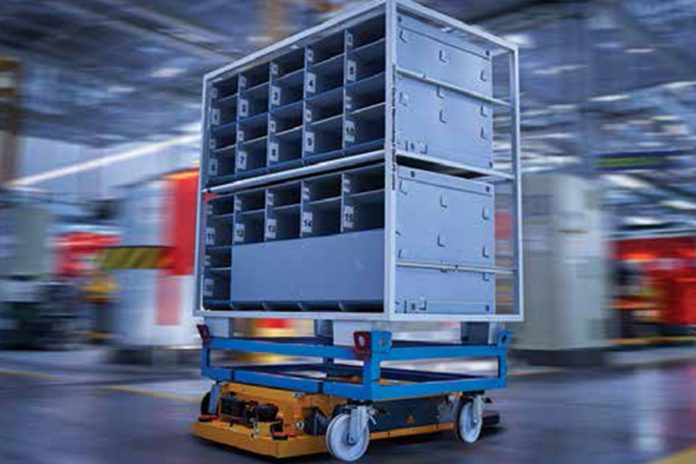
With currently over 3,000 machines, robots and autonomous transport systems connected with the BMW Group IoT Platform, which is built on Microsoft Azure’s cloud, IoT and AI capabilities, the BMW Group plans to contribute relevant initial use cases to the OMP community. One example is the company’s use of their IoT platform for the second generation of its autonomous transport systems in the BMW Group plant in Regensburg, one of 30 production and assembly sites worldwide. This has enabled the BMW Group to greatly simplify its logistics processes via a central coordination of the transport system, creating greater logistics efficiency. In the future, this and other use cases, such as digital feedback loops, digital supply chain management and predictive maintenance, will be made available, and in fact, developed further within the OMP community, with the BMW Group retaining ownership of its pre-existing business Intellectual Property (IP) and data.
“Mastering the complex task of producing individualized premium products requires innovative IT and software solutions,” said Oliver Zipse, member of the Board of Management of BMW AG, responsible for production. “The interconnection of production sites and systems, as well as the secure integration of partners and suppliers, are particularly important. We have been relying on cloud services since 2016 and are consistently developing new approaches. With the Open Manufacturing Platform as the next step, we want to make our solutions available to other companies and jointly leverage potential in order to secure our strong position in the market in the long term.”
The OMP is the next evolution in the BMW Group and Microsoft’s long-standing technology partnership and mutual commitment to innovation and creating industry-wide opportunities for collective success. Through the OMP, community members will have greater opportunities to unlock the potential of their data, allowing them to build and integrate industrial solutions more quickly and securely and in turn, benefit from contributing to and learning from other organizations.
The OMP will be designed to address common industrial challenges such as machine connectivity and on-premises systems integration. This will facilitate the reuse of software solutions among OEMs, suppliers and other partners, significantly reducing implementation costs. For example, a ROSbased robotics standard for autonomous transport systems for production and logistics will be contributed to the OMP for everyone to use. The OMP is compatible with the existing Industry 4.0 reference architecture, leveraging the industrial interoperability standard OPC UA.
“This is very good news for the manufacturing industry,” says Stefan Hoppe, President and CEO of the OPC Foundation. “The use of open international industry standards such as OPC UA in the OMP community enables manufacturers, machine builders and suppliers to integrate their existing equipment and systems efficiently and securely. For a long time, companies have promoted proprietary, closed ecosystems – the OMP commitment to open development will shape tomorrow’s manufacturing”.
The underlying platform will continue to evolve over time, along with manufacturing requirements, to incorporate new innovations including areas of analytics, artificial intelligence and digital feedback loops.
The broader OMP community is being formed now, with recruitment of additional partners underway. The OMP Advisory Board is expected to be in operation with an initial set of 4-6 partners in place and a minimum of 15 use cases rolled out into select production environments by the end of 2019. The two initial partners, Microsoft and the BMW Group, encourage other manufacturers and suppliers including companies from outside the automotive industry to join the community.
Umati, universal machine tool interface, has chalked up further major successes on its way to becoming an internationally recognized standard interface for machine tool communication with higher-level IT systems.
“Our newly founded OPC UA Joint Working Group (JWG) started work in mid-February, and we have also succeeded in encouraging two other well-known control manufacturers to come on board: B&R Automation from Austria and Mitsubishi Electric from Japan,” said Dr. Alexander Broos, Head of Research and Development at VDW. umati is also supported by the control producers Beckhoff, Bosch Rexroth, Fanuc, Heidenhain and Siemens. “We now have all the major manufacturers of CNC controls for machine tools on board with umati,” said a pleased Götz Görisch, umati project manager at VDW.
The VDW launched umati in 2017 together with eight well-known machine tool manufacturers as part of the Connectivity for Industry 4.0 project. A major demonstration installation with international partners is planned for EMO Hannover 2019. “There is still a lot to do before then,” said Görisch from VDW. The OPC UA specification for machine tools will need to be available by then, and the necessary prerequisites and adaptations must also be in place in the participants’ machines and controls. The first use cases will then be showcased in Hannover. In the meantime, 130 employees from 60 companies in twelve countries have registered to participate in the JWG.
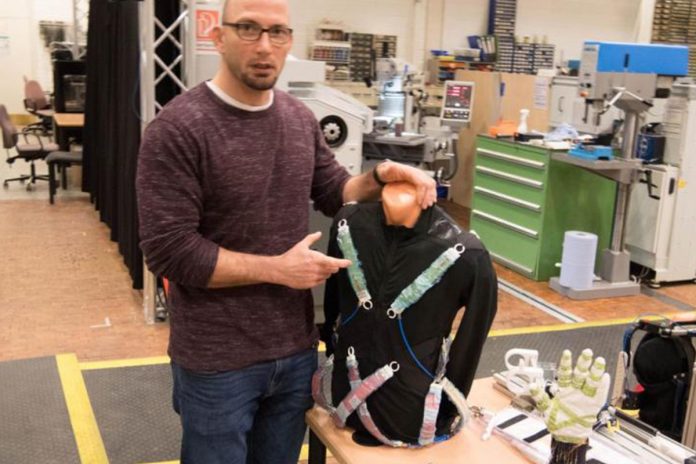
Andreas Argubi-Wollesen, LaFT, “Support elements are pneumatically stiffened,
relieving the jacket wearer of the need to
bear weigh in certain positions.
Photo: Nikolaus Fecht
Notable regular guests at EMO Hannover include scientists who are there not only to pick up new ideas, but also to inspire exhibitors with their work. Among these visitors is Prof. Jens P. Wulfsberg, who develops interdisciplinary technical support systems for production at the University of the Federal Armed Forces in Hamburg.
“OK, so what you’re talking about is ergonomic weapon systems.” “That’s exciting – you’re turning Bundeswehr soldiers into Ironman.” These were typical comments from my friends when they heard that I was researching into The development of exoskeletons at the University of the Federal Armed Forces in Hamburg”. “The development work is not being carried out for the military,” explains Wulfsberg, head of the Laboratory of Production Engineering (LaFT) at Helmut Schmidt University in Hamburg, a few days later. Ergonomic Smart Assist aids are being developed at LaFT in an interdisciplinary team. According to a LaFT flyer, these are technical support systems that people are really interested in. More than 20 different exoskeletons have already been developed – from ankle orthoses to muscle gloves.
Exoskeletons should be affordable, portable and lightweight
“The aim of our exoskeletal systems is to help reduce workplace injuries,” explains sports scientist Andreas Argubi-Wollesen, senior biomechanic at the LaFT-Institut für Konstruktions- und Fertigungstechnik (LaFT Institute for Construction and Manufacturing Engineering). “Our systems are designed to take the muscular strain out of certain tasks and not to cause additional problems through their own weight.” The sociologist Dr. Athanasios Karafillidis is not only interested in the acceptance levels of the eventual wearers of the exoskeletons, he is also involved in developing related ideas and classifications. “It was not our intention to create a superhuman Ironman in the form of an exoskeleton,” emphasizes the deputy head of the Smart Assist working group. “The request was for an affordable, portable and easy-to-apply support system that features as little technology as possible.”
Facilitating overhead work
“We didn’t set out to create an exoskeleton. We were given the task of developing support components,” says the LaFT manager, looking back. “The first request came from the Airbus plant in Hamburg, which wanted to relieve the strain on its workers while carrying out overhead work.” The first functional models were tested there back in 2016. The main focus is on prevention, i.e. reducing the number of days lost to sickness, through the avoidance of overexertion. Actually creating such a system was initially difficult because no-one had any idea about the possibilities. The team set about the task in an interdisciplinary and pragmatic manner: it developed the first components, which it then tested directly on site. In order to reduce development times and costs, the Hanseatic researchers also apply the Lego principle in their work: the components should be modular and capable of being combined to form customized systems.
The researchers’ interdisciplinary playground is located in the basement of the university. Argubi-Wollesen demonstrates a jacket, “we are planning the use of intelligent clothing with individual support elements which are pneumatically stiffened under negative pressure. The garments relieve the wearer of the need to bear weight in certain positions.” Pneumatics, electric motors or memory alloys which deform when electrical voltage is applied, can be used as drives.
Acceptance plays an important role
Acceptance is important in all this. Some people welcome the systems as cool, hightech gimmicks, while others reject them as crutches which supposedly make them look weak. Such reactions play a role, especially in conspicuous systems such as Lucy. Argubi- Wollesen helps me into the backpack-shaped exoskeleton. I raise my arms, it hisses – Lucy engages pneumatically to support the weight. I suddenly feel stronger and more powerful and realise that I can now hold a heavy object over my head for longer. I lower my arms and the pneumatic assistance dissipates. “Lucy is a typical active system that is only deployed for specific applications,” explains the biomechanic. “We can adjust it individually so that it only activates in certain positions with individually adjustable force levels. When you reach for a smartphone or a tool, for example, it turns itself off.” This is because complete assumption of all work would result in weakening of the musculature and that is not the purpose of the support systems.
RFID sensors to detect tools
In order to develop practicable systems, the researchers examine typical work processes with the aid of sensors and so-called 3D motion caption systems. “This enables us to see how much muscular effort is involved in certain movements,” explains Argubi- Wollesen. “Then we test the exoskeleton to see how much support it gives the wearer. Laboratory tests with power support reveal an average of 20 to 30 per cent muscular relief. In practical measurements conducted at automobile manufacturers such as Ford, individual alleviation levels of up to 50 per cent have already been achieved with heavy tools.”
The system can now be adapted for specific applications such as drilling, grinding or milling. Karafillidis, “in the future, intelligent exoskeletons will presumably be able to detect the degree of individual strain directly via sensors and adapt the level of support accordingly.” However, the method also raises questions about data monitoring: what do we want to capture and what is allowed? “For us as ethical researchers, it is not acceptable to monitor employees in this way – nor is it legal. As with all modern technologies, there also needs to be social consensus on how to deal responsibly with the technological possibilities which this opens up,” continues Karafillidis.
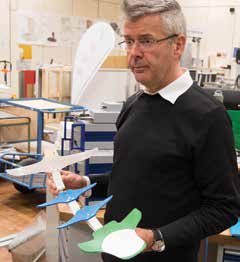
Jens P. Wulfsberg, Head of the Production Engineering Laboratory (LaFT) at Helmut Schmidt Universityy, Hamburg, “We didn’t set out to create an exoskeleton. We were given the task of developing support components. Photo: Nikolaus Fecht
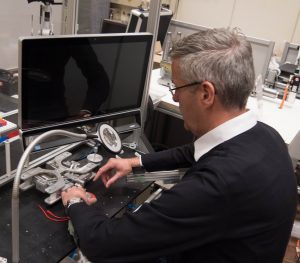
The Hamburg researchers also have their sights set on machine assembly: Wulfsberg leads me to an assembly site where an internally developed small machine tool feed unit with two degrees of freedom driven by two piezo actuators is being assembled (travel range: 1.6mm x 3.5mm, accuracy: 1μm). The drive element is intended for use in the construction of small machine tools required for microproduction, the manufacture of very small components such as those used in medical technology or the watch industry. The technician is assisted by movable elements that support his arms while he is working. These are tailor-made grip plates that LaFT produces by means of 3D printing. The Hamburg-based researchers use a robot to monitor the assembly processes. The robot’s sensors can be used to record the paths travelled and the forces. Wulfsberg: “we can use the recorded motion sequences to refine the assembly process.” Practical application in the field of medical technology is already planned.
Head of LaFt, Jens P. Wulfsberg, demonstrating how 3D-printed arm supports can aid fitters in their work, based on a feed unit for mini 2D machine tools. Photo: Nikolaus Fecht
Research at EMO Hannover 2019
The scientist is certain that support systems will become more important in the field of occupational health and safety in the future. In his capacity as an exoskeleton researcher, Wulfsberg is not only interested in systems for occupational safety at EMO Hannover 2019, but also in small machine tools for microproduction. After all, LaFT has already conducted research into small machine tools for small workpieces in its DFG SPP1476 programme. Wulfsberg, “I am also keen to discuss the construction of small, inexpensive machine tools for microproduction with manufacturers in Hanover. So it will be interesting for me to visit manufacturers of micro machining centres, for example.” This is certainly a possibility, as the EMO homepage currently lists 20 manufacturers in the category micromachining centres. Chiron, Benzinger, Datron, Fehlmann, GF Machining, Hermle, Kern, Kummer, Schaublin Machines, Sodick Willemin-Macodel and Yasda are some of the possible candidates.
ISCAR is expanding the range of BHD MB boring heads with a digital display by extending their connection sizes with MB32 and MB40, adding to the MB50, MB63 and MB80 sizes that are already available.
The clear digital display features a mm/inch value display selection that helps prevent human errors, Ø0.002mm (.0001 in) high adjusting accuracy, and a simple pre-loaded adjusting process, a 5mm (.2 in) mm radial stroke and 40 bar maximum coolant pressure. The displays are waterproof and coated with hard touch highly resistant coating.
For more information, please contact Iscar South Africa – Tel: 011 997-2700.
The 4th Industrial Revolution (Industry 4.0) is driven by the rapid growth in processing, communication networks and data storage capabilities.
Industry 4.0 focusses on the intelligent, horizontal and vertical networking of people, machines, objects and ICT systems for the dynamic management of complex systems.
But what are the benefits of these systems and what is driving the 4.0 revolution?
There is a need for flexibility and flexible machines. The ability to quickly change production to react to customer demands. Multi-purpose machines, must be able to produce a range of product types on a single machine, with short changeover and set-up times.
While there is the need for transparency, all machines and company systems must be able to communicate through one network and protocol. The complete production process must be visible, in order to optimize monitoring and improving maintenance processes.
There is a need for flexible machines that can produce small batches, customized on a make to order basis and a need for maximum machine availability, early detection of faults and reduction of unexpected machine events, culminating in systems for simple fault finding and self-correction with maintenance carried out on an as required scenario based on actual machine state feedback. Spare parts are ordered and stocked according to real time information.
Resources need to be used efficiently with minimization of waste. The interface between human and machine is simple, comfortable for flexible machine control, using the latest technologies such as IPads and cell phones.
How do such requirements affect the machine builder and automation blueprint? Machines providing ease of use, flexibility and optimal efficiency will, in themselves, require more design input and use of the latest technologies.
All designs are now being produced in 3D CAD using digital software platforms. This has greatly improved accuracy as well reduction in design time. Such designs can now simulate and animate the machine function while it is possible to check the interaction between machine functions. At this level the animation is controlled by the design platform. From CAD designs as well as machine design requirements, it is possible to design the automation platform including motors, gearboxes, control logic, sensors and function. Taking both the CAD design and the automation platform, the motion, control, visualization, network and other software are developed.
The next major step with I 4.0 is combining the CAD and automation platform so that the machine animation is controlled by a simulated automation control system. The end result of combining these two platforms is called a digital twin.
The concept of a digital twin in future automation systems includes machines that are developed and designed in modules. Such modules are combined in digital format to simulate a production line. Complete simulation prior to manufacture allows for testing, improvements, checking human interface and many other benefits prior to manufacture. As actual manufacturing times and costs can then be reduced, it is also possible to train line operators on digital platforms.
Machines will have a large quantity of sensors providing direct feedback to the local network via OPC UA. This is now a universal standard protocol for such communication. For example, motors will directly transmit temperature, pressure transducers transmit pressure to name a few. All devices will transmit information.
Another change in Automation includes the digital twin operating in parallel to the actual machine. The machine has its own control system. The digital twin is given the same commands. The digital twin is also receiving all the data from sensors and installed devices and compares this data to expected data. The digital twin can then determine if corrections need to be made to the control settings of the actual machine control. Machines will then self-correct and optimise. The control system, sensors and digital twin can send data to local edge devices or the cloud.
For more information, please contact Reef Engineering & Manufacturing – Tel: 011 864-1730.
While many assume press brakes to be mature technology, AMADA continues to push the boundaries of what can be achieved with this core metalforming process.
As a result of recent developments, the company can offer a number of important automation advancements that are designed to deskill and reduce costs for fabrication shops everywhere.
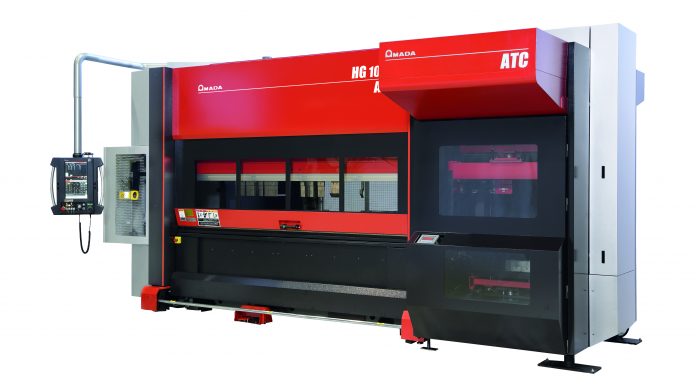
A piece of integral technology able to advance productivity is AMADA’s innovative ATC (automatic tool changer). The HG-ATC is the company’s flagship press brake and is unique in the marketplace. ATC technology facilitates the automatic locating and precise loading of punch and die profiles using an independent four-axis tool manipulator, delivering dramatic time gains. In fact, using a clever algorithm to guarantee the best set-up time means the HG-ATC can load even the most complex tool layout within just 3 minutes.
HG-ATC press brakes can also be equipped with AMADA SF75 sheet followers. These handy devices, which fit to the front of the machine, make it easier to handle large, heavy parts, which perhaps would have previously required two operators. As a result, labour costs can be immediately halved.
Of course, most people associate automation with robotics, and here AMADA’s latest offering is the HG-ARs. This robotized bending cell, which is equipped with the new AC-300 automatic pallet changer and ATC, perfectly illustrates all the productivity and flexibility gains that can be achieved using the latest automation technology. Material load/ unload and bending functions are performed by a seven-axis articulated robot, which is capable of a complete range of motions.
A seven-axis robot also features in AMADA’s HG-Rm press brake system for bending large-scale parts featuring complex rib and panel shapes. Here, special grippers dedicated to rib parts are used to process complex shapes in short cycle times. The automatic re-gripping device, which does not require any manual set-up, is equipped with two motorized arms and automatic scissor supports.
From a software perspective, AMADA can offer its advanced VPSS 3i suite for the provision of streamlined workflow from initial 3D CAD model to finished product, taking in processes such as cutting, punching, bending and welding. The key to the success of the VPSS 3i system is the constant data link between the separate software modules (such as Blank CAM, Bend CAM and Weld CAM), the machines and the central database. This database stores all parts, machines, tools, materials and technology-related information in a consistent way, distributing the data quickly and reliably. All of AMADA’s automation solutions incorporate the latest digital technologies in line with smart factory concepts.
For more information, please contact AMADA – Tel: 011 453-5459.
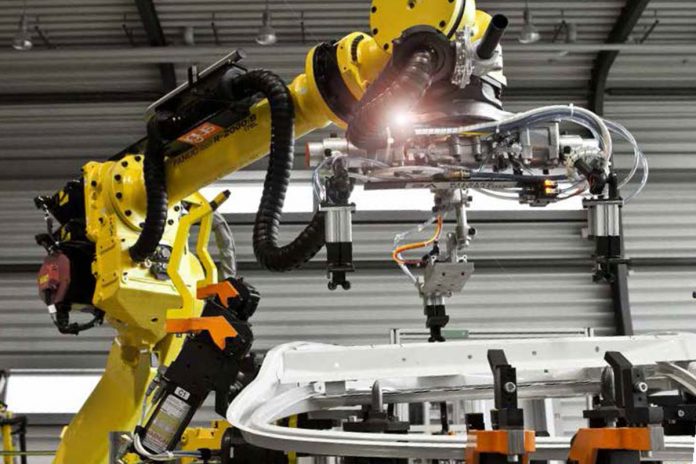
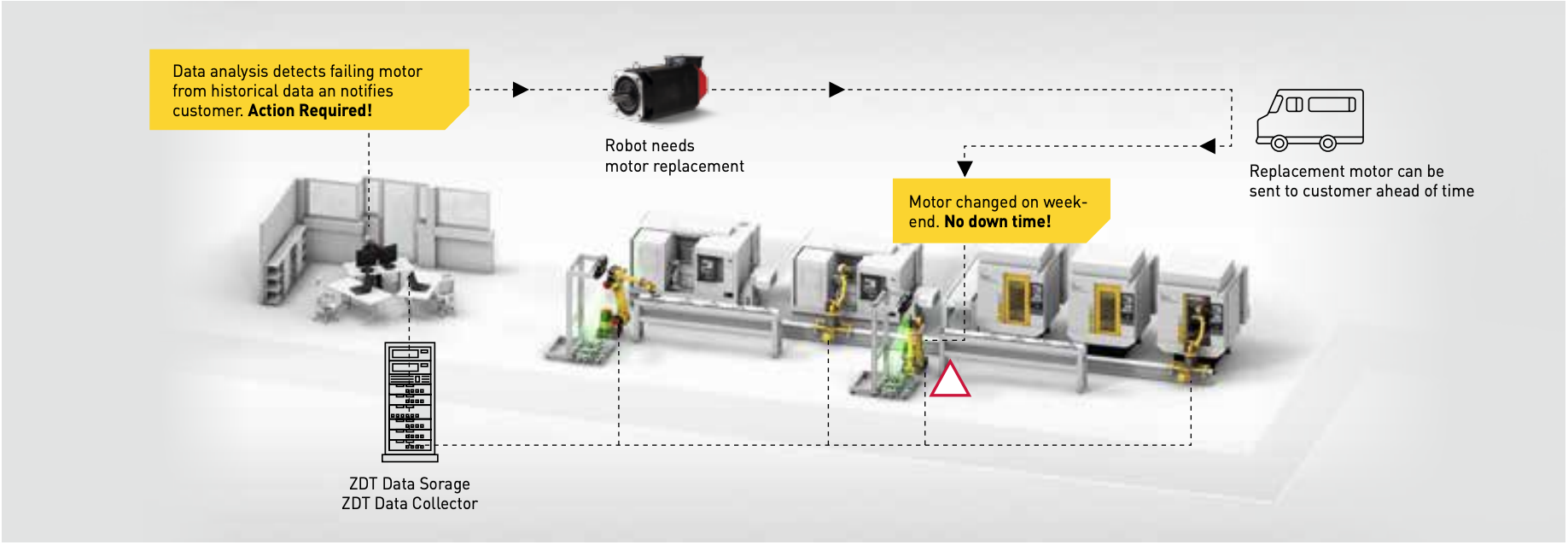
Unexpected downtime is a huge problem to any industry. It can be especially damaging to 24/7 non-stop factories. To address this problem, FANUC is introducing a new software package using technologies of Industry of Things (IoT) or Industry 4.0. This package is called Zero Down Time or ZDT.
The aim of ZDT is to constantly monitor all robots in real time to ensure that downtime doesn’t happen at all. ZDT delivers real time information about:
• Mechanical Health
Reducer diagnosis, servo motor and brake health, motor torque monitoring, servo alarm recoding and many more
• Process Health
Operating status, vision detection results, servo gun status for spot welding and many others
• System Health
Error information, memory usage, CPU and network load and many others
• Maintenance Health
Great change time, battery replacement time, lubrication of balancers bushes and other important parts and other maintenance parts.
All information can be centrally managed on a server and can be sent in real-time to remote devices such as smartphones and tablets.As well as a robot-only configuration, it is also possible to select the most suitable configuration for your environment, such as a cell-by-cell or factory-by-factory.
ZDT enables enhanced productivity by proactively detecting potential equipment issues before unexpected downtime occurs, while providing advanced analytics and reporting to help optimise equipment utilization in areas such as Smart Maintenance notifications to extend equipment life and optimise maintenance costs and recommendation of actions to extend robot life, reduce cycle times and energy consumption, while offering enhanced technical support services to increase productivity and overall customer satisfaction.
For more information, please contact FANUC South Africa – Tel: 011 392-3610.
DMG MORI considers the automation of its
machine tools to be the decisive foundation
of the digital factory.
Automated machines are crucial components of a digital factory and are therefore an integral part of Industry 4.0. DMG MORI is the pioneer of digitalization in machine tool construction and considers automation to be a strategic future-orientated field.
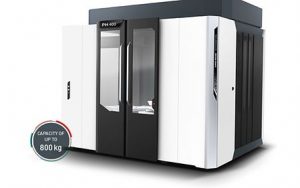
The latest examples of DMG MORI’s automation expertise are the Robo2Go 2nd Generation for flexible workpiece handling on lathes and the wide range of pallet handling systems. A PH 150 with up to twelve pallets and a maximum load capacity of 250kg is displayed on a DMU 65 monoBLOCK. A DMU 85 monoBLOCK is presented for the first time by DMG MORI with the new PH 400. Both palette handling systems are a part of the DMG MORI automation portfolio, which includes a total of 50 solutions in the area of workpiece and pallet handling systems. The latter are additionally divided into linear and rotary magazine systems, whereby the workpiece handling systems are available in robot or portal loading variations.
With an integral approach, Joint Venture DMG MORI HEITEC considers itself to be a supplier of modular, perfectly coordinated automation solutions. DMG MORI HEITEC supports DMG MORI in the development and realization of flexible automation solutions, such as work-piece handling. The automation expertise for pallet handling is directly integrated into the production plants of DMG MORI.
The interplay between engineering from the DMG MORI production plants and automation expertise on the part of DMG MORI HEITEC provides the user with a customized, integrated and reliable solution – and everything from a single source. “In essence, we implement modular manufacturing cells and systems on the basis of a building block system, which allows them to be individually set up and customized,” explains Kai Lenfert, joint managing director of DMG MORI HEITEC GmbH together with Markus Rehm. This is a decisive factor, particularly for small and medium-sized companies. Problem solving is what counts at DMG MORI HEITEC and thus value creation in the long term.
It is also about incorporating important implications of automation throughout the entire production process. Kai Lenfert provides a simple but obvious example: “A customer that develops an automated system for unmanned nightshift must also be capable of making available the required resources beforehand and during further processing.” The more complex the task, the more detailed the planning needs to be for the system and above all, integrated into value creation.
Integral overview with digital engineering.
Due to the direct interaction with the DMG MORI plants, DMG MORI HEITEC can already plan and optimize every automation project very specifically and optimized for the customer based on virtual mapping and in real time. Digital engineering with the depiction of real plants and machines through the digital twin and the analytical predictability of events are seen by DMG MORI HEITEC as an important building block for networked and intelligent production. Even specific component programs can be run virtually for the customers already prior to installation on the computer. This creates a high degree of investment security for the customer, guarantees fast installation and commissioning on site and ensures an incomparably fast production start. The cycle times can be reduced by up to 80 percent in this way. Above all, equipped with knowledge gained from the virtual results of the digital engineering, the customer can already precisely asses during the decision-making phase how the system will affect the process chain and what the company may potentially need to do to guarantee efficient operation of the system and its entire production process.
Processes can be quickly and easily created with the Robo2Go 2nd Generation even without any knowledge of robot programming.
The new second generation Robo2Go can be operated on the CLX and CLX series turning centers as well as the turn and mill complete machining centers from the CTX TC series. The flexible robot automation is easy to operate via new software. The processes can be directly created with the Robo2Go 2nd Generation based on predefined program modules and even without any knowledge of robot programming. This means that teaching a new workpiece takes less than 5 minutes, making the Robo2Go 2nd Generation an ideal and flexible solution for small and medium-sized batches.
PH 400: Automation for up to 800 kg loading.
With a load capacity of up to 800kg, the PH 400 in the DMG MORI portfolio is an ideal complement to the rotary magazine.
After the success of the PH 150 palette handling system, which has already been installed by DMG MORI over a hundred times, the machine tool manufacturer is expanding its palette automation portfolio with the new PH 400 – an ideal addition to the proven rotary magazine.This means that the DMU monoBLOCK and duoBLOCK series can now also be loaded with large palettes. The load capacity of the PH 400 is 530 kg in the version with twelve palettes and 800 kg if designed for six or eight palettes. With maximum workpiece dimensions of ø 850 mm diameter and 1,000 mm height, the PH 400 is an ideal automation solution for the DMU 80 P duoBLOCK and DMU 90 P duoBLOCK.
For more information, please contact Retecon – Tel: 011 976-8600.
The additive manufacture of large-volume plastic components is a timeconsuming undertaking. Researchers at the Fraunhofer Institute for Machine Tools and Forming Technology IWU have now developed Screw Extrusion Additive Manufacturing (SEAM), a system and process that is eight times faster than conventional 3D printing.
3D printers that build small souvenirs layer by layer from melted plastic are often used at tradeshows. It can take up to an hour to produce a pocket-sized souvenir. This process is far too slow for the mass-production of components, as required by the automotive industry, for instance. A system from the Fraunhofer Institute for Machine Tools and Forming Technology IWU in Chemnitz is now taking 3D printing to a new level: The system’s high-speed technology takes only 18 minutes to produce a plastic component that is 30 centimeters high. A team of researchers at the Fraunhofer IWU has developed this technology for the additive manufacture of large-volume resilient plastic components. Tool manufacturers as well as the automotive and aerospace industries benefit from the innovative 3D printer that achieves eight times the process speed. This printer uses the SEAM – short for Screw Extrusion Additive Manufacturing – process developed at the Chemnitz Institute.
How does SEAM achieve these high process speeds? “By combining machine tool technology with 3D printing,” says Dr. Martin Kausch, a scientist at Fraunhofer IWU. To process the plastic, the researchers use a specially designed unit that melts the raw material and ejects it at a high output rate. This unit is installed above a construction platform that can be swiveled in six axes by using the motion system of a machine tool. “So far, this combination is unique,” says Dr. Kausch. The hot plastic is deposited in layers on the construction platform. The motion system of the machine ensures that the construction panel slides along under the nozzle in such a way that the previously programmed component shape is produced. The table can be moved at a speed of one meter per second in the X-, Y- and Z-axes and can also be tilted by up to 45 degrees. “This enables us to print eight times faster than conventional processes, enormously reducing the production times for plastic components.”
Every hour, up to seven kilograms of plastic are pressed through the hot nozzle with a diameter of one millimeter. Comparable 3D printing processes, such as Fused Deposition Modeling (FDM) or Fused Filament Modeling (FLM), usually achieve only 50 grams of plastic per hour. A unique feature is that, instead of expensive FLM filament, SEAM processes free-flowing, cost-effective standard plastic granulate into resilient, fiber-reinforced components that are several meters in size. This method allows material costs to be reduced by a factor of two hundred.
SEAM allows researchers to implement complex geometries without supporting structures. The highlight is that the new system even makes it possible to print on existing injection-molded components. “As our construction platform can be swiveled, we are able to print on curved structures with a separately moving Z-axis,” says Kausch. “In tests, we were able to process a wide variety of plastics. They ranged from thermoplastic elastomers to high-performance plastics with a 50 percent content of carbon fiber. These plastics are materials that are particularly relevant to industry and cannot be processed with traditional 3D printers.”
The first printer of its kind in the world will be demonstrated for the first time at the Hannover Messe 2019.





 The aim of ZDT is to constantly monitor all robots in real time to ensure that downtime doesn’t happen at all. ZDT delivers real time information about:
 Great change time, battery replacement time, lubrication of balancers bushes and other important parts and other maintenance parts.
 For more information, please contact FANUC South Africa – Tel: 011 392-3610.