Home Blog Page 90

Milling And Machining Centres: Röders Tec RXP 500 DS 5 Axis-Machining Centre

Compact, highly dynamic, high-precision 5-axis HSC machine with counter bearing and special Röders geometry compensation.
The highest accuracy – well beyond what can be expected from comparable systems currently available on the market – is achieved by a number of features such as a sophisticated temperature management system, a spindle length deviation compensation device and an integrated tool-measuring system using a laser. A further feature in this context is a highly accurate contact-point measuring system for the workpiece.

For more information, contact Hurco South Africa – Tel: (011) 849 5600.

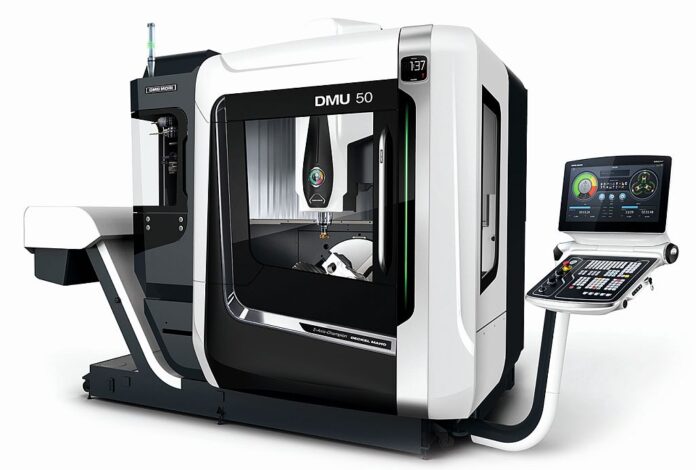
Milling And Machining Centres: DMU 50 3rd Generation

The DMU 50 combines more than 20 years of experience, proven technology and low investment costs in the 5-axis portfolio of DMG MORI.

On this basis and enhanced in all respects the bestseller has moved into the next round. This compact DMU 50 3rd generation sets new standards in 5-sided to 5-axis simultaneous machining. With its extended swivel range, more powerful spindle and its innovative cooling concept the world premiere guarantees a competitive edge in a multitude of branches. Its areas of application range from training, to general mechanical engineering, jig construction and on to include applications in demanding branches such as the aerospace, medical and automotive industries.


The 19″ DMG MORI SLIMline® Multi-Touch Control is one of a many Highlights of the new CLX 350.

While redeveloping the DMU 50 3rd Generation DMG MORI has managed to harmonize the modern appearance of the design with user-friendly operation. The large, smooth opening door to the work area, for example, with a width of 876mm ensures unrestricted access from the front, even in combination with automation solutions. The table also has an ergonomic loading height of 800mm. The optimum accessibility of the DMU 50 3rd Generation even encompasses maintenance components such as the control cabinet, fluid box, oil mist separator, heat exchanger and cooling unit.

Travel paths of 650 x 520 x 475mm and workpiece weights of up to 300kg mean the new DMU 50 3rd Generation covers a wide range of components. Its new NC swivelrotary table with an enlarged swivel range of −35°/+110° boosts this versatility. A rapid traverse of 42 m/min and 30 rpm in the swivel-rotary axis ensure the dynamics for 5-sided to 5-axis simultaneous machining. In addition to the 15,000 rpm speedMASTER® motor spindle, the user can also choose between motor spindles with up to a 20,000 rpm. Also available as an option is an expanded tool magazine with up to 120 pockets. There are 30 tool pockets in the standard version.

As basic universal turning center the CLX 350 realizes highly sophisticated machining operations in top quality.

The DMU 50 3rd Generation achieves a unique degree of precision of less than 6 μm that is unbeatable in this segment thanks to its one-piece machine bed on the one hand and on the other its innovative cooling of the guides, drives and table bearings. Directly driven ball screws and direct path measuring systems in all five axes round off the equipment with regard to the machine’s high degree of precision. The DMU 50 3rd Generation can be expanded with coolant tanks and tool measurement as an option.

A 21.5″ ERGOline® with CELOS® and Siemens 840D solutionline as well as a 19″ ERGOline® with HEIDENHAIN TNC 640 are available as modern control options. DMG MORI also has diverse automation solutions in its program for the DMU 50 3rd Generation, such as workpiece or pallet handling systems. This enables the world premiere to master challenging applications in the future-oriented aerospace, medical, automotive and energy branches – a demand that was already taken into account during the practice-oriented development of the machine. In other words, the DMU 50 3rd Generation continues to fulfil all the requirements that ensure it will remain DMG MORI’s bestselling 5-axis model.

Highlights of the DMU 50 3rd Generation include a 78 percent larger work area, 40 percent higher rapid traverse with speeds of 42 m/min as standard, 28 percent greater swivel range, a swivel rotary table with -35°/ +110° and 5-axis simultaneous machining as standard.

For more information, contact Retecon – Tel: (011) 976 8600.

Milling And Machining Centres: Makino A120NX HMC Built For Large, Heavy Part Production

“You can’t approach big parts the same way you would any other part, and that’s why everything about the a120nx is sized for heavy-duty manufacturing,” said John Einberger, product line manager at Makino. “We wanted to employ the proven designs of our other nx-series machines, such as three-point leveling and tiered column design, while ensuring that the machine could mechanically handle the unique challenges of large workpiece machining processes.”


The a120nx features vast X-, Y- and Z-axis travels of 1,900mm, 1,600mm and 1,700mm, respectively, and the machine’s standard large pallet size of 39.4 inches by 39.4 inches provides capacity for parts weighing up to 11,000 pounds. The machine’s automatic pallet changer switches from one pallet to the next in 38 seconds, minimizing non-cut times for the highest levels of productivity. Capable of storing up to 204 tools of wideranging sizes and designs, the a120nx accommodates tools up to 35.4 inches long, 14.0 inches in diameter, and weighing up to 77 pounds. Tools are loaded into the automatic tool changer (ATC) from an easily accessible, ergonomically friendly exterior loading station to prevent operator fatigue.

Built for Rigidity During Continuous Production

At the foundation of the machine is a threepoint supported bed casting to ensure all points are stable and contacting the floor. Developed to maintain the machine geometry and alignments, this design characteristic of the nx-series machines simplifies installation and enables easy relocation of the machine. Building on the rigidity of the bed casting, the a120nx uses a unique tiered column design that delivers greater resistance to Z-axis cutting forces throughout the work envelope. Robust cross roller-style B-axis table bearings work in concert with a high force rotary clamping system to ensure stable cutting throughout the machine’s expansive work zone.

The a120nx is equipped with Makino’s four cone pallet location and clamping system that delivers a secure 46,500 pounds of force on the pallet. This superior clamping capability, combined with all pallets built to a master pallet, eliminates deflection. An engineered precision air-blow system provides locating surfaces cleaning, as well as pallet clamp confirmation as standard features.

Larger parts typically mean larger features, too. Tool length, diameter and weight capacities of the a120nx support processes that feature the use of large face mills, boring bars and line-bar tooling.

To further ensure ideal geometry and accuracy, the a120nx has a number of systems in place to manage the heat generated by rapid traverse of 2,126 inches per minute. For one, the ballscrews are core-cooled in all axes to give consistent accuracy during continuous production. Moreover, the ballscrews are all dual supported and pre-tensioned to ensure unparalleled dynamic positioning repeatability. Feature-to-feature movement distances on large parts are typically much greater, so rapid traverse rates were increased for the a120nx in order to cover these expansive distances quickly.

Powerful Spindle, Pallet Clamping for Speed and Accuracy

Beyond its proven speed and accuracy, the a120nx also improves productivity in cutting and non-cutting performance. The standard high torque 8,000-rpm spindle boosts continuous power levels by 19 percent over levels typical to machines of this class. With 50 continuous (74 peak) horsepower available, this spindle is ideally suited for heavy roughing of iron castings and hard-metal applications. In addition, the spindle features significant improvements in acceleration and deceleration due to its high duty rated performance characteristics that reduce rigid tapping times by up to 30 percent. Also available is an optional 18,000-rpm high power spindle, ideally suited to high metal removal rate machining of light alloy structural components.

Chip and coolant management features are often overlooked and result in interrupted operations, increased labor costs, machine damage, part-quality issues and reduced tool life. The a120nx enables shop owners to avoid these challenges with supplementary management features, including a sloped surface to remove obstacles between the workpiece and an external chip conveyor, letting chips fall freely. The trough design facilitates rapid chip and coolant evacuation and reduces maintenance needs with a solid panel Z-axis cover design. A standard cyclonic filter provides ultra clean coolant to the through spindle coolant pump and acts as a secondary coolant filter, polishing coolant in the main tank.
The a120nx comes to the market automation ready, being fully compatible with Makino’s versatile multi-machine, multi-pallet MMC2 flexible manufacturing system, complete with Makino’s highly capable MAS-A5 cell controller. Machining massive parts poses multiple challenges. However, speed, accuracy and durability remain crucial when working with large parts and meeting customers’ delivery demands.

For more information, contact Rothco – Tel: (011) 970 1930.

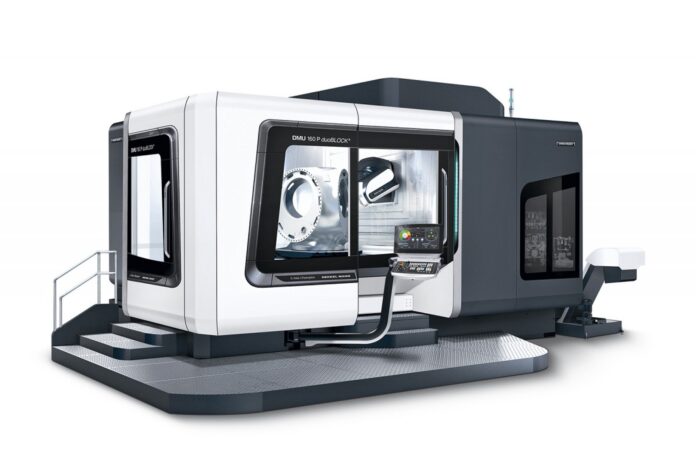
Milling And Machining Centres: DMU 160 P DuoBLOCK® – Versatile With Long-Term Accuracy

With 30 percent enhanced precision, performance and efficiency DMG MORI has set new standards with the fourth duoBLOCK® generation.

The extensive cooling measures, together with the top rigidity of the fourth generation of the duoBLOCK® concept, are the basis for the very highest demands on precision and machining performance. Cooled guideways and drives plus the optional spindle growth sensor ensure minimum thermal-related displacement of just 12 μm. Numerous features of the basic structure also promote the high long-term accuracy of the DMU 160 P 4th generation duoBLOCK®. These include large linear guideways in all axes and standard double wipers as well as the re-designed ball screw principle in the X- and Y-axes. In addition, the geometry of the Y-axis has been improved by means of an optimized fixator position. Fixation of the standard Magnescale measuring system in the Y-axis on a carbon plate has optimized the measuring accuracy Cont. on page 16  thus resulting in a more exact positioning accuracy of the table.

As the largest model in the series the DMU 160 P duoBLOCK® 4th generation has also been given a larger work area. This now measures 1,600 x 1,600 x 1,100mm. Table dimensions are Ø 1,600 x 1,250mm and the maximum workpiece weight has been increased to 4,500kg. Productive and dynamic 5-axis machining is effected with rapid traverses of up to 60m/min in all axes. The acceleration rates in the X, Y and Z-direction are 6 m/s², 4 m/s² and 7 m/s², respectively.

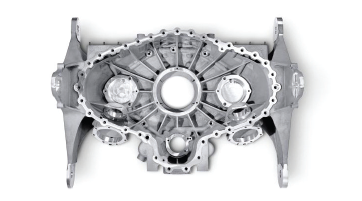
Gearbox Housing of a Helicopter.

The modular concept of the DMU 160 P duoBLOCK® 4th generation offers an ideal solution for every application – starting with the innovative wheel magazine, which in its largest expansion stage can accommodate 453 tools (SK40/HSK63) and on to include the most extensive range of spindles to be found anywhere on the market. The offer here ranges from the powerMASTER® motor spindle with up to 1,000 Nm to the gear spindles with max. 1,800 Nm and on to include the speedMASTER® spindles with their impressive speeds of up to 30,000 rpm. The standard version of the DMU 160 P duoBLOCK® 4th generation comes equipped with a motor spindle that achieves a speed on 15,000 rpm and a torque of 200 Nm.

The 4th generation DMU 160 P duoBLOCK® appears completely revised in the joint design from DMG MORI, which embodies quality and value retention and offers functional added value in work ergonomics thanks to optimized accessibility. CELOS® is used for its control. This uniform appbased user interface with its unique multitouch screen is as simple to operate as a smartphone. As a result, users benefit from a 30 percent saving in setup time and 50 percent less effort for calculating technical values and searching for important information.

For more information, contact Retecon – Tel: (011) 976 8600.

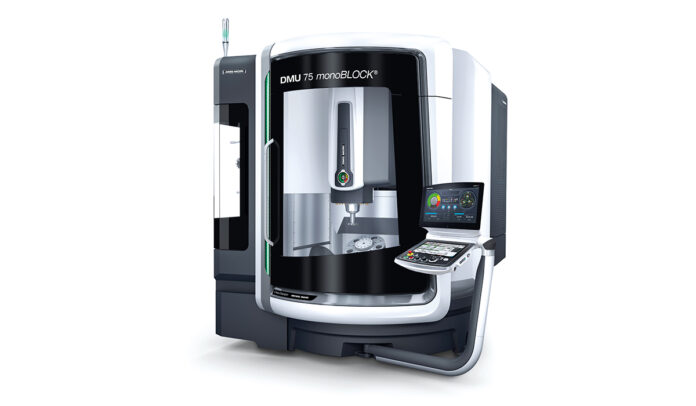
Milling And Machining Centres: DMU 75 Monoblock® With CELOS®/MAPPS With Fanuc

The DMU 75 monoBLOCK® combines top features for five-axis simultaneous machining and a large working space with 750mm X-travel.

Equipped with CELOS® with MAPPS on FANUC from DMG MORI. Highly demanding industries require machine tools that are up to the challenge of realizing best quality in the most economical way. The monoBLOCK® series developed by DMG MORI has set a benchmark in almost every sector: aerospace, automotive or medical, among others, relies on the machine tools’ precision, stability and flexibility. With the new DMU 75 monoBLOCK® the world leading machine tool manufacturer addresses in particular price-conscious as well as innovation oriented customers. Therefore, the package contains the latest fiveaxis simultaneous machining technology, 60 pockets as magazine, speedMASTER® spindle with 20.000 rpm and as CELOS® with MAPPS on FANUC.

The extremely compact footprint of less than 8m2 and the spacious working area (X/Y/Z: 750/650/560mm) suitable for various work pieces of up to 840mm diameter and 600kg are the most obvious characteristics of the DMU 75 monoBLOCK®. Since the easily accessible working area can be loaded with a crane from directly above, the table users are provided with a maximum of comfort during their work. Apart from that the working area is cased with durable stainless steel for a longterm value. Another user-friendly factor that additionally guarantees best working results is the optimized chip fall and chip disposal from the machine to the rear.

Looking at the inner values of the DMU 75 monoBLOCK ® DMG MORI has ensured a maximum of precision. Whereas direct scale feedback allow exact machining, a one-piece stand, stable slides, 45mm roller guides in all axes plus a FEM optimization of all components stand for highest rigidity. The stability is continued in the swivel rotary table with its large bearing as well as the large ball screws in all axes, whereas weight optimized X- and Y-slides as well as the Z-ram promise highest dynamics. The linear axes achieve rapid traverse speeds of up to 40 m/min and an acceleration of 6 m/s2. Consequently, the table is the basis for reliable and challenging five-axis simultaneous machining of complex work pieces.

The DMU 75 monoBLOCK® package is completed by a powerful SK40 speedMASTER® motor spindle with 20,000 rpm, 130 Nm (40% ED) and 35 kW (40% ED) and a vertical chain magazine for 60 tools. Offering CELOS® with MAPPS on FANUC, DMG MORI is able to meet the preference of even more customers.

For more information, contact Retecon – Tel: (011) 976 8600.

Milling And Machining Centres: King Rich Precision Milling Machines

Established in 1975, KING RICH Industries has evolved from a traditional knee-type mill manufacturer into a bed-type mill and CNC mill producer. While manufacturing precision milling machines, KING RICH today is a leader in Taiwan through R & D, quality and dependability with over 50,000 KING RICH machines installed around the world. KING RICH is an ISO9000 certified company and machines are CE certified.

A wide variety of models are available in South Africa from Harp Machine Tools including the KR-V2000, KR-V3000. KR-V3000SL and the bed type mill model KR-B4V.

KING RICH Turret Mill – Model KR-B4V – Table size 1930mm x 355mm – T-Slots (3) 15.9mm – Longitudinal travel (X) 1500mm – Cross travel (Y) 600mm – Head travel 480mm – Quill travel 140mm – Spindle motor 7.5HP – Spindle speeds 70-3600Rpm – Spindle taper ISO40 – Coolant system –Splash tray – X and Y ball screws – Auto lubrication.

King Rich Turret Mill – Models: KR-V2000 / KR-V3000 / KR-V3000SL.

KING RICH Turret Mill – Model KR-V3000SL –Table size 1473mm x 305mm – T-Slots (3) 15.9mm – Longitudinal travel (X) 1016mm – Cross travel (Y) 400mm – Head travel 406mm – Quill travel 127mm – Spindle motor 5HP – Spindle speeds 70-3600Rpm – Spindle taper ISO40 – Over arm Swivel 360º – Coolant system –Splash tray –Power feed X and Y – Power up & down on knee.

KING RICH Turret Mill – Model KR-V3000 – Table size 1372mm x 305mm – T-Slots (3) 15.9mm – Longitudinal travel (X) 850mm – Cross travel (Y) 400mm- Head travel 406mm – Quill travel 127mm – Spindle motor 5HP – Spindle speeds 70-3600Rpm – Spindle taper ISO40 – Over arm Swivel 360º – Coolant system – Splash tray – Power feed X and Y – Power up & down on knee.

KING RICH Turret Mill – Model KR-V2000 – Table size 1220mm x 254mm – T-Slots (3) 15.9mm – Longitudinal travel (X) 762mm – Cross travel (Y) 400mm- Head travel 406mm – Quill ravel 127mm – Spindle motor 3HP – Spindle speeds 60-4200Rpm – Spindle taper R8 – Over arm swivel 360º – Coolant system – Splash tray – Power feed X and Y.

For more information, contact Harp Machine Tools – Tel: (011) 918 5138.

Milling And Machining Centres: Greater Damping With Latest Silent Tools™ Milling Adaptors

The latest Silent Tools™ milling adaptors from cutting tool and tooling systems specialist Sandvik Coromant are designed to offer improved damping characteristics. These advanced adaptors have been developed in direct response to the need for greater metal removal rates and reduced vibration wherever long, slender milling tools are deployed.

Thanks to the upgraded Silent Tools milling adaptors from Sandvik Coromant, production engineers now have an effective way of enhancing productivity, process security and surface finish in vibration-prone, longoverhang operations. Benefits such as the significant reduction of chatter and vibration make them today’s first choice for any machine shop looking to optimize the performance of its long milling cutter assemblies.

“Inside the adaptors is a pre-tuned passive damper – a counteracting mass that acts as a shock absorber,” explains Pål A. Sollie, Product & Application Specialist at Sandvik Coromant. “The damper improves the dynamic behaviour of the tool assembly to a level where there is room to achieve the best milling tool quality and unbeaten metal removal rates for a variety of milling applications with slender tools, whether it is face milling (even at high feed), deep shoulder and side milling, pocketing, slot milling, profiling, circular ramping or helical interpolation.”

Silent Tools reduce vibration, increase productivity and improve security when machining with long overhang.

Additional advantages include undersized shanks which, where required, allow side clearance between the adaptor and workpiece. This permits the use of a nominal diameter cutter – rather than an oversized cutter – which is advantageous because a lower mass cutter is more productive than a larger version on a long, slender assembly. Having this flexibility avoids the need to compromise component designs and productivity when the use of slender milling tool assemblies is required.

Suitable for all ISO material groups, the new Silent Tools milling adaptors can be deployed on tool assemblies with useable lengths from 4 x cutter diameter. They are available with Coromant Capto® and HSKA/ C as machine side interfaces.

For more information, contact Sandvik Coromant – Tel: (011) 570 9615.

Extended Flutes For ISCAR’s 3 Flute Ball Nose Range

ISCAR attributes its great success to the company’s ability to help customers improve their productivity, profitability and performance through the application of leading edge technologies and the use of advanced cutting tools. In addition to other machining fields, the progressive work of ISCAR’s creative Research and Development Department has enabled the company to remain constantly at the very forefront of milling cutting tool development.

The latest company innovation in this area is the expansion of ISCAR’s 3 Flute Ball Nose (BLPK) range by the addition of extended flute endmills. The new, extended flute ball nose endmills carry tangent straight edge inserts that enables machining to be carried out beyond the round edge of the cutters. The extended flute ball nose endmills are designed for both roughing and semi-finishing operations. In addition to use in general engineering, they are particularly useful for cavity profiling and shouldering in the Die & Mold industry.

The tools feature three effective flutes, centre cutting and coolant holes that are directed to the cutting edges. The application of a HARD TOUCH coating assists in smooth chip flow; it provides protection from corrosion and also delivers excellent wear resistance.

The use of ISCAR’s 3 Flute Ball Nose range enables machining at higher depths of cut than the cutter’s radius. In addition to boasting a wider application range, increased table speeds and depths of cut provide enhanced productivity when compared to the current BCM DROPMILL cutters that carry the BCR inserts. Also, reduced cutting forces lead to improved stability and less power consumption.

Applications include the rough and semifinish milling of complex surfaces, especially those with steep and perpendicular profiles, including up and down ramping. The advanced new tools are available in 32, 40 and 50mm diameters, complementing ISCAR’s DROPMILL3 Flute Ball Nose line.

For more information, contact Iscar South Africa – Tel: (011) 997-2700.

Milling And Machining Centres: Competing With The Unbeatable

The remarkable strength-to-weight ratio and high corrosion resistant properties of titanium has resulted in the ever growing use of this important engineering material in many demanding sectors, not least the global aerospace industry.

The production of critical structural parts from titanium ensures their required performance and reliability whilst significantly reducing components mass. Although relevant to all users of titanium, the enhanced strength and reductions in weight that the material delivers are of particular importance to the aerospace industry, as these advantages improve the aircraft’s’ performance and increase fuel economy.

The negative trade-offs produced by the use of titanium are the many problems uncounted for when machining this difficult-to-cut material. When used in metalworking industries, the word titanium normally relates not only to pure titanium but also to titanium alloys. In accordance with metallurgical properties, depended on the present elements, there are several groups of titanium: commercially pure titanium (unalloyed), α-, β-, α-β- and other alloys. It is sometimes stated that titanium machinability is similar to that of austenitic stainless steel. This proposition is more or less true if it relates to commercially pure titanium, although it is totally wrong with respect to treated α-β- and especially β-titanium alloys.

Machinability rating depends heavily on the type of titanium and its treatment. The machinability of the widely used annealed titanium TiAl6V4 is approximately 35-40% less than annealed stainless steel AISI 304. However, if we take the machinability of the aforementioned titanium grade as 100%, the so-called triple 5, titanium 5-5-5-3, a major manufacturing headache for many machine shops, features machinability characteristics that are twice as difficult.

Machine tool manufacturers continue to introduce innovations and developments that make the cutting of titanium more effective. Modern machine tools allow operators to apply advanced machining strategies and to employ one-hit production methods. However, the typically low cutting speeds used in the machining of titanium severely limits machine tools’ efficiency potential and results in the cutting tool becoming the weakest element of the whole technical production system. In short, the cutting tool determines the productivity boundaries when machining titanium, and as such, has become a major factor in the quest for a radical improvement of this situation.

Due to the low thermal conductivity of titanium, the main problem in cutting this material is the generation of heat. Poor heat transfer leads to considerable thermal loads being directly transferred to the tools cutting edge. Also, less of a problem when machining steel, titanium’s modulus of elasticity contributes to vibration during cutting, as a result, surface finish and accuracy problems can be encountered.

Cutting tool producers continue to place a greater emphasis on developing progressive tools for the efficient machining of titanium. Manufacturing titanium parts is a process with significant buy-tofly ratio, when a large amount of metal needs to be removed. The eventual weight of a finished titanium part may be only 10%, or less of the original weight of a workpiece. Frequently, these parts will have cavities, pockets and ribs that dictate milling as the main method for manufacturing. As a consequence, every new tool that is intended for the milling of titanium creates intense interest amongst the global technical community. Therefore, the latest products from ISCAR, an acknowledged innovator in the field, always attract the attention of the world’s manufacturers involved in machining titanium.

Tool material is of fundamental importance in the success of cutting tools, especially for use when indexable milling difficult-to-cut aerospace materials, in particular titanium. Within this challenging field, ISCAR has developed a new carbide grade IC840. The word new relates to all grade elements: IC840 is characterized by a newly cemented carbide substrate and an innovative hard PVD coating. The grade substrate is highly resistant to thermal cracks; the bronze-color, chocolate, coating boasts high oxidation and chipping resistance; whilst an advanced post-coating treatment improves overall toughness. The advantageous combination of the above IC840 provides users with great opportunities in milling titanium. ISCAR believes that the new chocolate will definitely suit the taste of the manufacturer of titanium components and increase the performance of indexable cutters.

As previously mentioned, milling titanium usually involves removing considerable stock. True workhorses in this field are extended flute indexable tools (porcupines) that are intended for the rough cutting of deep pockets, cavities and wide edges. For these operations, ISCAR has developed the HELITANG H490, a family of advanced milling tools with tangentially clamped inserts, and also the MILLSHRED P290, a range of milling tools carrying serrated inserts that provide an efficient chip splitting (even chip chopping) effect. In addition, the company offers HELITANG FIN, a family of tangential porcupines that was designed especially for semi-finish milling.

ISCAR has recently introduced a new group of extended flute shell mills related to the proven and popular HELIQUAD family. These mills carry one-sided square inserts, which are clamped radially. Why has the company, so well known for its commitment to innovative advantageous cutting geometries, equipped the new mills with traditional simple square inserts? The deceptively simple, new extended flute tools feature a well-designed structure resulting in significantly improved dynamic rigidity and anti-vibration strength. In addition, radial insert clamping enables the inclusion of a chip gullet with a generous volume that answers the requirements of free chip flow when milling at high metal removal rates (MRR). Also, the tools of more popular diameters have internal channels, which are specially designed for machining with a high-pressure coolant (HPC) supply. Even these simple square inserts are characterized by a progressive cutting geometry that provides effective titanium milling.

Hence, if HELITANG H490 and MILLSHRED P290 are intended for productive roughing, and HELITANG FIN for qualitative semifinishing of titanium workpieces, the new HELIQUAD (real HELIQUAD) extended flute shell mills from an application point of view and provides high-efficiency milling with resulting surface conditions close to semi-finish conditions.

ISCAR recently introduced the Ti-TURBO family of solid carbide endmills in a diameter range of 6 to 20mm. The new family was designed for finishing operations and also for high-speed machining (HSM) of mainly slots, with the use of the trochoidal technique. Trochoidal milling features a small width and significant depth of cut, combined with a tool path dictated by a trochoid curve. Under such conditions the tool slices metal up at a high rate. An engagement angle here is small and produced chips are very thin. This results in dramatically decreasing the thermal load on the tool. Ti-TURBO endmills, of unique patent design, have 7 or 9 variable flutes with variable angular pitch (similar to the beneficial CHATTERFREE solid carbide tools) that ensures powerful resistance to vibration. That is why the new family is regarded to as a true turbo booster in the area of titanium milling.

ISCAR’s MULTI-MASTER versatile line of assembled tools with replaceable solid carbide cutting heads, has been recently enhanced by the introduction of new, six-flute, fast feed milling heads with central coolant holes. The ultra-fine grain carbide substrate of the heads, protected by the advanced AL-TEC coating technology, provides outstanding wear resistance and toughness. The heads are used in productive high feed milling (HFM), resulting in significant reductions in the cycle times of roughing operations.

Manufacturers of titanium parts are constantly placing new demands on cutting tool producers. In order to meet these challenges, cutting tool producers are forced to think out of the box on a regular basis. ISCAR’s prolific R&D team continues to cooperate with many of the world’s leading manufacturers of titanium parts to ensure that the company retains its lead within this challenging sector.

For more information, contact Iscar South Africa – Tel: (011) 997-2700.

Industrie 4.0 – Virtual Twin Controls Production

“The smart factory is no longer just a trendy buzzword – our digital twin concept is ready for implementation together with industrial partners.”

– Prof. Rainer Stark (Head of the Virtual Product Creation division at Fraunhofer IPK)

Efficient production control is a key industrial technology. So at first, the notion of building up two parallel factories instead of one may sound like nothing but doubling of effort. But what if one of the factories existed only in virtual form? This is the basic idea behind an innovative concept from the Fraunhofer Institute for Production Systems and Design Technology IPK in Berlin.

The real factory is fully modelled at the digital level, creating a virtual twin that not only visualizes the production system with all its machines, but also reproduces the dynamic processes and the behavior of system components during production in real time. In the virtual twin, it is possible to observe the manufacturing process in detail. Numerous sensors continuously feed the operating status of the individual workstations to the system. This opens up new possibilities for production control. Production planners can analyze the manufacturing process in the virtual simulation and then optimize or reorganize individual steps as required.

System reacts intelligently to changes 

However, the concept of the digital twin goes far beyond mere simulation of the real production system. The system is actually bidirectional. At the virtual level, you can intervene and make changes, which can be simulated immediately. Conversely, you can load changes in the real system into the digital twin. For instance, a production manager may activate additional machines to process a workpiece or incorporate an additional work step when a custom build is required. To do this, production does not have to be stopped and reconfigured, but the system reacts intelligently to every change and reorganizes itself.

A merging of real and digital production 

The merging of real and digital production creates an overall system that monitors, controls and corrects itself while production is running. Whenever required, machines and software communicate with each other autonomously and keep production moving. If, for example, a fault arises – such as the failure of a subsystem – the system can decide independently how to resolve the problem. The supervising manager sees the change in production, but does not have to intervene.

Moreover, because the system feeds the digital twin continuously with data, it is possible to permanently control the quality of workpieces and the end product. The concept can also be used to quickly manufacture small-scale series with individualized parts in such a way as to cause minimal disruption to overall production. Even the manufacture of individual pieces (batch sizes of one) is conceivable through the use of product models for the generation of production models (e.g. NC code).

Simplified commissioning of new production systems 

Another advantage is that the virtual twin can be used while designing and constructing the production system. Before the first actual workpiece is processed, factories can simulate the production flow in advance, identify weaknesses and optimize processes. In this way, the system is virtually put into operation and tested ahead of actual production. This speeds up planning and makes it easier to commission a new production system.

Consequently, the Fraunhofer project supplies a practical example of how the Industrie 4.0 megatrend can work. “Our goal is not only to describe key Industrie 4.0 technologies, processes and methods, but to really make them tangible,” says Professor Dr.-Ing. Rainer Stark, project manager at Fraunhofer IPK. Together with industrial partners, the Fraunhofer expert and his team want to develop initial pilot projects to market-readiness in the near future.

To be able to make the ambitious concept a reality, the Fraunhofer experts had to overcome a series of technical challenges. Many of the techniques and applications for the digital twin were not yet available, which meant that the researchers had to develop them. “We want to do without proprietary components entirely and for all interfaces to be 100% compatible with industrial standards,” explains Stark. “At the same time, the system must not become too expensive. After all, the company should be able to recoup its investment quickly.”

Combination of physical and virtual sensors 

The sensor technology used is one of the engineering highlights. The Fraunhofer researchers use a combination of physical and virtual sensors, whereby the virtual sensors process the measurement data into complex reports about the status of the system. A key technical element is the data transmission, which has a hybrid design for transferring data within the production facility and to the control center. That is to say, it uses classic wireless data standards such as WLAN and LTE and also industrial standards such as EtherCAT.

The technology can be scaled as required. It is capable of controlling individual systems, but could also monitor a whole factory. Computing power and network capacities are the only limits, although the work and effort required for modelling and the fidelity to detail or granularity of the digital twin are also restrictions of sorts.

After that, there only remains the issue of security, which the engineers carefully considered in their planning. The whole system moves inside its own separate internal network, which is protected by a firewall and the strictly controlled authorization of individual ports.

Fraunhofer IPK will demonstrate how the system works from April 24-28 at Hannover Messe (Hall 17). The demonstration features a production system for manufacturing beverage coasters, which are each produced on an individualized basis.

The digital twin is synchronized in real time with the real production system. © Fraunhofer IPK

SMART FACTORY – TECHNOLOGY HIGHLIGHTS

Virtual sensors 

Physical sensors measure variables such as temperature and speed or determine positional data. Virtual sensor systems collect this data, evaluate it and generate complex reports that, for example, analyze the situation at a specific production step. This also makes it possible to make predictions about the future behavior of the system or certain components in the system (predictive maintenance).

Hybrid data transmission 

The smart factory uses a combination of wireless data standards such as WLAN and LTE and the EtherCAT (Ethernet for Control Automation Technology) industrial standard. EtherCAT is a transmission protocol (IEC standard 61158) optimized for automated manufacturing environments which need data to be available in real time. Beckhoff Automation was the company that initiated the EtherCAT standard.

Smart data dashboard 

This is a web-based, user-friendly control center that visualizes the production process and all important data, while also providing the opportunity for operators to intervene in the manufacturing process.