Home Blog Page 87

E-Turn: In-Process Right-Hand And Left-Hand Bending


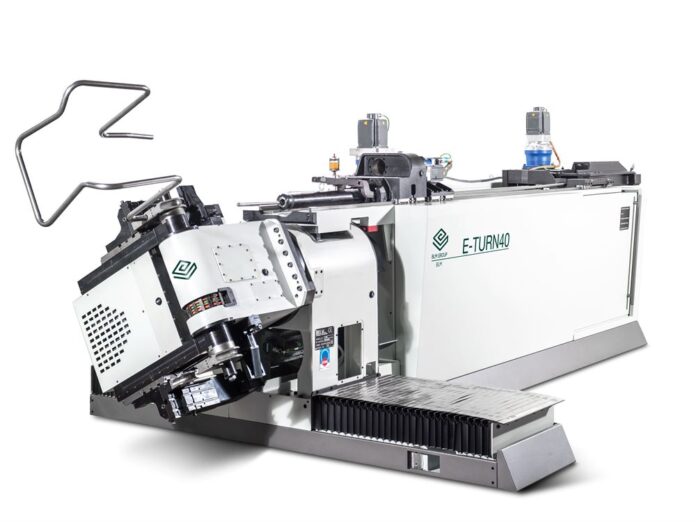
E-TURN is the BLM GROUP family of all-electric tube bending systems known for their flexibility, speed and accuracy in making complex shaped parts.
The family of machines comes in four models, for tubes up to 30, 35, 40 and 52 millimetres in diameter and inprocess right-hand and left-hand bending: the systems are all-electric with fixed and variable multi-radius capabilities and integrated loading and unloading systems.

The E-TURN stands out among the BLM GROUP bending systems for the variety of applications it can successfully tackle to bend complex parts fast and accurately. Inprocess right-hand and left-hand bending, 15 All-Electric axes, integrated to automatic loading and unloading systems, the VGP3D programming system and the B_Tools and B_Right functions to get it right from the first part. These are the strengths of a system which can often succeed when the others simply give up.

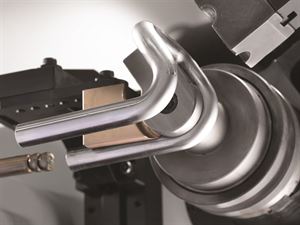
Each of the two bend heads for in-process right-hand and left-hand operation can mount up to four tools for creating various fixed and variable bending radii. In many cases, this means that a variety of jobs can be performed without the need to change the tools between each one.

The clever bend head design is capable of applying up to 2000 kilograms of pressure making it possible to bend complex radii less than 1D, on tubes ranging from 6 to 52 millimetres in diameter. Being able to modulate the torque during bending according to the clamping force means creating unblemished parts with perfect quality.

All machine movements, including the clamps, are controlled via CNC by means of electric axes to guarantee accuracy and repeatability. The tools are calibrated automatically using pre-stored parameters. This drastically saves setup and job changeover times.

The powerful 3D visual graphic programming system, VGP3D, is a key element of the E-TURN and, all BLM bending systems. The programmer can see the 3D simulation of the part being created simply by entering the bent tube’s geometric data. Once the data is entered, the part can be simulated to calculate real processing times and accurately check for collisions prior to bending the first part. The B_Import option can be used to directly import 3D models in IGES or STEP format.

No rejects – the first part is good. With the B_Tools option the E-TURN system can store the elastic characteristics of a material to compensate for spring back and tube elongation automatically ensuring that the part is right from the first go. B_Right is a tool for automatically measuring spring back and tube elongation while processing. These values are stored and applied to the tube being processed.

The E-TURN bending system can be integrated in an All-In-One process with a Lasertube system to generate accurate laser cut and bent parts. Data is exchanged between the systems to resolve and correct for the issues inherent to each technology such as tube elongation caused by bending.

Automatic tube loading and unloading are functions included in the E-TURN system operating logic. Loading or feeding systems can be positioned to either the right or left side of the machine. Finished parts can be unloaded by releasing them onto an exit conveyor.

The environment impact is very low. The E-TURN electrical consumption is less than one tenth of a conventional hydraulic bender. It only draws electricity when the axes are actually in use. The elimination of the hydraulic system means no need to dispose of waste oil and ensures very quiet operation.

High performance, extreme flexibility and high accuracy means that E-TURN can satisfy the demanding bending needs of a variety of industries: metal furniture components, complex automotive parts (such as exhaust manifolds), system components, bicycles, motorcycles and all sectors in general.

For more information, contact First Cut – Tel: (011) 614 1112

Makino DA300 VMC Reduces Machining Time For Complex Aluminium Components

Makino’s latest full 5-axis machine solution, the DA300 vertical machining center, provides the ideal blend of speed, precision and flexibility for complex part applications.

Inspired by the best design characteristics from both vertical and horizontal machine platforms, the DA300 delivers the highest productive capabilities for multi-axis workpieces in the smallest of machine footprints.

“The DA300 integrates numerous features that increase productivity and efficiency by providing significant reductions in noncut time,” said Bill Howard, VMC product manager at Makino. “The machine provides a 50 percent reduction in spindle acceleration time, 15 percent reduction in positioning time, 40 percent reduction in tool-change chip-to-chip time and includes a standard vision-type broken-tool sensor [Vision B.T.S.] that optically checks tools outside the work zone to ensure tool consistency and part quality while simultaneously reducing non-cut time during tool changes by 80 percent. Individually, each element reduces part cycle time and increases productivity; however, when all of these time savings are combined, the result is a dramatic advantage in reduced part-production times and increased profitability.”

The DA300 worktable is an integral, 340mm by 300mm table, accommodating workpiece sizes up to 450mm in diameter, 400mm tall and weighing 250 kg. The machine provides X-, Y- and Z-axis travels of 450mm, 620mm and 500mm, respectively, at feed rates of up to 60,000mm per minute. The direct-drive, motor-driven A-axis table offers 150 degrees (+30 to -120) of tilt capability at 100 rpm. The rotary C-axis has full 360-degree rotational positioning at 150 rpm. Combined, these rotational axes have the range and speed necessary to achieve the highest productivity in complex five-face or full 5-axis machining application. Equipped with scale feedback on all axes, the DA300 also offers a rare blend of speed and precision.

The DA300 comes equipped with a 20,000- rpm HSK-A63 spindle, delivering the speed and flexibility to tackle high-speed, highly productive machining of various workpiece materials, including aluminium, die-cast, steel and titanium. Acceleration and deceleration to and from full speed can be accomplished in a mere 1.5 seconds, reducing chip-to-chip times. Additionally, the machine’s standard configuration includes a 60-position ringtype tool magazine with capacity for a wide variety of tooling as well as a Vision B.T.S. to verify the integrity of the tooling prior to use.

With a perfect blend of the proven stability of the FANUC hardware and Microsoft Windows Embedded Standard 7OS, the state-ofthe- art Professional 6(Pro6) control helps move operators fluidly through machine setup, empower them with easily accessible information and protect them with enhanced safety. Cycle-time saving and dynamic-control capabilities have been added to the control’s GI functions to help lower costs per part.

Included is GI Drilling, a unique G-code drilling cycle that enables the spindle and tool to arc from hole to hole instead of following a square path. This simple change reduces non-cut time by as much as 15 percent on common hole-pattern drilling.

On complex 2-D paths, testing has reduced cut time up to 35 percent. While not every tool can make use of these functions, advanced motion control GI is proven to reduce overall cycle time by 3 to 8 percent in typical production components. This reduction saves substantial cost in both high-volume and low-volume production environments by reducing the number of spindles required and freeing up machine availability to take on more work.

Other intelligent machine functions include Inertia Active Control (IAC)designed to further speed up machine motions based upon system dynamic attributes and Collision Safe Guard (CSG), a real-time crash-avoidance feature that has a look-ahead function and takes real machining conditions into consideration to prevent collisions.

Designed to eliminate interferences in accessing the pallet, the DA300 can be configured using several approaches, including direct part handling as a standalone machine, manual handling using a table chuck and pallet, one of the workpiece pallet systems (WPS)or third-party automation using an EROWA chuck and pallet system. The DA300 can be field modified to add multiple pallet magazines, starting with a seven-pallet workpiece pallet system (WPS- 7), and up to a 19-pallet workpiece pallet system (WPS-19). These configurations deliver the highest productive capabilities using minimal floor space.

With Makino automation integration services manufacturers are able to combat fierce pricing pressures from low-labor-cost countries by providing complete automated cells and systems. Whether demands call for simple machine tending or complex, highvolume robotic cells, Makino’s automation integration services offer the equipment, skills and manpower necessary to reduce labor costs, increase throughput, ensure and enhance part quality, all while retaining the flexibility to adapt quickly to changing volumes or new parts.

For more information, contact Rothco – Tel: (011) 970 1930

Volkswagen Group South Africa – Passenger Car Market Leader

Volkswagen Group South Africa, the country’s leading passenger car manufacturer continues to grow market share, despite the tough economic climate and a declining new vehicle passenger car market.

Volkswagen has been the passenger car market leader for the last 7 consecutive years and continues to lead the market in 2017. Overall the Volkswagen Group has a market share year to date of 22.8%, with Volkswagen alone enjoying 19.8% of the local passenger market and Audi accounting for the other 3%. The two locally produced cars from its Uitenhage factory, have been instrumental in this success, with the Polo Vivo consistently being the best-selling car in the country which is closely followed by the Polo in second place since their launch in 2010.

“This means that nearly a quarter of all cars sold in South Africa come from our stable, something we are very proud of and plan to continually build on” said Chairman and Managing Director Thomas Schaefer. “This success does not come on its own, but is due to having the right products built by a great workforce, a loyal and dedicated dealer network providing outstanding sales and aftersales back up, good residual values, outstanding advertising and a compelling cost of ownership proposition,” added Schaefer.

2017 has also been a watershed year for Volkswagen Group South Africa with the local company being named as responsible for the 4th fully fledged region in the Volkswagen World, namely Sub Saharan Africa. This comes hot on the heels of the opening of the first assembly operation outside of South Africa in Kenya in December last year.

“We are now working on an integrated mobility solution which we will pilot in Rwanda, this would include an assembly operation together with car sharing offerings exclusively from Volkswagen. This would be the next step in our expansion into Africa” commented Thomas Schaefer.

Volkswagen believes that there is great potential in Africa going forward. The middle class is growing at a fast pace as many of the economies in Africa start to grow and the need for mobility will increase dramatically in the coming years. This presents a great opportunity for Volkswagen South Africa to develop its own markets and reduce its dependence on the local market and the current right hand drive export markets.

Some 18 months ago Volkswagen announced a R4.5 Billion investment in new product and technology and this investment is now nearing completion, with the already state of the art factory in Uitenhage being transformed into arguably the most modern and efficient motor assembly plant in sub Saharan Africa. Customers both in South Africa and internationally will see the benefits of this investment in early 2018.

Weaker Rand Will Further Reduce Margins Of Metal And Engineering Companies

Manufacturers continue to face serious headwinds despite the recent decision by the South African Reserve Bank to cut the repo rate by 25 basis points, which was an expansionary monetary policy move to reduce costs and stimulate demand, Steel and Engineering Industries Federation of Southern Africa (SEIFSA) Chief Economist Michael Ade said recently.

SEIFSA Economist Marique-Mari Kruger

Ade was commenting on the latest seasonally adjusted Absa Purchasing Managers’ Index (PMI) which declined by 3.8 points to 42.9 in July 2017, with all five of the PMI subindices performing poorly. This is a second consecutive monthly decline from 46.7 in June, and also the weakest since the second half of 2009. The seasonally adjusted business activity sub-index performed the worst, declining to a low 39.3.

“The data point is largely driven by souring of sentiment, including low executive, business and consumer confidence. These feed into poor month-to-month changes in demand and factory activity. A further consequence of the generally low confidence is a depreciation of the rand against the dollar, despite a strong performance in July,” he said.

Ade said the poor PMI data and the weakening of the rand against the dollar would increase input costs and add pressure on the bottom line of companies in the metals and engineering (M&E) sub-component.

“This does not augur well for business, especially given that the M&E sub-industry is at a crucial phase of wage negotiations. Businesses are in a very dynamic environment of increasing costs and diminishing returns, which heightens the level of uneasiness,” he said.

SEIFSA Economist Marique-Mari Kruger said the PMI reading, which came well below the 50 mark, signaled a contraction in the manufacturing sector. “This is disappointing when compared to the performance of our important trading partners in the Eurozone and the US, with the countries generally scoring PMI indices of above 50,” she said.

However, Kruger said there was still hope because, while the PMI index dropped in July 2017, compared to June 2017, the movement was better than the downward 4.8 index points recorded from May 2017 to June 2017.

Ade and Kruger said next month’s data could improve, provided there was increased focus on the Government’s economic policy implementation, improved business and market sentiment, continued positive inflation outlook and a speedy resolution to the wage disputes in the metals and engineering industry.

Export Competitiveness In The Metals And Engineering Sector Is Pivotal For Economic Growth

Our review of the State of the Metals and Engineering sector in the first quarter of 2017 reaffirmed the lowgrowth scenario, which saw a second consecutive contraction in GDP technically catapulting the South African economy into a recession.

Dr Michael Ade, Chief Economist of the Steel and Engineering Industries Federation of Southern Africa (SEIFSA).

However, the latest prediction by the Steel and Engineering Industries Federation of Southern Africa (SEIFSA) captures an adjusted annual economic growth trajectory, highlighting a moderate turnaround in GDP growth this year of 0.8%, which is generally congruent with a global positive outlook.

The recovery – albeit slowly – of some economic fundamentals provides some comfort and basis to argue that the South African economy is gradually weathering the depression. Indications are that the trough in the current business cycle may have finally been reached and a rebound is eminent.

There is optimism that second-quarter GDP figures will provide a mild impetus for slightly robust growth from the second half of 2017 onwards. This is possible given the generally improving international economic environment, underpinned by moderate recovery of investment and exports.

Moreover, developments in key external markets – such as the SADC, the rest of the African continent, Europe, Asia (particularly China) and the USA – for locally-manufactured products are important in gradually improving demand conditions regionally and globally. These should be beneficial to local exporters over the medium to long term.

Also, it is expected that an improvement in the current socio-political environment (including a clearer government economic policy stance) and international commodity prices will translate into better business opportunities and improve the financial positions and performances of local companies. This is potentially good news for the manufacturing industry at large and the metals and engineering (M&E) subindustries in particular.

SEIFSA’s first-quarter revised growth outlook for 2017 specifically simulates the M&E subsectors benefiting from these developments and expanding by 0.9% in the second quarter, thereby contributing to a revised predicted annual outlook of 1.2%. This figure was revised downward from 1.4% due to the weaker-than-anticipated first-quarter results and deterioration of the outlook in 60% of the sub-industries.

Although there is confidence for mediumto- long-term economic activities in the M&E sub-sectors, the short-term figures are cause for concern. SEIFSA is of the view that increasing pessimism about current business conditions and poor performance of key economic indicators does not presently bode well for production activity. Both the ABSA Purchasing Managers Index (PMI) and the Producer Price Index (PPI) reduced by 4.8% and 1% respectively from May 2017 to June 2017. This was accompanied by a reduction in the Unit Value Index for exported commodities from 2.2% in April to -2.8% in May 2017.

Additionally, an oscillating rand does not provide confidence to businesses. A weak rand translates to high cost of exchanging currencies, resulting in increasing import costs (including costs of inputs). Input costs are a fundamental component of manufacturing input cost inflation and a trade-off between rising input cost inflation and the reducing PPI (including the PPI of stage of processing) impacts negatively on the margins of companies. SEIFSA closely monitors these indicators as their performance at the moment is cause for concern to the M&E sub-sectors.

A consistently poor performance may dampen the outlook and present a basis for further revision of our estimates. Contemporaneous to the need for improved economic indicators towards economic growth is exports competitiveness in the M&E industry. SEIFSA strongly believes that export competitiveness will ensure that output growth is consistent and sustainable, generally translating to better employment opportunities as companies rally to boost productive capacity in anticipation of higher-than-expected demand for their products.

Indeed, an imperative need exists for all companies in the M&E sub-sectors to be both inward looking (that is, sell within SA, in addition to intra-company transactions to upstream local companies) and outward looking (that is, sell beyond our borders and reduce dependence on the local economy) in order to benefit from an expectant economically buoyant aura.

In our first-quarter review of the State of the Metals and Engineering sector, we noted that the M&E production capacity expanded by 0.5% in Q1 2017, against our forecast of 1.3%. Total exports decreased by 8.4% in real terms. Despite a stronger rand in Q1, imports also decreased by 7.9% (real), which is indicative of a weak domestic economic environment. The table of export-to-output ratios of the metals and engineering subindustries shows that 87% of demand for plastics, 77.5% of demand for electrical machinery and 67% of demand for metal products is derived domestically.

An interesting observation is that those subindustries with the most significant exposure to the domestic economy experienced the most severe contraction in output, while the opposite mostly held for the sub- industries with higher export-to-output ratios. In addition, the sub-industries contracted the most in Q1 2017, confirming a cyclical output pattern to that of the domestic economy.

A paradigm shift and new strategy is needed in doing business in the M&E sub-industries. Rather than conducting business as usual, a focus on improving export competitiveness is needed in order to enhance profits and act as a buffer during difficult times and sustained economic down-swings.

Indeed, export competitiveness is pivotal if M&E companies want to benefit from expected domestic green shoots (given the current expansionary monetary policy stance) and increasingly optimistic global outlook. It is necessary to ignite and sustain economic growth as South Africa seeks to benefit from the broadest synchronized upswing the world economy has experienced in the last decade.


Expansion In U.S. Manufacturing Technology Orders Accelerating

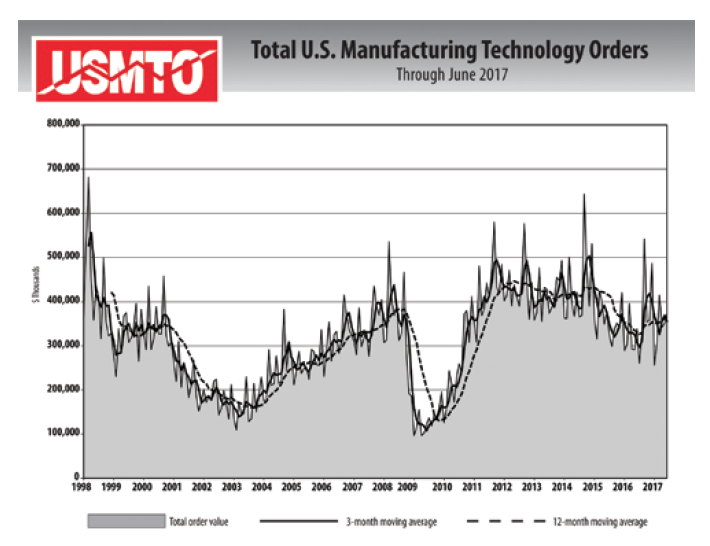
June manufacturing technology orders climbed 6.5 percent over May, according to a report released by AMT – The Association For Manufacturing Technology.

The latest U.S. Manufacturing Technology Orders (USMTO) report also shows a year-over-year increase of more than 10 percent, the fifth consecutive month posting a year-over-year gain.

The U.S. manufacturing technology market has been weak since oil prices began to drop dramatically in June 2014. Orders peaked on a monthly basis that September at $643 million and bottomed out at $260 million in June 2016. IMTS – The International Manufacturing Technology Show, held in September 2016, rekindled the market, but it was not until March 2017 that year-overyear numbers began to consistently show a positive, accelerating trend upwards. Now, three months later, June figures are up 10 percent over June 2016 and represent the volume and growth that supports an announcement that the manufacturing technology market is officially expanding.

“If the USMTO numbers aren’t convincing enough that a recovery is underway, certainly the buzz among our members underscores that a recovery is indeed underway,” said AMT President Doug Woods. “Members have shared that the aerospace supply chain in the Midwest is hot, auto orders doubled between May and June and sales in the Southeast exploded. Over the next six months, they look forward to a broadening of the recovery into areas like agricultural, construction, power generation and off-road machinery industries.”

The USMTO data supports the anecdotal evidence from AMT members. Automotiverelated orders were up 109 percent from May and the aerospace industry’s bookings of new production technology were up 47 percent. While the largest growth by any region is the 42 percent increase in orders originating in the states from Tennessee north to Michigan, the Southeast and West are posting the fastest growth rates yearto- date in manufacturing technology orders.

Key indicators that businesses in the manufacturing technology sector rely on have been improving steadily. Housing starts are an important indicator of trends as every new house has at least seven new appliances, a car in the driveway, and a consumer or two with disposable income.

In June, housing starts topped 1.2 million which isn’t at peak levels but continues an upward trend in the indicator. The increase goes hand-in-hand with the continuing strength of consumer confidence which, according to the University of Michigan’s Consumer Confidence, has been over 90 since September 2016.

It isn’t only the consumer that is fostering growth in the need for additional manufacturing capacity. USMTO tracks well with the Purchasing Managers’ Index (PMI) produced by the Institute of Supply Management. Any mark over 50 represents an expansion and the index is 56.3 in July, up from the June level. Business’ profitability over the past three quarters primes the pump for expansion on corporate investment in new durable goods and production equipment.

Mark Killion, Director of U.S. Industries for Oxford Economics, noted, “Recent increases in new orders for machine tools are supported by a better environment for business investments in the U.S. and globally, especially in the sectors for metals products, electrical and industrial machinery.”

AMT has recently replaced one of its key indicators with the Gardner Business Index (GBI) which tracks well with USMTO and turned upwards markedly in December 2016, about 90 days before the recognizable upturn in USMTO.

“As we expected, machine tool orders have performed well in recent months. The backlog index from the GBI: Metalworking bottomed out in January 2016. The backlog index tends to lead machine tool consumption by 14 to 20 months. Since the backlog is still growing at an accelerating rate, we expect solid growth in machine tool orders through at least the end of 2017,” commented Steve Kline, Director of Market Intelligence, Gardner Business Media and creator of the GBI.


Bosch And Daimler Demonstrate Driverless Parking In Real-Life Traffic

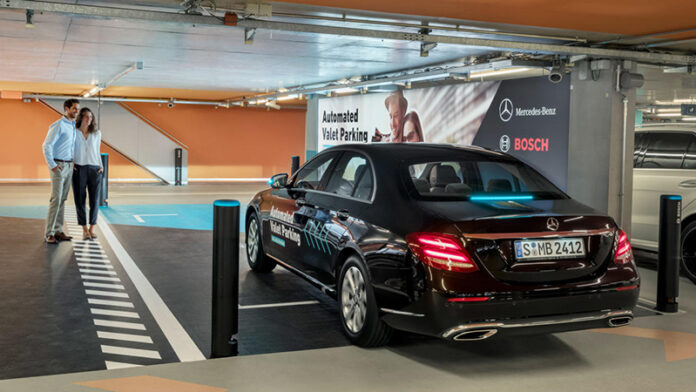
Leave your vehicle to park itself. Daimler and Bosch have teamed up to realise driverless parking (Automated Valet Parking) in the multi-storey car park at the Mercedes-Benz Museum in Stuttgart.

Cars now proceed without a driver to their assigned parking space in response to a command issued by smartphone, without any need for the driver to supervise the manoeuvre. Automated valet parking marks an important milestone on the way to autonomous driving. The pilot solution at the multi-storey car park of the Mercedes-Benz Museum represents the world’s first infrastructure-supported solution for an automated drive-up and parking service in real-life dual operating mode. From the beginning of 2018, visitors to the museum’s multi-storey car park will be able to experience the convenient service at first hand and avoid spending time parking their cars.

“We are approaching autonomous driving faster than many people suspect. The driverless parking solution at the Mercedes- Benz Museum demonstrates in impressive fashion just how far the technology has come,” said Dr Michael Hafner, Head of Automated Driving and Active Safety at Mercedes-Benz Cars Development. “Parking will be an automated process in the future. By applying an intelligent multi-storey car park infrastructure and networking it with vehicles, we have managed to realise driverless parking substantially earlier than planned,” said Gerhard Steiger, Director of the Chassis Systems Control unit at Bosch.

To the parking space and back – fully automatically

Anyone can reserve a car using a smartphone app. The vehicle rolls into the pick-up area autonomously to start the journey. The return procedure is equally convenient: the customer parks the vehicle in the car park’s drop-off area and hands it back by smartphone app. After being registered by the intelligent system installed at the multistorey car park, the car is started and guided to an assigned parking space.

Driverless parking is made possible by an intelligent multi-storey car park infrastructure from Bosch in conjunction with the vehicle technology from Mercedes-Benz. Sensors installed in the car park monitor the driving corridor and its surroundings and steer the vehicle. The technology on board the car performs safe driving manoeuvres in response to the commands from the car park infrastructure and stops the vehicle in good time when necessary. The sensors for the multi-storey car park infrastructure and the communications technology come from Bosch. Daimler is providing the private museum car park and pilot vehicles, defining the interface between infrastructure and vehicle together with Bosch and adapting the sensor technology and software in the vehicles accordingly.

First operating licence worldwide for driverless parking

The premiere on 24 July 2017 is to be followed by an extensive trial and commissioning phase. The project has been overseen from the outset by local authorities – Stuttgart regional council and the federal state transport ministry – and by appraisers from the TÜV Rheinland technical inspection authority with the aim of assessing the safe operation of the vehicle and car park technology. Before the driverless customer service goes into operation at the beginning of 2018 – as the first such application worldwide – final approval will be required from the licensing authority.

Everything will then be in place to enable automated valet parking to be made available to everyone at the Mercedes-Benz Museum’s multi-storey car park from the beginning of 2018. Bosch and Mercedes-Benz intend to use this project to acquire experience regarding users’ handling of automated valet parking. Other existing multi-storey car parks can be retrofitted with the infrastructure technology. For the operators of multi-storey car parks, driverless parking means more efficient use of the available parking space: up to 20 percent more vehicles fit into the same space.


BMW Group Announces Next Step In Electrification Strategy

Electrification is one of the central pillars of the BMW Group’s corporate strategy NUMBER ONE > NEXT and the company has announced that all brands and model series can be electrified, with a full-electric or plug-in hybrid drivetrain being offered in addition to the combustion engine option.

Additional electrified models will be brought to market in the coming years and beyond 2020, the company’s next generation vehicle architecture will enable further fully-electric vehicles.

Recently, the BMW Group announced that the new battery-electric MINI will be a variant of the brand’s core 3 door model. This fully electric car will go into production in 2019, increasing the choice of MINI powertrains to include petrol and diesel internal combustion engines, a plug-in hybrid and a battery electric vehicle. The electric MINI’s electric drivetrain will be built at the BMW Group’s e-mobility centre at Plants Dingolfing and Landshut in Bavaria before being integrated into the car at Plant Oxford, which is the main production location for the MINI 3 door model.

Oliver Zipse, BMW AG Management Board member for Production said, “BMW Group Plants Dingolfing and Landshut play a leading role within our global production network as the company’s global competence centre for electric mobility. Our adaptable production system is innovative and able to react rapidly to changing customer demand. If required, we can increase production of electric drivetrain motor components quickly and efficiently, in line with market developments.”

By 2025, the BMW Group expects electrified vehicles to account for between 15-25% of sales. However, factors such as regulation, incentives and charging infrastructure will play a major role in determining the scale of electrification from market to market. In order to react quickly and appropriately to customer demand, the BMW Group has developed a uniquely flexible system across its global production network. In the future, the BMW Group production system will create structures that enable our production facilities to build models with a combustion engine, plug-in hybrid or fully electric drive train at the same time.

The BMW Group currently produces electrified models at ten plants worldwide; since 2013, all the significant elements of the electric drivetrain for these vehicles come from the company’s plants in Dingolfing and Landshut. Dingolfing additionally builds the plug-in hybrid versions of the BMW 5 Series and the BMW 7 Series and from 2021, it will build the BMW i NEXT. The BMW Group has invested a total of more than 100 million euros in electro-mobility at the Dingolfing site to date, with investment continuing as the BMW Group’s range of electrified vehicles further expands.

Electrification of all brands and model series continues

The new, fully-electric MINI is one of a series of electrified models to be launched by the BMW and MINI brands in the coming years. In 2018, the BMW i8 Roadster will become the newest member of the BMW i family. The all-electric BMW X3 has been announced for 2020 and the BMW iNEXT is due in 2021.

Today, the BMW Group offers the widest range of electrified vehicles of any car manufacturer in the world, with nine models already on the market. These range from the fully-electric BMW i3 to the company’s newest electrified model, the MINI Cooper S E Countryman ALL4, a plug-in hybrid version of the MINI Countryman, which is produced by VDL Nedcar in the Netherlands. The company has committed to selling 100,000 electrified vehicles in 2017 and will have a total of 200,000 electrified vehicles on the roads by the end of the year.

The BMW Group has benefited from its early start on the road to electrification. Indeed, the company’s pioneering, large scale electric vehicle trial began world-wide in 2008 with the MINI E. Learnings from this project played a crucial role in the subsequent development of the BMW i3 and BMW i8, technology pioneers which themselves informed the company’s current range of plug-in hybrid vehicles.

Composites – Airbus Continues To Shape The Future

Composite materials have been called the shape of aerospace’s future. With their winning combination of high strength, low weight and durability, it’s easy to see why.

For more than 30 years, Airbus has pioneered the use of such materials in its commercial jetliners, from the cornerstone A310’s vertical stabilizer to today’s A350 XWB – on which more than half of the aircraft’s structure is composite.

In essence, a composite material is made from two or more constituent materials with different physical or chemical properties. When combined, the composite material exhibits beneficial physical characteristics quite different from what the individual components alone can provide. Commonlyrecognized composites in everyday life include plywood and reinforced concrete.

From nose to tail, Airbus utilizes advanced composites in its jetliner product line that have been at the forefront of materials science. One particular standout material is carbon-fibre reinforced plastic, or CFRP. Composed of carbon fibres locked into place with a plastic resin, CFRP offers a better strength-to-weight ratio than metals and has less sensitivity to fatigue and corrosion. In short, it’s lighter than aluminium, stronger than iron and more corrosion-resistant than both.

Like all composites, the strength of CFRP results from the interplay between its component materials. By themselves, neither the carbon fibres nor the resin is sufficient to create a product with the desired characteristics to be integrated on an aircraft. But once combined in multiple, integrated layers and bonded, the CFRP airframe component or aerostructure takes on the strength and load-bearing properties that make it ideal for aviation use.

The application of carbon-fibre reinforced plastic reached new proportions with the A350 XWB, which boasts a significant application of composites throughout. For example, most of the A350 XWB’s wing is comprised of the lightweight carbon composites, including its upper and lower covers. Measuring 32 metres long by six metres wide, these are among the largest single aviation parts ever made from carbon fibre.

With CFRP, not only is the jetliner’s airframe tougher and stronger, the reduction in weight enables it to carry more passengers, burn less fuel, fly farther…or combinations of the three.

While initially more expensive to produce than traditional metallic parts, CFRP components can save aircraft operators money on future maintenance costs since the material doesn’t rust or corrode. An A350 XWB, for example, requires 50% fewer structure maintenance tasks and the threshold for airframe checks is at 12 years compared to eight for the A380.

In CFRP production, thousands of microscopically thin carbon threads are bundled together to make each fibre, which joins others in a matrix held together by a robust resin to achieve the required level of rigidity. The composite component is produced in precisely shaped sheets laid atop each other and then bonded, typically using heat and pressure in an oven called an autoclave, resulting in a high quality composite.

Parts such as fuselage and wings can make extensive use of composites as the required fibre loading – the way the fibres are laid up and cured in the autoclave – is simple. However, parts requiring complex loading will, for the foreseeable future, continue to use metal.

The two most commonly used types of CFRP are thermoset and thermoplastic. While thermoset CFRPs are currently more widespread in the aeronautics industry, thermoplastics are gaining popularity because of their recyclability – an important lifecycle consideration that has long been a factor against wider CFRP adoption.

A key difference between thermoset and thermoplastic materials is what happens during the curing process. When cured in the autoclave, thermoset material undergoes a chemical reaction that permanently changes its makeup. A thermoplastic part, though, can be re-melted and still maintain its composition.

That difference makes thermoplastics attractive since Airbus and its suppliers produce hundreds of tonnes of scrap composites each year. While scrap thermoset resin cannot be reused, thermoplastic scrap can be used in a variety of ways and in a number of sectors beyond aeronautics.


Proliferation Of Bandwidth-Heavy Applications Creates Growth Opportunities

Governments and industry stakeholders are keenly following developments in the microelectronics industry, as these technologies could potentially disrupt and bolster the Internet of Things (IoT) Mega Trend.

Microelectronics will support eco-friendliness, Innovating to Zero, smart and connected homes, cloud computing and miniaturization trends and influence the technological progress of a wide range of industries. This will open up opportunities across value chains and key industry participants are actively entering this technology space to gain an early mover advantage.

“One of the major selling points of microelectronics is its low power consumption. Industries recognize that the technology’s rapid charging, smart antenna, wireless charging and organic light-emitting diodes (OLEDs) make it extremely cost effective in the long term,” noted Frost & Sullivan TechVision Research Analyst Brinda Manivannan. “Furthermore, a small footprint makes microelectronics relevant in an era that is experiencing the accelerated adoption of wearables and smart devices. Wireless communication technologies and display technologies will be significantly affected by this trend.”

Top Technologies in Microelectronics, 2017 is part of Frost & Sullivan’s TechVision (Microelectronics) Growth Partnership Service programme. The study assesses the impact of the top emerging microelectronics technologies, the innovation strength of each region and the global market potential of the technology. It also covers the dynamic technologies that enable the convergence of Mega Trends such as smart cities, vehicle to X (V2X) systems, IoT and connected systems.

While the benefits of microelectronics are manifold, scientists and adopters are still challenged by the huge cost of research and development (R&D), capital-intensive manufacturing, scalability limitations, volume production and lack of a structured supply chain. However, technology developers are gradually addressing these roadblocks to adoption, with North America leading in technology advancements and Asia-Pacific in technology adoption.

“Microelectronics R&D will also get a boost with the impending bandwidth crunch due to the increased penetration of augmented reality and virtual reality devices. Microelectronics can be employed to develop faster data transmission technologies such as visible light communication (VLC) and advanced data storage techniques to power data-intensive applications,” noted Manivannan. “Meanwhile, the evolution of display technologies from conventional liquid crystal display to flexible and highly versatile OLED technology is also accelerating the need for microelectronics, ensuring a steady stream of innovations from visionary industry participants.”

About TechVision

Frost & Sullivan’s global TechVision practice is focused on innovation, disruption and convergence, and provides a variety of technology-based alerts, newsletters and research services as well as growth consulting services. Its premier offering, the TechVision programme, identifies and evaluates the most valuable emerging and disruptive technologies enabling products with near-term potential. A unique feature of the TechVision programme is an annual selection of 50 technologies that can generate convergence scenarios, possibly disrupt the innovation landscape, and drive transformational growth.