Home Blog Page 83

U.S. Manufacturing Markets And Economy Improving

US Manufacturing Technology Orders (USMTO) continued to expand in July, up 23% from July 2016 order levels.

The July rate of increase is a notable acceleration in growth relative to the 10% increase in June orders posted over the previous year.

The nearly three-year decline in the U.S. manufacturing technology market turned the corner last March with a string of year-overyear improvements in order levels. IMTS 2016 rekindled the market last fall but it was not until March that year-over-year numbers began to consistently show a positive, accelerating trend upwards. At the current expansion rates, manufacturing technology orders are likely to outpace the growth rates analysts forecasted at last October’s Global Forecasting and Marketing Conference hosted by AMT.

“It is encouraging to see the U.S. manufacturing markets and economy improving, especially when the European and Asian markets are not doing as well,” said Doug Woods. “AMT is excited about the prospects for 2017 and the possibilities in 2018, particularly if Washington takes steps to address tax reform and infrastructure spending.”

Orders posted in July are typically down 15% from the previous month. This year, orders followed that historical summer trend coming in at $320 million, off 19% from June orders of $397 million. “AMT members noted the marked difference in the start of this summer season,” said Pat McGibbon, AMT Vice President of Strategic Analytics. “Usually quotations and leads start to slow in the summer but that has not been the case in 2017.”

Several large projects converted mature quotations into major orders with bundled addons such as special tooling and automation. The contract machine shop sector, where companies typically buy one or two machines at a time, was one of the stronger markets in July, representing 41 percent of all the units ordered in July and 32 percent of the total July dollar value. The big surprise was a jump in defense orders from less than one percent of total orders to 4 percent in July – more than a 10-fold increase. Medical equipment and agricultural equipment sectors were up 10 percent and seven percent respectively.

The southeast region registered one the largest month-to-month declines in the past three years falling 34 percent relative to June and down 10 percent relative to July 2016. Almost the entire decline can be attributed to a dramatic drop in aerospace activity in the region. The northeast region posted the only regional increase over June figures of the six USMTO regions.

ABB Drives The Expansion Of E-Mobility Fast Charging Infrastructure In Germany

The latest generation of charging columns is connected to the Internet via a cloud solution, enabling cashless payments, among other things.

Last year, EnBW awarded an order to ABB for 68 such rapid-charging stations with a high-charging capacity of 50 kilowatts (kW). With this latest order, ABB is further expanding its market leading position in the charging infrastructure for electric mobility in Germany. In Europe and the US, ABB is already the market leader, with no other company having such a large installed base.

“This latest major order demonstrates that ABB is also the preferred partner in the charging infrastructure sector for electric and hybrid vehicles in Germany,” says ABB CEO Ulrich Spiesshofer.

“This is why we are delighted that EnBW has once again chosen our technically advanced products in this forward-looking project. The need to rapidly expand the charging infrastructure network has once again been shown during this year’s International Motor Show in Frankfurt, where nearly all automotive companies have announced a massive expansion of their electric vehicle ranges.”

ABB has been investing in electromobility since the turn of the century. Since 2010, the group has been offering rapid charging solutions. More than 5,000 networked systems for passenger cars and commercial vehicles have been installed worldwide.

ABB’s portfolio in DC fast charging solutions ranges from 20kW wall boxes to Ultra-Fast Charging solutions for cars and 600kW electric buses.

The fast-charging stations, which are now being installed in cooperation with EnBW, have a charging capacity of 50 kW and are very compact, which makes them particularly suitable for highway rest stops, service stations, car dealerships, business locations and highly frequented inner-city areas. The charging stations can be installed in almost every parking configuration and vehicles can be recharged within 30 minutes.

Digital solutions from the ABB AbilityTM portfolio are testament to ABB’s technology leadership. ABB Connected Services offers round-the-clock monitoring of each individual charging station overseen by a team from our Network Operating Center.

Internet-based services – based on Microsoft’s Azure cloud computing platform – enable predictive control, which leads to a reduction in operating costs and increased uptime. ABB Ability is the industry-leading portfolio of more than 180 digital solutions for power, industrial, transportation and infrastructure companies. The range is based on the pioneering achievements of ABB and the more than 40 years of experience as an innovator in industrial digitization.


Airbus Perlan Mission II


Airbus Perlan Mission II, an initiative to fly a glider without an engine to the edge of space to collect ground-breaking insights on climate change, weather and high-altitude flight, recently reached a new high altitude in its second season of flight testing in El Calafate, Argentina.

Pilots Jim Payne, Morgan Sandercock, Tim Gardner and Miguel Iturmendi have soared the pressurized Perlan 2 glider in a series of flights reaching a maximum altitude to date of 32,500 feet.

Image from the tail camera of Perlan 2 taken at 30 000 feet. ©Perlan Project.

El Calafate, in the Patagonian region of Argentina, is in one of a few places on earth where a combination of mountain winds and the polar vortex create the world’s highest stratospheric mountain waves – rising air currents that Perlan pilots believe can eventually carry their experimental aircraft to the edge of space.

Over the next few weeks, the all-volunteer exploration team sponsored by Airbus will seek for the rare waves in an attempt to break the world gliding altitude record of 50,727 feet, set by Einar Enevoldsen and Steve Fossett in Perlan 1 in 2006. Along the way, the aircraft will continue to collect scientific data on the atmosphere made possible by the Perlan 2 aircraft’s unique attributes.

“Just recently the world witnessed another reminder of the importance of understanding climate change, with the fracture from the Antarctic ice shelf of an iceberg the size of the state of Delaware,” said Perlan Project CEO Ed Warnock. “Airbus Perlan Mission II will allow us to study a range of atmospheric phenomenon that ultimately will give us more accurate models of our upper atmosphere and the climatic changes that matter to every world citizen.”

The engineless design of the Perlan 2 sail plane enables it to collect uncontaminated air samples from a range of altitudes. Unlike a weather balloon, it can be steered, can stay in one area, and can take off and land in the same location.

Besides studying factors influencing climate change, Airbus Perlan Mission II will also provide insights into high altitude turbulence and radiation effects on pilots and aircraft.

“As demand for air travel rises, and we are faced with questions about how to safely and more efficiently transport a growing population, the insights that Airbus Perlan Mission II will be collecting are invaluable,” said Allan McArtor, Chairman of Airbus Americas. “Perlan’s discoveries will help us shape the future of aerospace with innovations related to design and engineering, more efficient air travel and even aviation science related to travel on Mars.”

Western European Passenger Car Market Expands

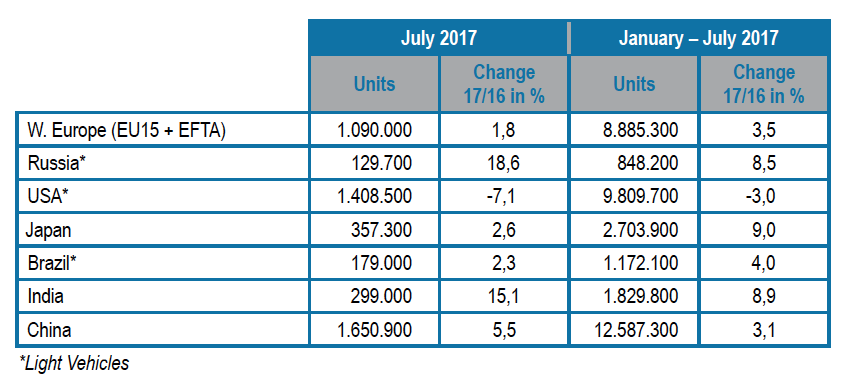
According to statistics released by the German Association of the Automotive Industry, sales of passenger cars in Western Europe and China increased in July – Russia and India actually recorded double-digit growth rates – while the US light vehicle market contracted.

In Western Europe (EU15 + EFTA) the number of new passenger car registrations added 2 percent in July to reach around 1.1 million new cars. Among the five largest national markets, France enjoyed the strongest growth of 11 percent. The markets also developed positively in Italy (+6 percent), Spain (+2 percent) and Germany (+2 percent). In the United Kingdom, by contrast, sales fell in July for the fourth time in succession (-9 percent). The Western European passenger car market grew overall during the first seven months of this year by around 4 percent to 8.9 million units.

On the US market, 1.4 million light vehicles (passenger cars and light trucks) were sold in July (-7 percent). Demand for passenger cars fell once again (-15 percent). However, sales of light trucks also decreased – for the first time since September 2013 (-2 percent). The accumulated light vehicle market since the beginning of the year has lost 3 percent, falling to 9.8 million units, but starting from a high level.

July saw the Chinese passenger car market continue its expansion. The sales volume came to 1.7 million new cars, with year-on-year growth of about 6 percent. Since January, passenger car sales have risen by 3 percent, reaching an accumulated total of 12.6 million vehicles.

Following contraction on the Indian market in June caused by a current tax reform, the market returned to a strong dynamic. Passenger car sales climbed to 299,000 units, i.e. 15 percent up on July 2016. Totaling 1.8 million units, the market remains clearly in the growth zone (year-to-date rise of 9 percent).

In Japan, new registrations of passenger cars increased in July for the ninth time in succession. The number of vehicles registered amounted to 357,300, which was 3 percent up on the same month last year. During the first seven months of 2017 sales rose by 9 percent to 2.7 million new cars.

The positive trend also continued in Russia. At 19 percent, growth was well into double figures for the third month in succession. The market volume came to 129,700 light vehicles in July. This means that since January a total of 848,200 new vehicles have been sold – 9 percent more than in the same period in 2016.

The Brazilian light vehicle market also expanded in July, rising by 2 percent to 179,000 vehicles. From January to July 1.2 million units were sold, which was a year-on-year rise of 4 percent.


CECIMO – More Than 25 Billion Euro Of Machine Tools Production And The New EU Industrial Policy Strategy

Positive outlook for machine tools production in Europe for 2017

This year the MT production in Europe is expected to grow again at an annual rate close to 4%, to hit 25.2 billion euro and increase CECIMO’s production market share beyond 36%. Germany and Italy are the biggest MT producers (46.2% and 19.3% respectively), shortly followed by Switzerland (12.0%). Hence, the CECIMO MT production is continuing its stable growth trend.

Dr Frank Brinken

The trade among CECIMO countries is rising. One out of four machine tools exported by companies in CECIMO countries is directed to another CECIMO country. Outside CECIMO, the largest customers are China (25.6%) and USA (18.0%). Moreover, the Chinese consumption is expected in 2017 to increase at an annual rate of 3.6 versus 3.2 in Europe and in the world. In 2016, all CECIMO exports amounted to 18.34 billion euro. As pointed out by Dr Frank Brinken, Chairman of the CECIMO Economic Committee and Vice- Chairman of Starrag Holding AG, “given the uncertainties by various announcements from the US about the implementation of protectionist trade barriers, we have to refrain from making a detailed forecast for 2017/18. However, we estimate, in an unchanged business climate, to reach an export volume slightly beyond 19 billion euro”.

The European MT consumption is likely to reach around 18.6 billion euro demonstrating a moderate but certain growth, in line with the world consumption trend. Investments in modern machine tools are fuelled by investment tax incentives in certain countries and the trend towards digital manufacturing, which requires a state-of-the-art machine population.

CECIMO reacts to the “Renewed EU Industrial Policy Strategy” of the European Commission

Filip Geerts

European Commission President Jean- Claude Juncker gave his annual State of the European Union address at the European Parliament urging us “to catch the wind in Europe’s sails”. While CECIMO appreciates the positive outlook of the EU, as described by President Juncker, we believe that the EU should do more to deliver its promises for a stronger and more competitive industry.

It is undeniable that the Machine Tool industry is a major driver for employment, skills and innovation in Europe and has a strategic role in advanced economies. In fact, machine tools are often called “mother machines” due to their essential role in – virtually – every manufacturing process and in industrial value chains like automotive, aerospace, energy, electronics, medical etc.

The European Commission through the recently launched Communication on a Renewed EU Industrial policy strategy has committed to support the European industry to address the current challenges and achieve its vast potential in the new industrial age.

CECIMO welcomes the EC initiative, nevertheless believes that it lacks a longterm vision. Moreover, the Communication does not outline a set of concrete actions to help the EU industry stay or become the world leader in innovation, digitization and decarbonization.

Luigi Galdabini

The most promising announcement in the Communication was the European Commission’s intention to join forces with the member states, the EU Institutions and the European industry to reflect on the main elements of such a strategy in the framework of a High Level Industrial Roundtable (to be set up in 2018) and the continuation of the EU Industry Day. “CECIMO is keen to contribute to this collaborative dialogue and ensure that MT industry’s needs and concerns are heard and acknowledged”, said Filip Geerts, CECIMO Director General.

In our view, the challenges of the EU industry remain the following – developing skills and competences, nourishing research, development and innovation, bridging the investment gap, building on our biggest strength – the single market and maintaining a global level playing field.

Effective market surveillance essential to ensure product safety and a fair Internal Market

EU legislation lays down the essential health and safety requirements that products must conform to. The non-enforcement of this legislation puts health and safety at risk, creates unfair competition and undermines the competitiveness of those economic operators who do comply with the rules. Market surveillance is therefore a key element of the Internal market.

“CECIMO welcomes the Commission’s intention to make proposals to enhance the cooperation among market surveillance authorities announced in the Industrial policy strategy and believes that effective market surveillance requires close cooperation between economic operators and public authorities”, explained Mr Luigi Galdabini, CECIMO President and Managing Director of Cesare Galdabini SpA. This is why CECIMO decided to proactively develop Guidelines to support economic operators, market surveillance and customs authorities to assess the conformity of machines with existing European product safety law.

Cutting Tools: Mitsubishi Hitachi Tool Engineering Creates Moldino

While as from 1st of April 2015 Mitsubishi Materials Corporation (MMC) holds a 51% stake in Hitachi Tool Engineering, the new brand name, MOLDINO and logo were created. MOLDINO is a combination of the words MOLD + DIE + INNOVATION.

This name stresses the effort to be an innovator with a specialization in the die and mold industry, based on own research and development as well as own production and application support at customers worldwide. “MOLDINO is a statement of our clear focus for the future and also summarizes the way in which we’ve been operating for decades,” states a company spokesperson.

“Our customers face their global competition on a daily basis and are required to produce molds and dies with increasing speed, precision and quality. In consequence of this reality, our engineers are applying and implementing our cutting tools in customer’s processes. In doing so, we are focusing on achieving highest levels of process safety and repeatability, while striving for opportunities in terms of standardization. We always have standardized automated processes in mind that prepare our customers for the (industry 4.0) future.

“However, nowadays it is not enough to simply introduce another cutting tool into an existing process. In order to significantly reduce production time and costs it is necessary to analyse and adjust the entire process chain from start to finish: CAD, CAM programming and toolpaths, tool selection, production and programming strategies, machine selection, tool and workpiece clamping plus cooling, cutting parameters as well as chip evacuation need to be taken into account in order to achieve optimal results. Our growing number of application engineers aims to provide customers with this full service approach,” he points out.

Under the new MOLDINO brand name and logo, Mitsubishi Hitachi Tool Engineering is following its proven concept, while extending it even further with the current and future needs of the die and mold sector in mind.

Mitsubishi Hitachi Tool Engineering is one of Japan’s leading tool manufacturers. The company’s business has been focused on tool and mould construction for decades, developing a considerable tool range that covers the entire process chain.

For more information contact Multitrade Distributors – Tel: 011 453 8034

Cutting Tools: MMC Hitachi Tool Presents The New TD4N

Anzeigen P50

Joern Mackensen von Astfeld, Product Engineer (M.Sc.) of MMC Hitachi Tool, underlines, “the TD4N is not just an extension of our proven range of High Feed Cutting tools.

Novelties of TD4N are the newly developed high-feed geometry and the double faced, 4 corner inserts for economic machining.” He also points out that “the special cutting edge geometry optimizes chip formation and minimizes undesired residual material for subsequent operations. As a result the TD4N ensures a high process reliability and convinces with smooth machining, low costs per cutting edge and a long and stable tool life.”

The TD4N enhances the high-feed product portfolio and strengthens MMC Hitachi Tool’s strategic approach as an holistic technology partner for the die and mould industry. In combination with highly skilled application engineers, the characteristics of the new High Feed Cutting Tool TD4N emphasize MMC Hitachi Tool’s dedication for process optimizing in the die and mold industry. The effective and efficient integration of the cutting tool in the production process is a core component of MMC Hitachi Tool’s Production50® concept.

“By using advanced tools and application know-how with new manufacturing strategies and technologies, dies and moulds can be produced faster and thereby more efficiently,” Mackensen von Astfeld summarizes. With the indexable milling tool TD4N, MMC Hitachi Tool continues its course of innovation.

For more information contact Multitrade Distributors – Tel: 011 453 8034

Cutting Tools: Tough Materials Meet Their Match

Both the TC3020 and TC3030 ceramic grades are suitable for high temperature alloy machining where difficult-to-cut materials such as Inconel, rene and titanium are used.

These ceramic grades are characterized by their excellent toughness and anti-chipping capabilities making them the best choice for both interrupted and continuous machining. The new grades are available for insert lines in turning, milling and grooving applications.

The TC3020 is ideal for high temperature alloy machining and runs in the same conditions as the whisker ceramic grade. Its superior wear resistance is due to its high stability while it offers better flank and notch wear resistance compared to the competitor’s similar grade. Furthermore, the TC3020 has excellent high temperature strength and fracture toughness.

The other new offering, the TC3030, is also created to handle high temperature alloys with the difference being that the grade’s extreme toughness enables it more for higher feed and heavier depth of cut machining and is suitable for scaling and roughing applications while offering excellent thermal shock resistance and thermal conductivity.

By combining silicon nitride and aluminium oxide, TaeguTec’s SiAlON grade offers incredible chemical stability in order to reduce notch wear in demanding operations and has the capability to run at 4-6 times the speed of conventional carbide inserts.

Product testing in real-world machining conditions demonstrated increases in productivity and tool life. While performing a continuous grooving operation on an engine casing made from Inconel 718, the TC3020 grade’s productivity increased by 40 percent over the competitor’s similar ceramic grade. For an engine casing made from the same Inconel 718 with external interrupted turning and interrupted grooving operations, TaeguTec’s TC3030 increased tool life by 23 percent and 56 percent, respectively.

The biggest improvement over the competition was on a rene 108 material, the TC3030 performed incredibly well on a face milling operation of a shroud workpiece when it increased tool life by 100 percent.


For more information contact TaeguTec – Tel: 011 362 1500

Cutting Tools: The Route To Successful Composites Machining

New CoroMill® Plura routers unveiled by Sandvik Coromant offer optimized milling and slotting operations in composite materials such as CFRP (carbon fibre reinforced plastic) and GFRP (glass fibre reinforced plastic). Production engineers, machine shop managers and operators will all benefit from the patented geometries provided by the new routers, particularly those in the aerospace industry, where these materials are increasingly prevalent, as well as others in sectors such as automotive, motorsport, wind power and marine.

The CoroMill® Plura range comprises three cutters for composite materials: the CoroMill Plura compression router, CoroMill Plura low helix router (pictured), and CoroMill Plura serrated router.

Machining solutions dedicated to specific composite materials are becoming an increasingly important factor at machine shops looking to achieve improvements in quality, cycle time and costs. The abrasive content of many composites causes issues such as rapid tool wear, compromized cutting quality, elevated temperatures, vibration and unstable cutting conditions. With these challenges in mind, the latest CoroMill Plura generation from Sandvik Coromant has been developed to improve CFRP and GFRP machining on three-, four- and five-axis CNC machining centres, as well as gantry-type CNC machines and stand-alone robotic arm systems.

“The CoroMill Plura brand is long-established and proven throughout industry, and with this latest generation of routers, patented geometries have been designed specifically to boost the machining of composite aerospace parts that include fuselage, wings, stabilizers, stringers, spars, ribs, frames, substructures, floor beams, struts and pressure decks,” says Aaron Howcroft, Global Product Manager Composites, Sandvik Coromant. “The routers offer high productivity and have the longest tool life on the market. Furthermore, they are available as standard items for fast ordering, thus delivering benefits to procurement/ purchasing teams.”

When milling and slotting composite materials, the new routers are used primarily in full radial engagement and at full depth of cut. In some cases, finishing passes can also be deployed. Helix angles have been carefully designed for ideal sharpness and cutting edge strength, thus ensuring longer tool life and high-quality surface, edge and slot finishes. The range comprises three cutters – the CoroMill Plura compression router, CoroMill Plura low helix router and CoroMill Plura serrated router.

The CoroMill Plura compression router, with its dual 40° helix, works best with special woven glass layers on both sides of CFRP components. As there is an overlap between compressed flutes, the router performs well in thin, flat materials by reducing material vibration.

Specifically designed for smooth and burrfree finishing passes in CFRP workpieces, the CoroMill Plura low helix (5°) router features a high number of teeth and a coating that is designed to aid quick cutting and protect from heat. Right and left helix options allow flexibility in material with challenging support conditions, such as weak or compromised fixturing.

Finally, the CoroMill Plura serrated router, with its large flute form, allows for very high material removal rates. The geometry also offers a dual cutting action to reduce delamination and vibration, ultimately providing a single-pass solution to minimise stress on composite parts.

All three CoroMill Plura routers can be used with or without coolant.

For more information contact Sandvik Coromant – Tel: 011 570 9615

Cutting Tools: New Specialized Thread Mills From Reime Noris

The company already offers an unusually extensive product range of threading tools for the manufacture of large-threads from Ø 20mm.

However, to supply the customer with more economical solutions, REIME NORIS is expanding its thread milling NES TS and now offers this powerful and universal tool solution for threads from Ø 60mm with 1mm to 6mm pitch.

The three possible thread milling bodies of tool steel are equipped with pitch-overlapping carbide inserts. Due to the special design of the cutting geometry different pitches can be produced with one insert type. This results in a reduction of tool variants. Due to the constructive design of more insert seats (more working thread tooth on the circumference) more effectively higher feed rates are possible, thereby reducing the processing time dramatically.

For the user, the use of the NORIS thread milling system NES TS means cost savings, flexibility and increase the quality of work by this innovative tool solution.

For more information contact Duncan Macdonald – Tel: 011 444 4345