Home Blog Page 82

MOBI Highlights EV Powertrain Optimization Techniques

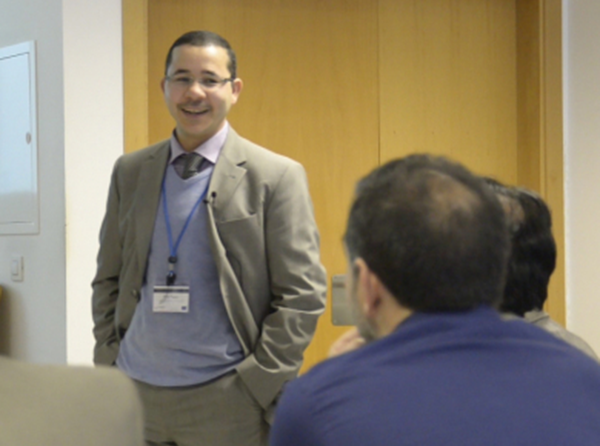
Prof. Omar Hegazy, head of power electronics and electrical machines at the MOBI Research Centre, University of Brussels (VUB), recently highlighted his team’s EV powertrain optimization techniques at CWIEME Istanbul 2017.

Electric vehicle (EV) and hybrid electric vehicle (HEV) technology continues to gain momentum. The more research that goes into it, the more automotive OEMs are hailing it as the inevitable future of the industry. This shift is mirrored throughout the supply chain, with a greater number of parts manufacturers launching products tailored to the needs of hybrid and electric vehicle motor designers.

But such an impending revolutionary shift in the industry raises many questions: Will it be cost effective? Will it be efficient? And what will it take to implement the necessary infrastructure?

One organization in Belgium is helping to provide some answers. The Mobility, Logistics and Automotive Technology Research Centre (MOBI), situated at the Vrije Universiteit Brussel (VUB), is a leader in EV and HEV research and in socio-economic evaluations for urban mobility and sustainable logistics. It employs a multidisciplinary team of over 90 specialists who address the challenges that the transport value chain faces, by integrating engineering, economic, social and environmental sciences and policy issues.

MOBI possesses state-of-the-art infrastructure and models for the testing, development and design of components, vehicle powertrains, and inductive and conductive charging infrastructure. Simulation techniques have been developed to define energy-efficient and low-emission power control strategies in hybrid propulsion systems. There is also a team working on big data and analytics.

Hegazy is head of power electronics and electrical machines at MOBI. His team is focused on finding the perfect balance between efficiency and affordability using powertrain optimization techniques. Hegazy recently spoke about MOBI’s powertrain optimization techniques at CWIEME Istanbul 2017, during a seminar, entitled Co-design optimization framework for vehicle powertrains: From technology to topology.

“The three largest barriers that we currently have in the electric transportation industry are a high purchase cost, a short driving range and a limited charging infrastructure,” says Hegazy. “The solutions to the first two points can be found in the powertrains of the machines themselves. My team is focused on the optimization of powertrain sizing components and control system design, known collectively as co-design. We start by looking at the available space in EV or HEV powertrains; we then evaluate which components would work best before trying to find innovative ways to incorporate them – the perfect symbiosis of technology and topology. There are many things to consider, such as battery technology, energy consumption, battery pack voltage, charging power and charging time, but we use our 40 years’ experience in electric, hybrid, fuel cell vehicles and stationary applications R&D to produce successful results.”

While in recent years, a growing number of industrial companies, public administrations and institutions have approached MOBI for collaboration or direct contract research, MOBI has also worked with companies to deliver social, economic and environmental impact studies, decision-making support, modelling and simulation, engineering and standardization. It offers a unique life cycle assessment (LCA) methodology for the entire automotive sector to analyse the environmental, economical and societal impacts caused by the development and implementation of new vehicle technologies, components, materials and policy measures.

“Using a large database with real-life measurements, which has been developed by MOBI over four decades, we’re able to provide accurate technical, economical and environmental assessments,” Hegazy says. “The database is kept up-to-date with the latest information obtained during research projects and the execution of contracts.”

Over the last five years, the centre has undertaken 23 major European projects, 51 direct contracts with the industry and 76 projects funded by national organizations.

EWF And CECIMO To Accelerate Adoption And Utilization Of Additive Manufacturing Technologies

CECIMO and EWF will henceforth work together to support Europe’s industry through this profound and impactful change, by finding mutually relevant opportunities and exchanging information on activities such as qualification and advocacy in Additive Manufacturing or on AM-specific EU project proposals, as well as creating joint working groups that will develop relevant activities on areas of mutual interest.

Additive Manufacturing describes the technologies that create 3D objects by using the most diverse type of material, adding them layer-upon-layer. The materials used could vary, and AM application is limitless. Early use of AM in the form of Rapid Prototyping focused on preproduction visualization models. More recently, AM is being used to fabricate end-use products in aircraft, dental restorations, medical implants, automobiles and even fashion products.

The connection between all these technologies is the need to use computers, 3D modelling software (Computer Aided Design or CAD), machine equipment and layering material, that will be used by the AM equipment, once a CAD sketch is produced, to read in data from the CAD file and generate successive layers of liquid, powder, sheet material or other, to create a 3D product.

CECIMO is the association conveying the concerns of the AM industry to the EU authorities. Representing key companies in the AM ecosystem, it engages with policy actors for the creation of an enabling policy, and regulatory and business framework for the uptake of additive technologies in Europe. This includes initiatives such as developing specific AM standards within the remit of EU regulations, advising the European institutions on the AM priority research areas for the next EU budgetary programme and producing curricula to boost AM in education. CECIMO is also partners in several EU projects, coordinating one on the evolution of skills in the machine tool sector as a result of AM and participating in three others as task leader. Furthermore, CECIMO organizes high-level conferences in the European Parliament with leading AM businesses and European policy-makers and hosts the meetings of its own industry-driven AM Working Group, gathering experts from across Europe.

On its turn, EWF contributes to the VET in the welding sector over 31 member countries across Europe, managing an harmonized system for qualification and certification of personnel working in the welding sector, as well as certification of companies and as such, is developing today the qualifications required for the next batch of professionals entering the workforce while at the same time providing the basis for getting today’s workers ready for the challenges posed by new technologies, such as is the case of Additive Manufacturing.

ISCAR Expands The Bayo T-Ream Line With 1.5XD Effective Overhang Tools

Following market demand for shorter BAYO T-REAM tools, ISCAR is expanding its family of tools by adding 1.5xD effective overhang tools to the already available 3xD, 5xD and 8xD overhang tools.

The RM-BNT-1.5D tools were designed for effective reaming depths of up to 1.5 times the hole diameter. They feature BN5 to BN9 reaming head connection sizes for a reaming range of 11.501 to 32.000mm.

The new tools should be applied whenever shorter tools are required, mainly on lathe machines or for higher rigidity requirements.

For more information, contact ISCAR South Africa – Tel: 011 997 2700.

Bystronic Automation Solutions For Ultrafast Sheet Steel Processing


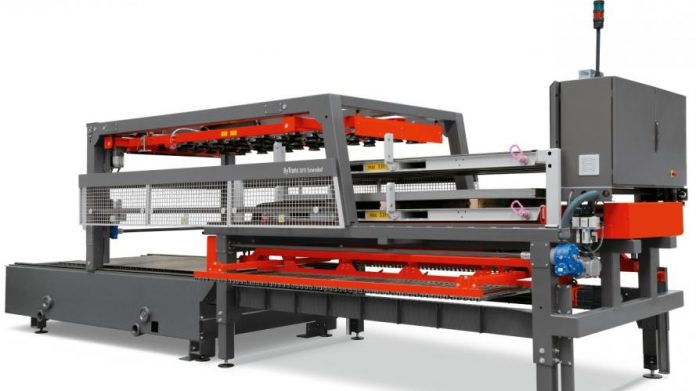
The ByTrans, which is linked to the Bystronic fiber laser, automatically loads steel sheets onto the fiber laser’s shuttle table.

After the cutting cycle is completed, it unloads the finished parts and residual sheets.

The ByTrans requires only 60 seconds in which to carry out the loading and unloading cycle, with the result that the automation system is always faster than the cutting plan being processed. While the ByTrans loads a shuttle table with raw material, the fiber laser is cutting components on the other table, meaning that the laser can cut uninterrupted for an extensive period of time.

‘Extended’ solution with ByTrans Extended

The ByTrans Extended features not one but two cassettes, which increases the automatic capability of the system, while offering greater flexibility as it can not only store and return, but also handle the removal of large parts. It is also capable of preparing plastic protective separators, which are placed between the steel sheets.

The ByTrans Extended is available in 3 x 1.5 metre and 4 x 2 metre options. Bystronic’s latest fiber laser solutions are processing raw material substantially faster than earlier systems such as CO2 lasers. However, the laser forms the hub of an extended automation system, which includes downstream processes such as punching, bending and welding. However, where space in a manufacturing facility is constrained, the Byloader automation system is a compact loading unit that is positioned on the side of the laser system’s shuttle table, supplying raw metal sheets to the laser without taking up unnecessary space.

The ByTrans, the ByTrans Extended and the Byloader are operated using the ByVision Fiber’s touch screen. Bystronic has seamlessly integrated the control of the two automation systems into the fiber laser’s operating software. This enables users to perform all the operating steps on a single touch screen.

For more information, contact First Cut – Tel: 011 614 1112

Automation Solutions For AMADA Press Brakes


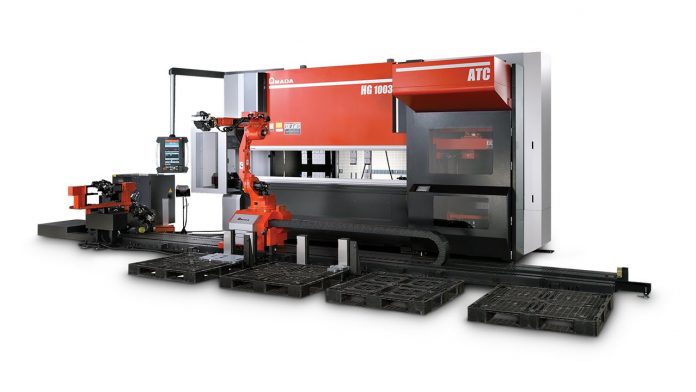
A piece of integral technology able to advance productivity is AMADA’s innovative ATC (automatic tool changer). The HGATC is the company’s flagship press brake and is unique in the marketplace. ATC technology facilitates the automatic locating and precise loading of punch and die profiles using an independent four-axis tool manipulator, delivering dramatic time gains. In fact, using a clever algorithm to guarantee the best set-up time means the HG-ATC can load even the most complex tool layout within just 3 minutes.

HG-ATC press brakes can also be equipped with AMADA SF75 sheet followers. These handy devices, which fit to the front of the machine, make it easier to handle large, heavy parts, which perhaps would have previously required two operators. As a result, labour costs can be immediately halved.

Of course, most people associate automation with robotics, and here AMADA’s latest offering is the HG-ARs. This robotized bending cell, which is equipped with the new AC-300 automatic pallet changer and ATC, perfectly illustrates all the productivity and flexibility gains that can be achieved using the latest automation technology. Material load/unload and bending functions are performed by a seven-axis articulated robot, which is capable of a complete range of motions.

A seven-axis robot also features in AMADA’s HG-Rm press brake system for bending large-scale parts featuring complex rib and panel shapes. Here, special grippers dedicated to rib parts are used to process complex shapes in short cycle times. The automatic re-gripping device, which does not require any manual set-up, is equipped with two motorized arms and automatic scissor supports.

From a software perspective, AMADA can offer its advanced VPSS 3i suite for the provision of streamlined workflow from initial 3D CAD model to finished product, taking in processes such as cutting, punching, bending and welding. The key to the success of the VPSS 3i system is the constant data link between the separate software modules (such as Blank CAM, Bend CAM and Weld CAM), the machines and the central database. This database stores all parts, machines, tools, materials and technology-related information in a consistent way, distributing the data quickly and reliably. All of AMADA’s automation solutions incorporate the latest digital technologies in line with smart factory concepts.

For more information, contact AMADA – Tel: 011 453 5459

Automation: The Dream Machine From TRUMPF

A high-precision, fully automatic machine that takes care of production largely autonomously – that’s the new TruLaser Center 7030.

It offers extremely efficient, automated and synchronous processes, from its programming all the way to sorted and stacked workpieces. The machine works with a hybrid drive system to meet the ambitious development goal of eliminating all obstacles to smooth processing in laser cutting today. These include shutdowns due to collisions involving parts tilting over, refinishing work on microjoints, spatter on the undersides of components and excessive programming work.

The TruLaser Center 7030 moves the sheet and the cutting head simultaneously and the slats have now been replaced by brush tables. The machine can eject small parts safely and sort them into containers, it disposes of residue and slag, it sorts and stacks larger parts during machining, it can load itself with blank sheets on a very tight space, it stacks scrap skeletons and the programming is also largely automatic. Numerous innovative and patented solutions contribute to the coherence of the entire concept. Heinz- Jürgen Prokop, Head of Development and Procurement in the TRUMPF Machine Tools division, explains, “we were gradually having to face more and more calls for help from our customers, asking us for solutions that would create a secure overall process. It turned out that this wasn’t possible with the machine concepts we already had, so a complete re-think was required.”

High dynamics through additional axis of the optic

The TruLaser Center 7030 works with a TruDisk solid-state laser, with six kilowatts of laser power. In terms of cutting productivity, it is easily on a par with today’s high-end machines with flying optics, even though the sheet, with its relatively high mass, is moved precisely over the brush table in the Y direction. This was made possible by two solutions. Firstly, the sheet – maximum large format 3000mm by 1500mm – is moved across the short side. And secondly, the cutting optic, which moves mainly in the X direction, has an additional axis in the Y direction with travel of ±55mm. This means that with smaller contours, only small masses need to be accelerated, enabling high dynamics.

Secure part support thanks to the mobile SmartGate

On a hybrid machine, the support table for the sheet has to be divided beneath the path taken by the cutting head. This creates a gap through which the laser beam can escape downwards, but through which slag, slugs and cutting gas are also extracted. To prevent any sheet contours from getting caught there and to enable a far more efficient exhaust system, the TRUMPF developers invented the SmartGate – two slides which move synchronously with the cutting head. They can also change their distance from each other, to create different-sized gaps. This results in two major benefits – the sheet is securely supported during the cutting process and small parts measuring up to 160mm by 160mm can be simultaneously ejected downward.

To ensure maximum process reliability, an ejector cylinder has been attached to the cutting head that presses the sheet metal parts outward and downward. The programming system TruTops Boost calculates the ideal pressing-out point automatically to suit the respective part contour. Since the slides below form a counter-bearing parallel to the sheet, the workpieces cannot tilt over. Scrap and slag fall directly into the scrap cart, or are transported out of the machine on a conveyor belt. Good parts are intercepted by a retractable sorting flap and the SortMaster Box Linear distributes them into a maximum of eight containers.

Process-safe removal of parts from the scrap skeleton

For the automatic removal of the remaining parts from the scrap skeleton, the TRUMPF experts developed SmartLift and SortMaster Speed – and this represents an intelligent, completely new and above all, process-safe solution. With one stroke on the SmartLift, the cut parts are lifted off the scrap skeleton from below via a total of 180 freely positionable pins. Each individual pin can lift a weight of up to ten kilograms, making the process far more powerful than today’s suction solutions. At the same time, the SortMaster Speed pushes down from above with its suction plates, ensuring precise linear guidance during lifting. As a result, any risk of parts tilting over into the kerf can be safely ruled out. The two telescopic arms on the SortMaster Speed are equipped with three suction plates each, and can sort and stack parts onto a maximum of eight Euro pallets across a total area of 1.6 by 4.8 meters.

Only minimal cutting interruptions

TruTops Boost also calculates the optimal position of the pins and suction plates automatically – enabling removal of very large parts as well as smaller ones no larger than a credit card. Even highly complex or very filigree geometries – considered impossible to remove mechanically until now – are lifted safely from the sheet, without the need for any additional programming. The strategies for removing and cutting the parts are coordinated in such a way that the machine continues to cut even while the parts are being transported away.

Today, productivity per unit area is an important criterion, and the developers of the TruLaser Center 7030 were instructed to save space wherever they could. They did so successfully, with a solution that temporarily includes the transport route through the production hall. The machine has three electrically powered drawer-type carts, which can be extended as far as the aisle. Pallets with stacks of blank sheets up to 130mm in height, and weighing a maximum of 3 tons, can be placed onto the middle cart from the aisle by, say, forklift trucks. Similarly, there is a cart for scrap skeleton stacks up to 250mm in height, and also a cart that transports pallets with cut parts from the machine. Separating, lifting and insertion of the blank sheets into the clamping unit takes place automatically, parallel to unloading of the scrap skeleton.

Programming in a single step

The numerous options, and the synchronized interplay of the individual processes, make near-fully automatic programming indispensable. In fact, the TruLaser Center 7030 operates almost as simply as a printer in an office. If you send it a document with corresponding job data – geometries, amounts, material types, thicknesses – it provides you with the finished parts, sorted and stacked to suit the order. This includes nesting of the parts on the sheet, assignment of cutting technologies, removal strategies, placement of cut parts onto the storage shelves and ejection into the container.

Here, the SmartGate, ejector cylinder, pins, sorting flap and SortMaster Speed do not have to be individually programmed. Simulations running in the background take into account the component geometry and material characteristics, ensuring an optimal calculation result. They are supported by the clearly laid-out order management of the programming software TruTops Boost. As a result, programming takes place in one single step and largely automatically, but can be adjusted interactively at any time.

Consistently oriented to the future

The TruLaser Center 7030 is capable of working autonomously over long periods, without any operator intervention, and is also equipped with all the necessary interfaces and functions. This makes it an ideal machine for Industry 4.0, and many TruConnect solutions can be used directly. The Performance Cockpit gives an overview of relevant production data. The Dot Matrix Code supports connection to various processing technologies and creates transparency during part tracking. Moreover, the MobileControl app reduces the already low attendance of the operator to a minimum via remote control.

With the TruLaser Center 7030, TRUMPF is addressing sheet metal fabricators from all sectors who cut sheets from one to twelve millimeters thick at high capacity. And this fully-automatic laser cutting machine reveals its potential from the very first shift onward. With two-shift operation, processing costs are up to 30 percent lower compared to standard automated machines with solid-state lasers. As Prokop summarizes, “TRUMPF’s mission has always been to define the technological state of the art in its core areas, and to give its customers the competitive edge. The TruLaser Center 7030 is further proof of this.”

For more information, contact Retecon – Tel: 011 976-8600

Detecting Impurities On 3D Components

F-Scanner Polygon

Impurities adhering to the surface of components can cause problems in later stages of the production process – or even make the entire component useless.

A new fluorescence scanner developed by the Fraunhofer Institute for Physical Measurement Techniques IPM allows specialists to inspect metallic parts for residues of grease, machining chips and cleaning agents – for every single item in production cycle.

The smallest of details can have huge consequences. For instance, tiny particles of dirt clinging to the surface of components during the production process. The oil pan in vehicle engines is a typical example. If the process lubricant contains impurities that stick to the areas where the sealant will be applied, the seal will not be tight and the oil pan is likely to leak at this vulnerable point. Until now, it has not been technically possible to examine every single component for residual contaminants. The only solution was to test random samples, which is not only time-intensive but also fails to identify the exact spot on the component contaminated by foreign substances.

Spatially resolved inline measurement = 100% quality

In future, manufacturers won’t need to worry about such questions of contamination. The answer lies in the inline fluorescence scanner developed by researchers at the Fraunhofer Institute for Physical Measurement Techniques IPM in Freiburg. “This scanner not only enables us to perform inline measurements on every single metallic component – during the production process and without requiring additional time – but also enables us to pinpoint the exact location of the dirt particles,” explains Andreas Hofmann, Business Development Manager at Fraunhofer IPM. “The outstanding spatial resolution of this system enables us to identify even the slightest deposits or films of less than ten milligrams per square meter.”

Fluorescence detectors for oil films, machining chips and other contamination

The system works as follows: While the oil pan travels from point A to B on the conveyor belt, a point-source UV laser scans a specific area of the component. If traces of grease, remains of organic cleaning fluids, or fibers are detected on the surface, they reflect light in the visible fluorescence spectrum as a sort of response to the laser’s UV light. The sensitive detector that captures these light frequencies ignores all other wavelengths and is thus able to interpret the fluorescence signals as signs of contamination.

The metallic component itself does not reflect beams of fluorescent light. A scanner ensures that the laser focus passes over the surface at high speed, creating a point-by-point grid. The laser beam scans the object at a rate of approximately 200 times per second. As a result, the quality controller receives an image showing precisely where any dirt particles or oil films have been detected.

The fluorescence scanner is even capable of detecting metallic chips that adhered to the test object in previous machining steps, even though they are not fluorescent. “The preprocessed components are cleaned using water or compressed air. Any remaining chips are contaminated with oil or other fluorescent substances,” says Hofmann.

Spatial resolution and processing speed adaptable to the production process

The researchers can adapt the system’s spatial resolution and processing speed to the needs of the production process, for instance just-in-time manufacturing. And the fluorescence scanner is not restricted to applications involving metallic components – although further studies will be needed to adapt it to other materials.

SA And Turkey Commit To Enhancing Trade And Economic Relations

Caterpillar and the South African Department of Trade and Industry officially launched the largest ever Equity Equivalent Investment Program (EEIP) in the country.

Caterpillar has committed to source components and related services in South Africa worth a total estimated value of approximately 1.3 billion Rand (about $96 million) over the next 10 years in support of local enterprise and supplier development.

“We see that these agreements are also positive for the companies which participate in the Equity Equivalent Investment Programme. I want to commend Caterpillar for embarking on this journey with us as partners to stimulate and grow the South African economy. I look forward to see these commitments being executed,” said the South African Minister of Trade and Industry, Rob Davies at the launch event at Barlow Park near Johannesburg.

This commitment is one of Caterpillar’s largest engagements in Africa to date, and is part of the previously announced plan of Caterpillar, its independent dealers and the Caterpillar Foundation to invest more than $1 billion in countries throughout Africa over five years.

“Our multi-year commitment will help develop South Africa’s industrial local supplier base, generate more inclusive economic growth, and support our goal to be a leading B-BBEE (Broad-Based Black Economic Empowerment) organization in the industries we serve,” said Chris Monge, Caterpillar Director for Southern Africa. “We look forward to working with the South African government towards transformation and industrialization.”

“Our participation in the EEIP supports the development of local suppliers and enterprises, local content, skills transfer and development and job creation,” added Zakieya Parker, Managing Director, Caterpillar Industries. “The localization opportunities we are looking at include sourcing components locally to support the mining, construction, energy, and transportation industries.”

Caterpillar And Department Of Trade And Industry Launch Largest Ever Equity Equivalent Investment Program

Caterpillar and the South African Department of Trade and Industry officially launched the largest ever Equity Equivalent Investment Program (EEIP) in the country.

Caterpillar has committed to source components and related services in South Africa worth a total estimated value of approximately 1.3 billion Rand (about $96 million) over the next 10 years in support of local enterprise and supplier development.

“We see that these agreements are also positive for the companies which participate in the Equity Equivalent Investment Programme. I want to commend Caterpillar for embarking on this journey with us as partners to stimulate and grow the South African economy. I look forward to see these commitments being executed,” said the South African Minister of Trade and Industry, Rob Davies at the launch event at Barlow Park near Johannesburg.

This commitment is one of Caterpillar’s largest engagements in Africa to date, and is part of the previously announced plan of Caterpillar, its independent dealers and the Caterpillar Foundation to invest more than $1 billion in countries throughout Africa over five years.

“Our multi-year commitment will help develop South Africa’s industrial local supplier base, generate more inclusive economic growth, and support our goal to be a leading B-BBEE (Broad-Based Black Economic Empowerment) organization in the industries we serve,” said Chris Monge, Caterpillar Director for Southern Africa. “We look forward to working with the South African government towards transformation and industrialization.”

“Our participation in the EEIP supports the development of local suppliers and enterprises, local content, skills transfer and development and job creation,” added Zakieya Parker, Managing Director, Caterpillar Industries. “The localization opportunities we are looking at include sourcing components locally to support the mining, construction, energy, and transportation industries.”

NAAMSA – New Vehicle Sales Recorded Gains

Commenting on the new vehicle sales statistics for the month of September, 2017 NAAMSA said that, for the fourth month in succession, aggregate domestic new vehicle sales had recorded gains.

Despite the subdued economy, compounded by political and economic policy uncertainty, the new vehicle market had registered encouraging gains lead by upward momentum in the new light commercial vehicle and new car segments. New vehicle exports had also registered strong gains. The recent sharp increase in the Reserve Bank’s leading indicator and the improvement in the Purchasing Manager’s Index suggested that further improvement in domestic sales could be expected in the months ahead.

September 2017 aggregate new vehicle sales at 50 675 units had increased by 3 318 units or 7.0% from the 47 357 vehicles sold in September last year. September, 2017 export sales at 36 359 vehicles had registered an improvement of 3 595 units or a gain of 11.0% compared to the 32 764 vehicles exported in September last year.

Overall, out of the total reported Industry sales of 50 675 vehicles, an estimated 40 654 units or 80.2% represented dealer sales, an estimated 13.9% represented sales to the vehicle rental Industry, 3.0% to government and 2.9% to Industry corporate fleets. The contribution by the car rental sector to sales remained difficult to determine exactly since four companies did not report sales by channel.

The September, 2017 new car market had reflected further upward momentum and at 33 669 units had recorded a gain of 1 868 cars or an improvement of 5.9% compared to the 31 801 new cars sold in September last year. The car rental Industry had accounted for an estimated 18.9% of new car sales in September, 2017.

Domestic sales of industry new light commercial vehicles, bakkies and mini buses at 14 523 units during September, 2017 reflected a substantial gain of 1 520 vehicles or an improvement of 11.7% compared to the 13 003 light commercial vehicles sold during the corresponding month last year. This was on top of the improvement in light commercial vehicle sales in recent months.

The medium and heavy truck segments of the Industry reflected a mixed performance and at 692 units and 1 791 units, respectively, had recorded a fall of 80 vehicles or a decline of 10.4%, in the case of medium commercial vehicles, and in the case of heavy trucks and buses, a slight improvement of 10 vehicles or an increase of 0.6 % – compared to the corresponding month last year. The figures reflected generally poor investment sentiment in the economy.

The strong gains in the September vehicle exports were in line with expectations and total 2017 export numbers were expected to post a marginal improvement on 2016.

Over the past four months, the domestic automotive industry had held up well in the current challenging economic environment. A number of factors had contributed to the improved momentum in local sales and these included reduced new vehicle pricing pressures currently at an annualized rate lower than inflation, the July, 2017 reduction in interest rates and continued highly attractive sales incentives. Normally sales during the second half of the year were higher than aggregate sales in the first half and an overall year-on-year improvement of around 1.5% for 2017 was therefore likely. In the case of vehicle exports, continued positive global economic growth prospects should support new vehicle export sales.