XF6300 is a 5-axis vertical type machining center designed by European R&D center in Germany.
The XF6300 comes with a 19″ large monitor for enhanced visibility and the SIEMENS ShopMill customized technology package as standard.
ShopMill provides simple operation, supporting all operator actions with graphic help displays and functions for quick and practical machine setup, including calculating the workpiece position in the machine. The control panel has the same configuration as a computer keyboard for easy usage. Mold Package is provided as standard for a highly efficient mold process with the aid of various NC options and automatic tool measurement.
While the integrated bed and column have been designed by using HYUNDAI WIA’s unique analysis method, the XF6300 features a 4-way structure box type saddle inside the cross-beam to increase stiffness and minimize thermal displacement. The Box-in-Box structure design accomplishes thermal equilibrium, while minimizing thermal deformation. The direction of the main axis’ center of gravity and z-axis moving direction are in the same line, providing more precise machining.
The XF6300 features X-axis 650mm, Y-axis 600mm and Z-axis 500mm with 60 m/min rapid traverse and 1G of X/Z-axis acceleration and deceleration and a linear scale to all linear axes plus rotary scale to rotating axes as standard.
Various multipurpose built-in spindles are available, providing 15,000 rpm or optionally 24,000 rpm and 40,000 rpm for high quality mold machining. The main spindles produce almost no noise and vibration even at high speed machining, while ensuring highly stable machining performance.
The XF6300 main spindle features an oil cooling device as standard promoting high accuracy for long periods of time and a HSK tool holder for high positioning accuracy and precision.
The XF6300 is designed with a 5-axis rotary table which can be moved 30 degrees to the front side of the machine and 120 degrees to the rear side of machine based on A-axis and C-axis and can rotate 360 degrees. A-axis and C-axis achieve 70rpm and 110rpm, respectively.
The HYUNDAI WIA Europe R&D Center has also developed a racktype magazine providing various options. XF6300 is equipped with 34 tools, which has a single layer as a standard. Tool magazines can be upgraded to accommodate 68 tools and 102 tools, respectively.
For more information contact Rothco – Tel: 011 970 1930
The stability of the BX40i double-column bridge-type CNC machine design and the overall weight (20,062 lbs.) provide exceptional accuracy and outstanding surface finish capabilities.
While designed specifically for the mold market and aerospace industry, the BX40i meets the needs of any high speed machining application that requires tighter tolerances while allowing the machine to operate at optimum spindle speeds.
With the double-column design, there is less tool deflection and less vibration compared to a single column CNC machine and less thermal deformation due to the fact that the heat only affects the bridge structure in a straight line instead of occurring on both the X and Y axes. Another advantage is the fact that the spindle is closer to the mass of the machine on a double-column machine, which provides increased rigidity. Additionally, the BX40i is built with size 45 roller rails on all axes and linear scales are standard.
The Hurco BX40i differs from other bridge type CNC machines due to the integrated Hurco control powered by WinMax® control software and the patented motion system called UltiMotion®. The flexibility of the Hurco control makes machinists more productive and job shops more profitable because it supports multiple programming methods: conversational programming that minimizes idle time that occurs when waiting for the CAD/CAM station; industry standard NC programming; and a Hurco specific feature called NC/Conversational Merge that optimizes efficiency even further.
UltiMotion is the sophisticated motion control software system Hurco invented that determines the optimal trajectory to run the tool and achieves programmed feed rates more consistently, reducing cycle time by as much as 30 percent or more, depending on the complexity of the part, while improving surface finish quality. With UltiMotion, cornering velocity is 2.5 times faster than conventional motion and machine jerk is reduced by at least 50 percent. Instead of fixed look-ahead, UltiMotion includes dynamic look ahead that is smart enough to adapt as required by the tool path. UltiMotion is different than the smoothing features offered by CAD/CAM software and improves upon even excellent CAM output because it provides better handling of the machine mechanics and dynamics. All Hurco CNC machining centers are equipped with UltiMotion.
The GENOS M560-V vertical machining center, combines a high column design and CAT 40 BIG- PLUS® spindle to cut large, complex parts.
The larger work envelope minimizes restrictions on workpieces, tool lengths and the rotary table. A highly rigid, thermally-stable, double-column construction gives this CNC machine the ability to withstand thermal deformation, resulting in improved machining performance. It’s also one of the heaviest machines in its class.
A powerful 30 hp spindle with 146 ft. lbs. of torque allows this machine to cut challenging metals such as titanium and Inconel as well as stainless steel and aluminium. A separate automatic tool changer door makes tool changing seamless without interrupting the machining process. The table moves only in Y, while the spindle moves in X & Z, enabling a smaller machine footprint, rapid feed rates, precise cutting and smooth surface finishes. Coupled with a user-friendly design and energy-saving technology, the GENOS M560-V truly delivers machining excellence.
Thermo-Friendly Concept, Okuma’s proprietary thermal deformation compensation technology is standard on this machine. Pretension ball screws and bi-directional spindle cooling allow for better control of the machining process. Optional Collision Avoidance and Machining Navi Intelligent Technologies are available.
Key specs of the GENOS M560-V vertical machining center include a max machining volume of 1,050 x 560 x 460mm, table size of 560 x 1300mm and a max. load capacity of 900kg. Add to this a spindle speed of min⁻Å 15,000, spindle motor power of 22/18.5 kW (hp), a rapid traverse of X-Y 40 m/min and Z: 32 m/min and magazine capacity of 32 tools.
For more information contact F&H Machine Tools – Tel: 011 397 4050
Both the MU-8000V-L and the MU-4000V-L provide the power of process-intensive machining and high-speed, high-accuracy cutting through a combination of turning and 5-axis multitasking machining.
Okuma’s 5-axis machining centres MU- 8000V-L and MU-4000V-L grant the unrivalled accuracy customers have come to expect from the manufacturer. Both machines are ideally suited for use in die and mould construction, in medical applications or for the manufacturing of very complex aerospace or automotive components. While the MU-8000V-L features a more generous working area, the MU- 4000V-L is smaller in its overall dimensions. Both models deliver high traversing speeds and high cutting performance and offer maximum flexibility in 5-sided or 5-axis simultaneous machining of complex shapes. Process reliability, dimensional stability and geometrical accuracy are ensured thanks to a sturdy portal construction and the Thermo-Friendly Concept. The latter combines control technology and machine design to minimise the amount of heat generated and enable extremely accurate thermal deformation compensation. The MU-8000V-L and the MU-4000V-L are operated with Okuma’s OSP suite, which delivers the best IT-applications in one package.
Plenty of options for specific challenges
Okuma provides several options that can be used on both machines to meet the specific demands of their customers. As part of Okuma’s Intelligent Technology, the 5-Axis Auto Tuning System allows operators to take precision to the next level. It effectively compensates geometric errors that can naturally occur when machining with a 5-axis CNC machine tool – including volumetric accuracy. Adjustments can be performed within approximately ten minutes, whereas manual methods can take several hours.
The system is easy to use and allows the operator to focus on machining. Thus, the 5-Axis Auto Tuning System is an effective way to efficiently prevent problems, such as shape defects in curve machining and steps in slope machining.
All MU-V series machines are fit for options like Dynamic Tool Load Control, the monitoring and skiving functions and the ECO Hydraulic Unit.
For more information contact F&H Machine Tools – Tel: 011 397 4050
With the compactMASTER Turn & Mill spindle, the additional turret including Y-axis and a bar diameter of ø 102mm, the new NTX 3000 2nd Generation from DMG MORI combines maximum productivity with a footprint of just 16.5 m2.
Hard on the heels of the NTX 2500 2nd Generation exhibited at EMO 2017, DMG MORI presented the latest model of its compact turning-milling centres in the form of the NTX 3000 2nd Generation at the Open House in Pfronten. This world premiere is designed for larger bar diameters of 102mm and is also capable of machining the most complex of components with a torque of up to 1,194 Nm. As with its smaller siblings, the experience gained from more than 1,000 installed NTX 2000s is also brought to bear in the NTX 3000 2nd Generation. The latest model is therefore endowed with high process stability and flexibility with a generous work area (675mm in the X-axis and ±150mm in the Y-axis) on a footprint of only 16.5m2.
The decisive core component here is the B-axis with the company’s in-house compactMASTER spindle for demanding 5-axis machining with up to 122 Nm. With 1,194 Nm torque and optional counter-spindle, the main spindle extends the performance of the NTX 3000 2nd Generation into the realm of 6-sided heavy-duty machining in the aerospace industry, the automotive sector and medical engineering. Turn & Mill machining centres are in the premier league of modern machining. This is also borne out by the new NTX 3000 2nd Generation from DMG MORI. It is based on the robust machine bed together with stable roller guides. Added to this are comprehensive cooling systems in the spindles and ball screw drives. These ensure stable temperature conditions as a basic prerequisite for precision machining in continuous operation with 5 axes.
A further important criterion of the world premiere is the short, 350mm compactMASTER spindle on the B-axis, which, along with its actual performance data, provides additional space in the working area. Like the Turn & Mill spindle, the second tool holder in the form of a BMT turret with driven tools also has a Y-axis (±40 mm). The company’s in-house toolSTAR tool magazine with 38 stations, which, at the customer’s request, can be expanded to up to 114 pockets, makes for short setup times.
The NTX 3000 2nd Generation embodies the trend towards automation from two perspectives. While the integral tool measurement and tool breakage monitoring system and tool measurement in the work area ensure efficient machining, a choice of needs-oriented handling systems takes care of tool loading and unloading, the robot version being just one example.
On the control side, the NTX 3000 2nd Generation follows the Path of Digitization, on the basis of which DMG MORI is promoting the digitalization concept. The latest turningmilling centre is therefore equipped with the CELOS APP-based control and user interface and large, 21″ multi-touch display. On the one hand, CELOS enables consistent management, documentation and planning of job orders in production engineering and in the workshop. On the other, CELOS APPs such as CONDITION ANALYZER and PERFORMANCE MONITOR offer the user a detailed insight into the machining processes and the status of the machines as a basis for a continuous improvement process. CELOS works to an ever-increasing extent as an IoT interface and thus provides the basis for cross-company interaction in production networks of the future.
DMG MORI Technology Cycles are also available for the NTX 3000 2nd Generation. Easy Tool Monitoring enables spindle load and axis feed to be monitored. Technology cycles make it easy for operators to carry out demanding machining, setting up and measurement with universal machines as well as standard tools and fixtures. Special machines, programmes and tools were previously necessary for this.
For more information contact Retecon – Tel: 011 976 8600
For many years, DMG MORI has been offering high-performance machine tools with ULTRASONIC technology for 5-axis machining of complex workpieces made of advanced materials.
With the new ULTRASONIC 20 linear, this series now captures a completely new class. Spindle speeds with optionally up to 60,000 rpm, more powerful drive motors, an even smaller footprint plus CELOS with apps specifically developed for the ULTRASONIC are all part of the innovations which users from the fields of optics, precision engineering and clocks, medicine and high precision mould manufacturing will benefit from in the future.
Reduced process forces for filigree structures, surface qualities up to Ra <0.1 μm and longer tool service life
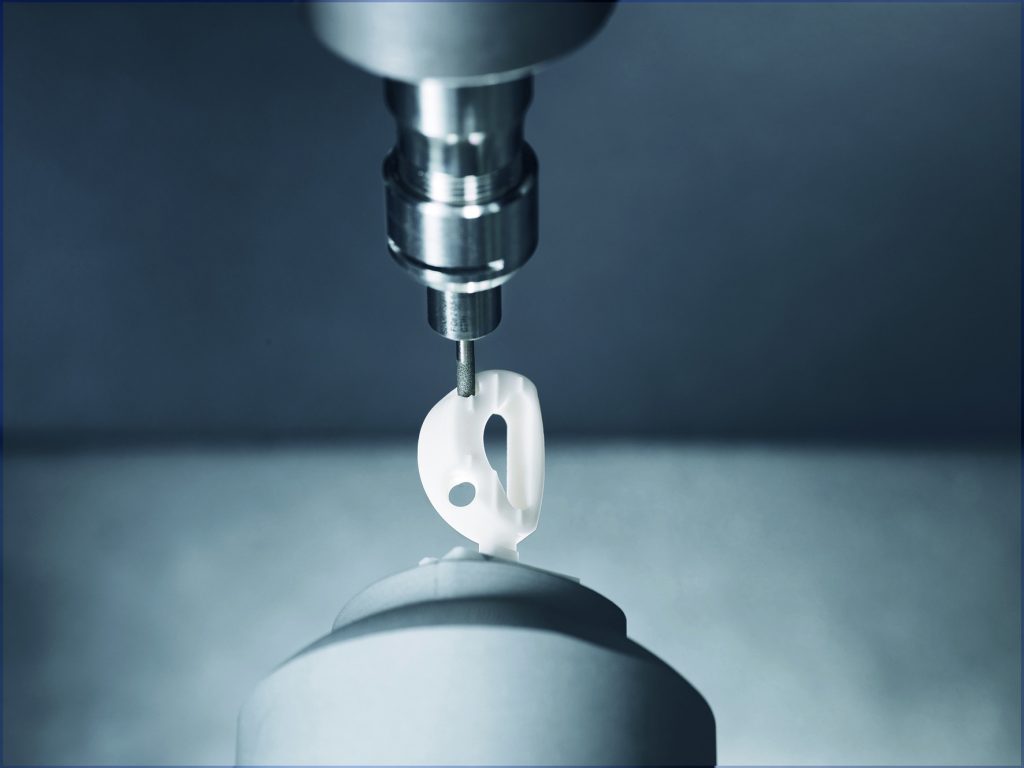
Included with the most important technological innovations of the ULTRASONIC 20 linear are a new, completely digitally controlled ultrasonic generator and the ULTRASONIC actuators with higher capacity and rotational speeds of up to 50,000 rpm. The tool holders with adapted actuator technology can be easily and fully automatically replaced in the milling spindle. Each of these holders is equipped with piezo elements, which are activated via a program-controlled induction system with high frequency between 20 and 50 kHz. The original tool rotation is thus superimposed with additional tool movement with defined amplitude in longitudinal direction. The resulting deflection of the cutting edges or grinding areas is controlled via the NC program and can be in a range of up to 10μm or even higher. During grinding, drilling and milling, these superimposed vibrations have a direct, positive impact on the process forces, the removal volume and the tool service life and thus result in reduced costs and higher productivity.
In detail, the ULTRASONIC technology achieves a higher removal volume, more precise edge processing and up to 40 percent reduced process forces during machining of advanced materials like glass, ceramics, sapphire, hard metal and composite materials as well as carbide. The precision of the workpieces and reliability of the process are increased at the same time. Furthermore, the oscillating interruption of the tool contact with the workpiece results in an improved lubrication and cooling of the cutting edges and the optimum removal of stripped particles from the work area. The outcome is longer service life of the tools and excellent surface quality of up to <0.1 μ for hard-brittle high-performance materials. The ULTRASONIC 20 linear ideally combines high speed cutting with highly efficient ULTRASONIC grinding of advanced materials on a single machine. It enables the machining of an unprecedented range of different materials.
Intelligent ULTRASONIC technology with process-optimized amplitudes
“ULTRASONIC Parameter Detection” of the ULTRASONIC 20 linear ensures automatic detection of the ultrasonic frequency most suitable for the actuator and tool with powerful functions for process monitoring. Another function used for the first time worldwide is the monitoring and tracking as well as of frequency and amplitude during the ongoing machining process. For this purpose, UAT (Ultrasonic Auto Tuning) automatically tracks the frequency response and compensates all exterior influences like the dampening of ultrasonic vibrations by means of the primary process forces. This way, a consistent readjustment to the nominal amplitude or the value specified in the NC program can be achieved. With this, users can fully exhaust their processes and increase tool utilization, reduce cycle times and, particularly by reducing the process forces, achieve even more filigree, precise and high quality machining results.
Included with the most important technological innovations of the ULTRASONIC 20 linear are a new, completely digitally controlled ultrasonic generator and the ULTRASONIC actuators with higher capacity.
Highly dynamic, long-term stable 5-axis machine concept – compact on just 3.5 mÇ footprint
With the ULTRASONIC 20 linear, DMG MORI relies on a long-term stable gantry machine design, to be able to safely meet all demands of ultrasonic machining. Despite this, the machine tool manufacturer was able to reduce the footprint of the machine to only 3.5mÇ. A double drive for the Y-axis and the concept of integrated cooling, which uses the temperature monitoring of drives, spindles and the control as well as all media guarantee highest precision and workpiece quality. The linear measuring systems from MAGNASCALE are a good example for the high-tech components which DMG MORI has used here.
DMG MORI has significantly increased the capacity of the drives for the new development: by 47 percent for the A-axis, 27 percent for the C-axis and 34 percent for the Z-axis. The linear drives achieve maximum acceleration of more than 2 g and provide rapid traverse speeds of up to 40 metres per minute. Due to the large swivel range of the A-axis of the work table, ranging from -15° to 130° and the fully integrated 360° endless rotation axis – both with torque technology, the ULTRASONIC 20 linear is optimally suited to 5-axis simultaneous machining. The rotational speed of 1500 rpm that can optionally be achieved for the C-axis also enables circular milling/circular grinding as well as turning/milling operations.
After the revamp, the ULTRASONIC 20 linear can now be used with larger tool diameters of up to 50mm and an increased maximum workpiece weight from 10kg to 15kg. The basic version of the machine is equipped with a powerful 15 kW motor spindle and a HSK-32 tool holder, the maximum rotational speed is at 42,000 rpm. Higher demands on the rotational speed can be achieved with an optional spindle, which reaches an impressive 60,000 rpm. The range in this segment is rounded off by an HSK-40 spindle with permanent lubrication.
The modular concept of DMG MORI enables a wide-ranging application-specific configuration of the machines – of course this also applies to the ULTRASONIC 20 linear. For example, the machine can be supplied with a 1,500 rpm turning/milling table, which extends complete machining of rotation-symmetric workpieces in a single setup to the operations of milling, turning and grinding. In addition to the tool magazine with 24 pockets and minute wheel, a 60-pocket chain magazine is optionally available.
The option MT for the internal and external cylindrical grinding of the ULTRASONIC 20 linear enables complete machining of rotational-symmetric workpieces with grinding and drilling as well as internal and external machining in a single setup.
Unique integration of technologies
The ULTRASONIC 20 linear with its special features enables the use of ultrasonic support for specific materials, namely the milling and drilling of nickel or titanium super alloys or of materials like magnesium, tungsten as well as composite materials. Process forces have been reduced for milling applications in titanium by up to 30 percent. For steel, double feed speeds are possible, for other materials, like magnesium, the feed speeds can be increased by up to five-fold. In addition, an improved surface quality can be achieved. The ULTRASONIC process has a significant impact on chip breaking behaviour and chip removal from the tool. Further to shorter chips, this also results in drastically reduced tool wear, making the technology interesting for almost all future-oriented target markets with high-tech products. The specific benefits associated with the option of using the ULTRASONIC technology have also taken the flexibility to a new level. It is now possible to machine workpieces from very different materials from soft to hard-brittle, in five axes for mould making, medical technology, the automotive and aerospace industry.
Complete machining of an orthopaedic implant made of HIP zirconium.
ULTRASONIC 20 linear with new design and CELOS
High-quality, long-lasting covers as an external distinguishing feature with functional added value thanks to optimum accessibility are the most important properties of the new standardized DMG MORI design. The ULTRASONIC 20 linear also has this new look, whose impact on value retention must not be underestimated and furthermore, the machines offer CELOS. This user interface with its unique multi-touchscreen can be used as easily as a smartphone. The user friendliness is further increased by CELOS apps which were specifically developed for ultrasonic machining. They visualise the ULTRASONIC technology cycles and the most important process parameters like frequency, amplitude and output power. At the same time, the apps monitor the process forces of the actuators and also support configuration of the tools.
Like veins in the human body, copper cables run through the fuselage of aircrafts.
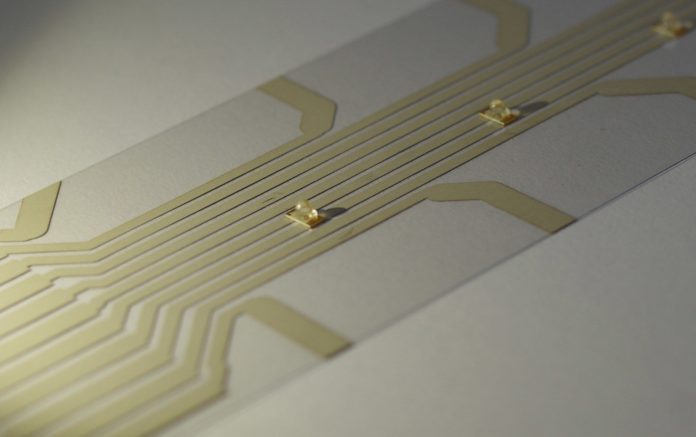
They transmit electrical signals for temperature-measuring sensors, LEDs in ceilings or electronic connections in seats. During their installation, individual cables are combined into harnesses. “The process of producing and installing cable harnesses is currently 100 percent manual. This is very time-consuming and expensive,” says Dr. Ralf Zichner. He is head of the Printed Functionalities department at the Fraunhofer Institute for Electronic Nano Systems ENAS in Chemnitz, Germany and works together with his research team on manufacturing processes that automatically print electrical conductors directly onto aircraft components. The advantages: There is no waste during production, the print templates can be adapted quickly and flexibly, the classic laying of the cable harnesses is eliminated and the aircraft manufacturers save space and weight.
“We use electrically conductive silver ink, which we apply by screen or inkjet printing in layers of only a few microns directly onto lightweight aerospace materials, such as high temperature resistant plastics,” explains Zichner. In addition to the use of printing technologies for the production of printed conductors, the Chemnitz scientists also integrate microcontrollers, diodes, capacitors, resistors and other electronic components into aerospace modules. Ink and printing processes have to be optimally matched to the materials on which the printing is to occur. The Fraunhofer ENAS has extensive expertise regarding these processes, especially in terms of aerospace requirements. The technology is about to be launched. It is currently being optimized in the Fraunhofer Go Beyond 4.0 Lighthouse Project.
An example of aviation-grade plastics are high-temperature resistant thermoplastics. They are an important component of lightweight, stable fiber reinforced plastics (FRP), which are indispensable in the construction of aircraft. Thermoplastics can be reshaped or formed in a specific temperature range; they also cool down quickly after processing and can be processed at a fast pace. In addition, they are impressive due to their good flame resistance and the possibility of functional integration. “In aviation, though, there has previously been a lack of concepts for the cost-effective production of functionally integrated thermoplastic structures,” notes Tobias Joppich of the Polymer Engineering/ Thermoplastics Processing Department at the Fraunhofer Institute for Chemical Technology ICT in Pfinztal, Germany.
Together with partners in the LuFo V-1 program, the research institute has taken an important step towards exploiting the potential of thermoplastics in the construction of aircrafts. Together, they have developed a new component and production concept with modular stiffening elements that is specially adapted to cargo holds. The light-weight construction experts produce these from fiber-reinforced high-temperature thermoplastics in a hybrid molding process, a combination of forming and injection molding processes. The lightweight components are flame retardant, stable, can be automated in large quantities and are easy to assemble. “This allows manufacturers to quickly stiffen interior walls of cargo holds according to a flexible design,“ says Joppich. The stable grid structure is then attached by laser transmission welding to the inner wall of the cargo hold. The new concept can also be applied to other aircraft components, including the body shell, clips or internal components, such as seat structures. Hybrid material combinations can also be realized by the Fraunhofer ICT.
ISCAR is upgrading the SUMOCHAM ICP-2M drilling heads by introducing a revolutionary drilling head geometry that features enhanced centering capabilities, improved surface finish and overall quality of the machined hole.
The new QCP-2M drilling heads are available in 8.0 to 25.9mm diameters, in 0.1mm increments. These new drilling heads ensure a hole tolerance of IT8 and can be mounted on any SUMOCHAM standard drill body with the appropriate pocket size.
The QCP geometry should be regarded as an improved version of the previous generation SUMOCHAM double margin inserts (ICP-2M). The new geometry design features superior self-centering capabilities when compared to the current ICP-2M inserts, by gaining better hole straightness, roundness and surface finish.
The tool is made from IC908 TiAlN PVD nano layer coated grade, ensuring high wear resistance, stable and predictable wear progression and high surface quality. The MQL cooling feature increases efficiency.
Following the 2008 financial crisis, which caused many industrial sectors around the globe to dwindle, South Africa’s manufacturing industry experienced a similar downturn and almost a decade later, its recovery remains a work in progress.
To revive the ailing South African economy, ambitious growth targets have been implemented along with government-led initiatives, such as The Manufacturing Circle’s Map to a million jobs in a decade plan which aim to boost the manufacturing sector. The programme focuses on creating between 800 000 and 1.1 million jobs (with five to eight times as many secondary jobs in the process) and increasing manufacturing’s input of South Africa’s economy by 30%. It’s therefore imperative to understand how recent manufacturing dynamics have changed to introduce policies that are successful in developing new manufacturers.
Professor Joseph Stiglitz, a Noble Prize-winning US economist and professor at Columbia University, recently remarked at the Redi 3X3 Summit: A Strategy for Inclusive Growth and Economic Transformation in South Africa hosted in Cape Town by the Economic Research Southern Africa and the Bureau for Economic Research, that while many countries aspire to drive their economic strategies according to those modelled by the East Asian economies of China, Japan and South Korea, such a scope of achievement cannot be replicated easily unless countries integrate today’s innovations whilst systematically improving the output of their public education sector to achieve this goal.
Next generation technologies such as big data, IoT, machine learning and robotics, also present potential growth opportunities for a nation’s manufacturing sector. Insight into the complex information related to processes, standards, procedures, productivity, schedules and machine performance allows improvements in quality and respective unit output levels.
Notably, not all manufacturing units across an economy share similar patterns however, certain uniform operational data can be collected across a vast number of facilities to identify and trace patterns relating to productivity, cost and compliance with quality standards. This solitary view of all operational data simplifies the challenges associated with managing complex data and supports the automation of manufacturing operations through the development of prescribed standards.
Herein lies the opportunity for experienced data scientists to make a positive contribution to the manufacturing sector by extracting and processing credible and valuable information.
The above-mentioned benefits of machine learning have been observed and recorded in real-world manufacturing scenarios, specifically at one of the largest foundries in the Southern Hemisphere. Here, integration of innovative practices yielded a 0% external scrap rate, thereby contributing towards a R10 million cost saving for the manufacturer every month and eliminating the cost of defects and errors. These savings were reinvested to further increase productivity, thereby enabling the company to tender for projects against some of the world’s most progressive manufacturers.
To rebuild its manufacturing industry, South Africa currently faces two major challenges: Firstly, there’s the task of acquiring machine learning capabilities that are on par with nations having established benchmark manufacturing sectors; and secondly, the upskilling of a high-performance workforce capable of tackling the complexities associated with the development of innovative capacity.
The formulation and employment of a specialized approach favouring skill enhancement over mass job creation is a fundamental step in driving the progress of manufacturing in South Africa. This mechanization of manufacturing support requires significant investment in STEM fields – science, technology, engineering and maths – readily priming workers for the skills necessary to incorporate and execute these exponential technologies.
A new age manufacturing strategy that dually serves the nation’s economic interests as well as works in alignment with the growth of other sectors, should demonstrate how leveraging technology, education and skills appropriately can yield benefits in the long term. To achieve this goal, strong cooperation is required on part of government entities, academic institutions, manufacturing associations, investors and the private sector, all of which share the common objective to develop new and advanced manufacturers across Sub-Saharan Africa.
The Manufacturing Indaba 2018 is hosted with the joint support and strategic partnership of the Department of Trade and Industry (the dti) and the Manufacturing Circle, the industry’s voice. This year’s event will underline the development of new manufacturers by empowering prevalent, innovative technologies with the objective of enhancing the South African manufacturing sector to a level that is relatively competitive with other nations. This discussion will enlighten anyone vested in the manufacturing sector to keep abreast of the rapidly-changing technological realm confronting the industrial sector.
The Coega Development Corporation (CDC) welcomes the appointment of the investment envoy introduced by the President of the Republic of South Africa, Cyril Ramaphosa, in a bid to generate at least $100 billion in new investment over the next five years.
The president’s investment envoy consists of the former Finance Minister Trevor Manuel, former Finance Deputy Minister Mcebisi Jonas, the executive chairperson of Afropulse Group, Phumzile Langeni and the chairman of Liberty Group and former CEO of Standard Bank – Jacques Marie. The envoy will report directly to the president and their work coordinated by the newly appointed economic adviser‚ economist Trudi Makhaya.
“The Coega SEZ as a Foreign Direct Investment destination is looking forward to working closely with the team to ensure that we attract investment to both regional and national economy,” says Dr Ayanda Vilakazi, CDC Unit Head, Marketing, Brand and Communications.
As indicated, the aforementioned group will be travelling to major financial centres in Asia, Middle East, Europe and the Americas to meet with potential investors as well Nairobi, Lagos as well as from Dakar to Cairo. According to Ramaphosa, the investment envoy is part of a broader push by government to advance economic integration in Southern African region and across the world.
“The CDC is enthusiastic about the new venture the investment envoy is taking and strongly encourages economic integration locally and beyond the borders of South Africa especially with emphasis placed on more effective use of industrial incentives and local procurement requirements the CDC has to offer investors,” concludes Dr Vilakazi.