A simple act on May 4th, 1776 of machining a cylinder for a steam engine was the beginning of precision and quality manufacturing and the catalyst that introduced the 1st industrial revolution, or should we say, Industry 1.0.
At the heart of our industry today is the fourth industrial revolution, Industry 4.0 and we are pleased that there is now a national strategy to embrace it.
The Intsimbi Future Production Technologies Initiative (IFPTI) has been developed with the principals that address the 4th Industrial Revolution and encompasses initiatives that will align us with advanced, developed economies.
It is the manufacturers’ function to produce good quality, low cost, affordable products. The future of manufacturing lies in our ability to adapt to the fast changing world and, we need association on the following very important pillars namely, Interaction, Specialised Knowledge, Compliance and Representivity. Now, we have to add a 5th, Inclusivity.
Paul Savides, Chairman MTMA.
This is why, during last year’s Machine Tools Africa exhibition, hosted by the MTMA, the modern era of artificial intelligence, machine learning and robotics played a significant role. Task reducing technologies (AI) are at the forefront in our industry and what was seen as disruptive technology, is now an industry norm with Industry 4.0 being the current trend of automation and data exchange between manufacturing stages and technologies that significantly improve productivity.
At the Machine Tool Merchants Association our members are up to the challenge of facing the increasing demands on the resources of companies. We believe that machine tools are the backbone of all our industries. Now, there are also new technologies that enhance the ability of a machine tool that was designed primarily to do subtractive machining, namely additive manufacturing.
While the manufacturing sector, if funded correctly, could become South Africa’s powerhouse we, at the MTMA, are ready to accept the challenge backed by our suppliers’ vast knowledge and experience in manufacturing, this would undoubtedly boost and develop South Africa’s economic position worldwide.
As we reach the fourth quarter of 2018, it seems we are already significantly down on any growth targets set last year, the knockon effect to the economy, particularly in terms of employment, is devastating. As an association we need to and are facing these many new challenges but the real unknown is certainly the government’s ability to tackle the issues preventing growth in our economy.
Udo Hänle, head of Production Integration and Pilot Plant, “the use of this state-of-theart computer tomography system is a major step forward for us as it will help us to improve the quality of our products even further.
We can now analyse our prototypes in minute detail without having to dismantle them first. The new system allows us to examine our vehicles in a way that wouldn’t be possible with conventional, static computer tomography systems. Ultimately, this will enable us to integrate new technologies into a series vehicles even faster.”
Analysis of internal structures
Michael Koch, head of Material and Process Analysis, adds, “we’ve been using CT and X- ray scans to check vehicle parts for many years, but this latest system takes quality assurance to an entirely new level. We can now analyse our vehicles right down to micro-metre level.”
This degree of detail is required for a range of reasons, for instance to check welds and punch screw connections, and to verify body condition before and after painting, where extreme temperatures can affect adhesive bonds. Findings from the scan are then used as a basis for making targeted modifications to series production.
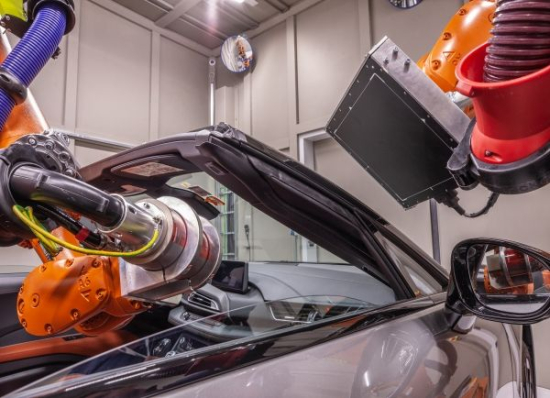
The scan itself is performed by four coordinated robots. Once the vehicle is in position in the system, the robots move around it. Working in pairs, they send X-rays through it and across to their counterparts. The data they collect is then put through a specially developed computer program that calculates a multilayered, three-dimensional image. This forms the basis for a detailed analysis of the internal workings of the vehicle, offering information on objects as small as 100 micro-metres – approximately the width of a human hair.
Engineers are currently carrying out research to establish how far Artificial Intelligence might be used to evaluate findings. By processing large amounts of data, the software can learn the many different patterns that occur, link individual items of data and gradually evaluate findings automatically.
Two years of development work
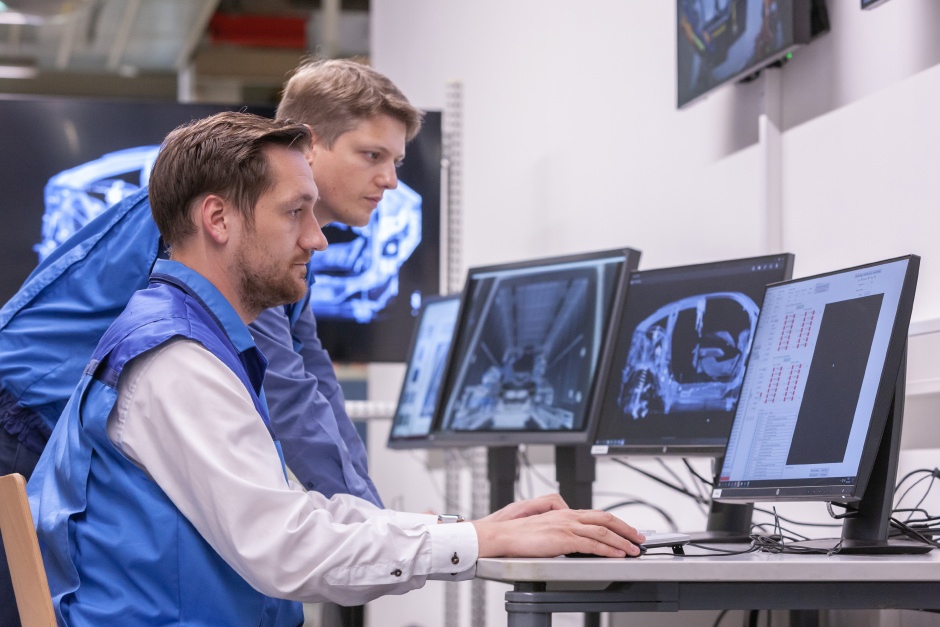
BMW Group engineers and the Fraunhofer Development Centre for X-Ray Technology (EZRT) spent two years developing the new system, which is the only one of its kind in the automotive industry.
Philipp Janello, project manager at the BMW Group, explains: “Working with X-ray specialists and plant engineers, we were able to enhance the software of the test system with the help of comprehensive test measurements carried out on the vehicle body.” The result is a customized system that meets the requirements of the BMW Group.
Around 2,200 exhibitors are expected, well over half of them from outside Germany.
According to the organisers, EMO exhibitors have responded well to the early bird discount, which runs until October 15 this year. “Not only does it provide planning security, it’s also a great offer – especially for companies with large stands,” explained Welcker.
Smart technologies driving production
The theme of EMO Hannover 2019 will be Smart technologies driving tomorrow’s production! This shifts the focus onto the development and implementation of new Industry 4.0 functions. The special IoT in Production show, for example, will be presenting a range of solutions – from individual machines up to cloud-based systems. The theme will also be highlighted in a new area for individual control technology, software and automation technology exhibitors.
Carl Martin Welcker, CEO and President of Alfred H. Schütte GmbH in Cologne, representing EMO Hannover as its General Commissioner.
EMO Hannover – traditionally the largest innovation platform in the industry – will, however, also be showcasing the latest developments in the full range of metalworking machining processes, from additive manufacturing through to metal cutting. “Beyond networking and software-controlled production processes, the industry is still very much about metalworking hardware; workpieces still have to be processed in the conventional way to create an end product. EMO Hannover will also be showcasing the full spectrum of equipment,” explained Welcker. It is aimed at international customers from the entire metalworking and processing industry such as the automotive and parts supply, mechanical and plant engineering, electrical and aerospace industries, plus fields such as medical technology and many others. Hannover will be the hotspot for all of these in September 2019.
In addition to the wide range of exhibitors, EMO Hannover also offers a wealth of special events, forums and conferences staged by EMO organiser VDW (Verein Deutscher Werkzeugmaschinenfabriken –
German Machine Tool Builders’ Association), its business partners and numerous exhibitors. At the last EMO Hannover, the online calendar featured over 600 additional events. The overall programme makes EMO Hannover an important networking and knowledge transfer get-together for production experts from all over the world.
Job shops don’t have the luxury of scrapping multiple parts to refine a program. They need the first part to be a good part, but achieving this goal has become a bigger challenge as designers have increased part complexity to take advantage of expanding machine capabilities.
“Job shops have to keep pace with new control technology to keep scrape rates low,” says Gisbert Ledvon, TNC Business Development Manager, Heidenhain Corporation. “Continuing to use outdated controls for complex parts is like Einstein’s definition of insanity. If you expect different and better results, then explore the new Control and CAD-CAM technologies showcased at IMTS 2018.”
IMTS 2018 – The International Manufacturing Technology Show, which runs from Sept. 10 – 15 at Chicago’s McCormick Place, is the industry’s premier resource for connecting with control and software providers. Visitors can explore technology not only in the Controls & CAD-CAM Pavilion, but also in the Additive Manufacturing, Quality Assurance, Metal Cutting and Fabricating & Lasers Pavilions, as well as HANNOVER MESSE USA.
“CNC controls are an integral part of the digital thread that extends from cutting tools to ERP systems,” observes Peter R. Eelman, Vice President – Exhibitions & Business Development at AMT – The Association For Manufacturing Technology, which owns and produces IMTS. “At IMTS 2016, exhibitors were mostly talking about connected controls. At IMTS 2018, visitors can experience connected manufacturing – from design to part as never before.”
While controls are becoming easier to use, they’re also becoming much more powerful. “The controls graphic interfaces, applications and connectivity have expanded their functionality so operators can make intelligent decisions and take immediate action on the shop floor,” says Eelman. “Attending IMTS provides visitors with a rich opportunity to interact with the digital world of manufacturing and see how these capabilities can improve results in their operation.”
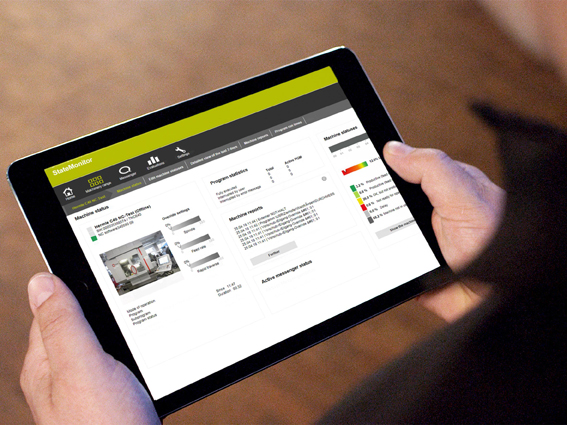
CNC controls are at the hub of the digital thread that extends from cutting tools to ERP systems. Look for a multitude of connectivity demonstration at IMTS 2018, such as those from Heidenhain featuring its State Monitor.
Connected Controls
Being able to load a part file or program into a CNC via the USB port was a good advancement for its time. Now, controls connected to CAD-CAM systems allow the operator to access part files, data and set-up sheets without ever leaving the machine and do so in a secure environment.
Of course, personnel working remotely from the CNC, whether in the engineering or QC department or managers at another facility, also want to capture, analyze and act on CNC-related data. Traditional types of data available from CNC controls includes machine status, current program running, spindle speed, availability, utilization rate and errors. Non-conventional data sources include tooling, workholding and discrete machine parts such as pumps, motors and encoders.
“IMTS visitors will notice that control manufacturers have placed a greater focus on importing more data into the machine control via MTConnect-enabled devices,” says Ledvon. “Correspondingly, they have developed software applications that graphically present information so shop owners can more easily make good decisions.” For flexibility, information can remain strictly within a user’s firewalls, can be accessed via the cloud or accessed from both.
IMTS visitors will also notice that machine controls now enable operators to switch the NC program between the desired functions. This gives job shops the freedom to decide how and when they want to combine machining methods, an important development necessary to keep pace with the expanded functions available from 5-axis mill turns. Other improvements include connecting controls to vision systems that can compare the current image to a reference image and spot any deviation from a perfect setup.
“It functions much like the face recognition feature of your iPhone. If something doesn’t look exactly right, the control will find it,” says Ledvon. Examples include missing hole for the next threading application, broken drill in the part, part not clamped correctly in a vice or on pallet, wrong engraved part number on the part and wrong part on the pallet.
New capabilities of the Heidenhain TNC 640 control include the ability to import a part file, call up a 3D model, zoom and rotate the display using touch screen controls, select portions of the file to modify and have the controls automatically generate new code.
Touch for Continuous Improvement
While machine learning and artificial intelligence may ultimately minimize the need for humans to interact with controls, those developments remain over the horizon. For the coming decades, Heidenhain believes that engaging operators is essential for optimizing the machining process.
As a result, new control capabilities include the ability to import a part file, call up a 3D model, zoom and rotate the display using touch screen controls, select portions of the file to modify and have the controls automatically generate new code.
“If operators discover a missing part feature or need to modify the cutting path to avoid a collision, they can make changes without engineering support,” says Ledvon. “Operators working on second or third shift tell us how they finished a batch of parts on time or minimized the number of bad parts because of new control capabilities. Operators also provide immediate feedback to CAD-CAM and quality control systems.”
Ledvon further notes that those working on smaller production runs need to cut the first part correctly. “New control technology makes cutting more accurate and shops more productive by eliminating sources of waste, such as cutting multiple bad parts in order to fine tune the cutting path,” says Ledvon.
AMT’s Eelman adds that, “the future is now for the connected manufacturing world and coming to IMTS provides the venue for interaction and engagement with the technologies that will shape the future of manufacturing.”
First came smart phones, then intelligent cars and houses. Now, visitors to the Metal Cutting Pavilion at IMTS 2018 – The International Manufacturing Technology Show, can experience the explosive productivity growth possible with smart, connected machining centers.
“The conversations at IMTS have changed from spindle speeds and traverse rates to how to deliver pertinent information so job shops and manufacturers can better manage their assets,” says Marlow Knabach, Executive VP, National Engineering, DMG MORI USA. “To start the conversation, exhibitors in the Metal Cutting Pavilion at IMTS will demonstrate smart machines with the ability to monitor critical elements, such as spindle bearing temperature, spindle vibration, ball screw temperature, coolant level and tool wear to identify potential sources of downtime before they occur.”
“Lean companies need smarter approaches, and connecting with the exhibitors in the Metal Cutting Pavilion at IMTS 2018 will help them develop new strategies for more efficient part manufacturing,” says Peter R. Eelman, Vice President – Exhibitions & Business Development at AMT – The Association For Manufacturing Technology, which owns and produces IMTS.
In addition to connectivity, Eelman says that technology highlights from the Metal Cutting Pavilion exhibitors at IMTS 2018 include more collaboration between CNC and automation providers, more process integration to create multi-tasking machines and more powerful software and user-friendly CNC controls.
Information for Everyone
Achieving overall equipment effectiveness (OEE) rates greater than 80 percent in job shops, is a greater challenge compared to higher volume manufacturing. Traditionally, job shops could not take advantage of software-based systems for automation and process monitoring or Ethernet- based communication protocols because the cost and complexity were too prohibitive.
“Communication protocols and software-based systems process monitoring enable considerable cost and time reductions in total system operation,” says Paul Gray, Ph.D., Manager for Path Planning, Front-end Design and R&D at Hurco. “Smaller job shops and those with high-mix, low volume parts who attend IMTS 2018 will find that the benefits of intelligent machining and automation are within their reach.”
Knabach adds that, “the return on investment for machine monitoring is so pronounced that I would challenge anyone if they could not obtain a return on investment within one year.” ROI happens quickly because monitoring usually reveals an OEE much lower than expected. “Understanding utilization rates, causes of common alarms and premature tool wear and so much more are available with a connection, especially since the growth of devices compliant with the MTConnect standard.” For companies who are not prepared for a cloud-based operation or cannot do so because of industry regulations (e.g., defense contractors), he notes that connected machines, devices and systems can operate entirely behind a company firewall.
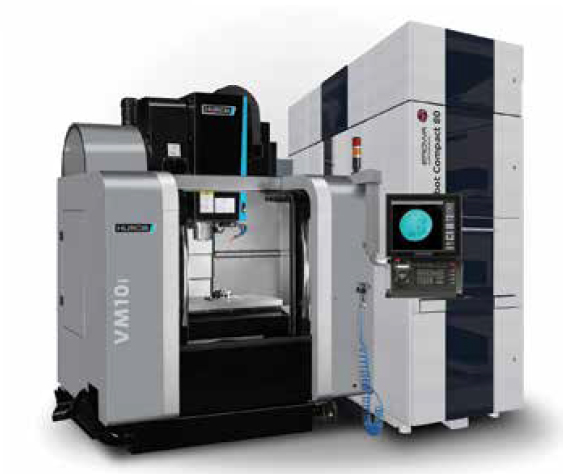
Hurco will showcase a 3-axis machining center in their automation quadrant. The VM10i features a small footprint with a large work cube. No other mill packs as much productivity into such an efficiently designed package. The VM10i offers a maximum load capacity of 1,499 lbs. and will partner with a collaborative robot to create personalized brass coins for booth visitors.
Automation & CNC Integration
In addition to Industry 4.0 machine and device monitoring demonstrations (likely numbering in the hundreds at IMTS 2018), exhibitors will show how enhanced data exchange is essential for intelligent manufacturing. One example would include a CNC, a robot for automated part loading/unloading and a CMM, all connected to create a closed-loop system that automatically updates tool offsets. Easy part change-over is another.
“Automation integration used to be more expensive and difficult because you had simple I/O connections and needed to reprogram a PLC when changing parts,” says Gray. “CNC manufacturers and automation providers have been working together to provide seamless integration between the CNC control and the robot control. With software systems talking with each other over an Ethernet connection, users can now bundle all aspects of the job together. We’ve created a new level of flexibility and simplicity in part change-over in production cells.”
Hurco will demonstrate automation integration as part of its 50th anniversary celebration at IMTS 2018. A collaborative robot will 3D scan visitors’ faces, generate a solid model from that data to create a tool path and then either a 5-axis CNC will cut the head from cylindrical aluminium stock or a 3-axis CNC will cut the form into a brass coin. Both CNCs will be connected to fully automated robot systems that are coordinated by a centralized job management system.
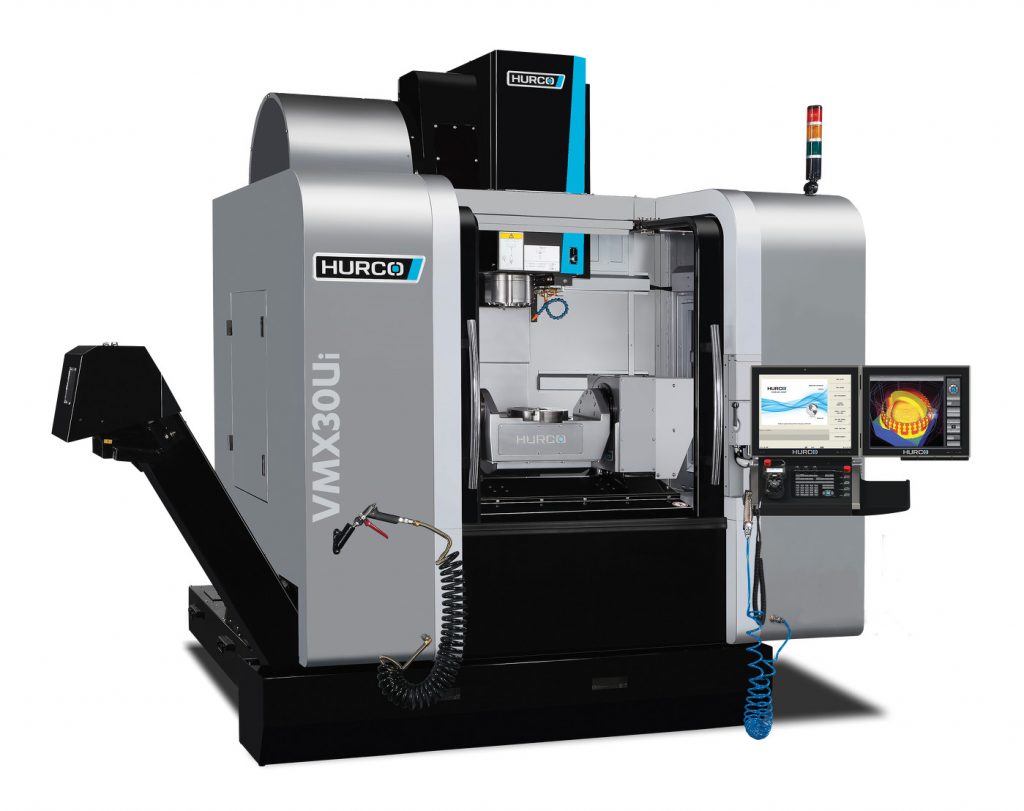
Focusing on automation, a collaborative robot will scan visitors’ faces and generate tool paths for Hurco’s 5-axis VMX30Ui to cut a 3D head from cylindrical aluminum. The VMX30Ui trunnion table machining center will be connected to a fully automated robot coordinated by a centralized job management system.
Process Integration
Like automation, process integration continues to fuel the technology needed to remove manual intervention to drive up OEE rates. Lathes and mills have morphed into a single machine platform, the mill turn.
“Machine manufacturers are now adding more capabilities. Examples to look for at IMTS include 5-axis CNCs that can also gear hob, gear skive and grind,” says Knabach. “By incorporating inspection software and a touch probe, the machine can confirm part profile before removing it from the machine, eliminating the need to re-orient the part if it requires additional processing. By reducing the number of times a part is handled and fixtured, process integration inherently increases part accuracy and improves OEE.”
In the age of digitization, DMG MORI will bring to IMTS the CELOS Ecosystem which includes 26 CELOS apps for tooling, machine configuration and digital interaction in the workshop available. With CELOS, customers receive intuitive, consistent solutions as an integrated basis for paperless digital production.
These multi-tasking machines work well for companies that have limited floor space and for those who don’t need a dedicated gear hobbing/skiving machine, such as R&D or MRO centers and job shops serving the transportation industry.
Controls
CNC and control manufacturers all want to improve the customer experience, and the ways to achieve that are as nearly as diverse as the exhibitors in the Metal Cutting Pavilion. AMT’s Eelman says that, “the manufacturing industry is now being influenced by software experts who bring new perspectives. More commonly, entering G-code is being replaced by importing and editing the digital model, while graphically intensive controls engage younger generations as they enter the workforce.”
“Innovations at IMTS 2018 include solid model import, a technology that directly imports 3D CAD models to the CNC control,” says Gray. “Users don’t have to punch in numbers or scroll through screens. They just click on the parts of the CAD model that they want to cut and solid model import automatically creates the data blocks. It drastically reduces programming time.”
Peter R. Eelman, Vice President – Exhibitions & Business Development at AMT – The Association For Manufacturing Technology, which owns and produces IMTS.
Gray notes that editing part features can now be as simple as selecting the geometry on a touch screen and the corresponding code (NC) or data block (conversational) automatically appears without the user wasting time searching through lines of code to find what they need to edit.
Knabach adds that, “today’s HMIs engage the operator by presenting information that is relevant to the operation of the machine at a specific point and time. Multi-touch monitors feature icons, while a series of apps help operators prepare, optimize and process production jobs – and of course, manufacturers continue to develop new apps.”
Knabach also reinforces Gray’s earlier message, saying, “machine manufacturers now design controls so that they connect with higher-level enterprise and other production systems via standards such as MTConnect. Holistic integration of CNCs into the rest of the organization is now our standard approach so that we can harness the advantages of Industry 4.0.”
Eelman says that staying current with new metal cutting technology has a much broader focus at IMTS 2018. “The CNC still forms the heart of machining, but users that want high utilization rates will evaluate CNCs in the context of a digitally connected production cell that includes automation, CMMs, enterprise systems and other devices. With the Metal Cutting Pavilion and nine other technology pavilions at IMTS 2018, visitors have an unmatched opportunity to evaluate all these new technologies in one place.”
TaeguTec has expanded the Chase2Hepta family series of cutters with new right-handed, neutral and wiper inserts which will cover a wide range of applications and considerably save on cutting loads.
Because of its 14 true cutting edges and double-sided 45 degree entry angle, the Chase2Hepta is an economical solution for a competitive world.
The dual usage inserts can be used on both cutter types a screw type cutter for steel machining and a wedge type cutter for cast iron machining at high feed rates. The new line of inserts’ efficient and smooth machining is due to its optimized cutting edges that lower cutting loads during machining.
The sharp – ML geometries of the new right-handed XNMU 0906 ANTR-ML insert with a full length helical cutting edge is perfect for milling steel under unstable machining conditions such as weak fixtures and clamping, long tool overhang and work pieces with weak cross-sections.
Moreover, this right-handed – ML geometry insert reduces cutting loads by as much as 9 percent compared to the – M geometry while machining alloy steel on a 25 kilowatt, BT50 spindle machine.
While machining a high-tempered alloy steel manifold, the XNHU 0906 ANTR-ML with the versatile TT9080 coating grade increased tool life from 12 to 15 pieces while machining at a cutting speed of 144 meters per minute, a table feed of 360 millimeters per minute and depth of cut of 0.5 millimeters. The case study noted that this insert was ideal for smooth machining and offered a small burr size.
The – ML geometry on the newly introduced Chase2Hepta neutral insert, the XNHU 0906 ANTN-ML, is dedicated to cast iron machining in unstable machining conditions. Its sharp and tight chipformer showed up to 11 percent reduction in cutting loads while machining ductile cast iron as compared to the – MM geometry inserts.
This neutral insert, with its TT6080 grade, helped decrease burr size and more than doubled its tool life while machining a cast iron bracket at 157 meters per minute with a 0.06 millimeter per tooth feed rate and a depth of cut at 0.5 millimeters.
For those looking for superior surface finishing in milling applications, TaeguTec also introduced the XNHU 0906 ANTN-W wiper insert which has two right-handed and two left-handed cutting edges.
As for the current geometries, the XNHU 0906 ANTN-MM handles cast iron and general milling, while the XNMU 0906 ANTR-M is more suitable for steel and general milling. The XNHU 0906 ANTN-CE, with its ceramic grade, is perfect for high speed machining of cast iron roughing.
By expanding the Chase2Hepta family of cutters, TaeguTec offers a greater amount of versatility for machining different types of materials while its 14 cutting edges lowers machining cost, extends tool life and increases productivity.
For more information contact TaeguTec – Tel: 011 362 1500
Walter’s LNHU… indexable inserts with a fully ground circumference have repeatedly proven themselves in various milling applications.
They can be used in F5041, F5141 and F5241 tangential Walter BLAXX shoulder milling cutters as well as porcupine milling cutters and adjustable cartridge cutters and have been gradually developed to become a system insert. Now Walter is adding a new sintered variant which is primarily characterized by its efficiency. The new LNMU… indexable inserts with L55T geometry will initially launch on the market in Tiger·tec® Gold, grade WKP35G and Tiger·tec® Silver, grades WKP25S, WK45S and WKK25.
As with the previous LNHU… ground indexable inserts, the new range has four cutting edges on each circumference-sintered insert, displaying extremely high levels of concentricity and run-out accuracy when used in Walter BLAXX milling cutters. Key features include soft cutting action due to helical cutting edges, high feeds and precise 90° approach angles plus high process reliability and efficiency.
For more information contact Spectra Carbide Tooling Technology – Tel: 086 023 2323
Walter’s Perform line combines increased standards of quality with maximum cost-effectiveness.
These Perform line characteristics will continue with the new ISO turning indexable inserts. The negative indexable inserts with four to eight cutting edges are available in three proven Walter geometries: FV5 (finishing), MV5 (medium machining) and RV5 (roughing). The WPV10 (for: ISO P10/M10/K20) and WPV20 (for: ISO P20/M20/K30) grades are CVD-coated universal grades with extremely high resistance to flank face wear. The inserts fit in all standard ISO turning toolholders in accordance with DIN ISO 1832, which makes them, not only cost-effective but also extremely versatile and easily identifiable by the “V” for “versatile” in the designation.
The coating composition provides maximum tool life at moderate cutting speeds (up to 250 m/min). During turning operations, the cutting parameters are limited, for example, by machines in the medium power range or by a corresponding component design (e.g. imbalance, size, etc.) with the aim to offer the most cost-effective, price-performance ratio for any application. In addition to excellent cost-effectiveness, the Perform line is also designed to offer users maximum reliability, versatility, easy handling and maximum process reliability.
For more information contact Spectra Carbide Tooling Technology – Tel: 086 023 2323
As pre-thread hole drilling is very popular in many industrial tapping applications, ISCAR is upgrading the DCT CHAMDRILL family to include similar drills that carry the more advanced SUMOCHAM drilling heads.
The new DCNT drills have been designed for M8 to M24 ISO M standard pre-thread holes and carry two standard chamfering inserts designated AOMT 060204-45DT IC908, symmetrically mounted so that the cutting forces are balanced for optimal performance.
The AOMT 060204-45DT IC908 chamfering inserts were designed for chamfering on a wide range of materials with optimal chip formation.
The new AOMT 060204-45HD IC908 inserts were designed for chamfering low carbon steel and soft materials.
They can be used on a wide range of workpiece materials and for blind as well as through hole applications, with no vibrations during chamfering due to a balanced drill construction.
SUMOCHAM is capable of using a range of drilling heads on each drill body, which facilitates diametric versatility and offers a substantial advantage for users who change drills for the same tap operation, as the same DCNT drill can be applied for ISO M (coarse pitch thread) and for ISO MF (fine pitch thread).
For more information contact ISCAR South Africa – Tel: 011 997 2700
Users will appreciate its short cutting times, long tool life and intuitive operation. The fully automatic machine is optimized for bimetallic and carbide blades and can be applied in areas such as the steel trade, steel production, forging mills, machine manufacturing and the automotive industry.
Besides helping to reduce tool costs, it significantly increases production speed and efficiency. Depending on the type of blade, cutting times can be reduced by 50 percent and more.
The KASTOwin pro AC 5.6 is designed for a wide range of applications and delivers top performance with both carbide and bimetallic saw blades. An important feature is its innovative feed system, which is controlled by means of two ball screw spindles, each with a servo drive for precise, infinitely variable control. The KASTOwin pro also has a retraction unit on each side for lifting the band from the surface when the saw head moves back. This makes for particularly efficient, exact sawing with minimal tool wear.
The fully automatic machine is optimised for bimetallic and carbide blades and can be applied in areas such as the steel trade, steel production, forging mills, machine manufacturing and the automotive industry.
The KASTOwin pro AC 5.6 is driven by an 11-kilowatt frequency-controlled motor, which provides plenty of capacity for use with carbide blades. The cutting range is 560 millimetres and the smallest dimension to be cut is 25 x 25 millimetres. The shortest residual length is ten millimetres for individual offcuts and 35 millimetres for automatic operation, enabling operators to reduce waste to a minimum. Two electrically driven plastic brushes keep the band free of chips. They are easy to replace and are automatically adjusted throughout their service life. The sawing unit has a heavy, torsionally rigid welded structure with vibration-optimized ribbing, ensuring quiet operation with shorter cutting times and a long tool life.
The KASTOwin pro AC 5.6 also has a powerful coolant pump and a large coolant reservoir so that difficult-to-machine materials can be cut with minimal tool wear. In addition, this fully automatic saw comes with EasyControl, a high-performance control unit. It is easy to use and reduces idle times in automatic operation for maximum cutting performance. All parameters can be optimized to match the type of blade being used.
For more information contact Retecon – Tel: 011 976 8600



 Analysis of internal structures
 Two years of development work