Home Blog Page 90

Every Drill Bit Counts

Currently, factories work on a principle of one size fits all when it comes to replacing or regrinding tools such as drill bits, milling machines or planes after a specified period of time – whether they need it or not. Not only does this unnecessarily increase the time spent on maintenance, it is expensive, too.

In the Cute Machining project, researchers from the Fraunhofer Institute for Microelectronic Circuits and Systems IMS in Duisburg are working on the issue by creating individual tool service records and employing a new communication technology that uses RFID tags. The aim is to optimize productivity, quality, throughput time and inventory in the manufacturing operations of the Industrie 4.0 era.

Machining is a core element of the manufacturing process, whether it’s drilling, milling, turning or planing. Not only the workpiece sheds material, however: these processes also lead to gradual wear on the tool. The decision on when to have a tool replaced or reground depends on its service life. This is far from easy to determine, however, on account of the differing circumstances to which each individual tool is exposed. A tool’s properties are easy enough to calculate, but the impact of machine settings, which are usually left to the employee, has been unquantifiable to date. As a result, a tool’s service life can vary by around 25 percent. In a bid to avoid downtime and damage to workpieces, tools often end up being exchanged too early – and this can push costs up by as much as 50 percent.

RFID tags enable uninterrupted operations

The key to success – and more tool productivity – is to be able to determine each individual tool’s maximum possible service life. This means factoring in a range of parameters, including the nature of the cutting operation, employee settings and the workpiece material. The solution is to create an individual tool service record that details every event in the time a tool has been in service. This data is then fed into a special management tool to create a digital twin of the tool, which lets users determine exactly when a tool must be serviced or replaced. But how to get the data from the tool to the management tool? Manual reading is not an option. Not only would it disrupt operations, but tools are often located in hard-to-access areas. On top of this, the surroundings tend to be highly metallic and therefore disruptive of conventional communication techniques, ruling these out.

In response, researchers at Fraunhofer IMS have developed a new RFID technology. The new transponders operate at a frequency of 5.8 GHz and can be read from up to a meter away even in the tricky metallic environment of a production plant. This allows for effective communication between tools and the management database. Since the RFID transponders take up an area of less than 5mm2, they can be easily installed on tools’ surfaces.

New applications for Industrie 4.0

For companies embracing the era of Industrie 4.0, the technology goes beyond making maximum use of their tools. “A big part of Industrie 4.0 is how it collects data to facilitate a production process as transparent as possible. That’s exactly what we’re doing with this new solution,” says Dr. Gerd vom Bögel, head of the Wireless & Transponder Systems business unit at Fraunhofer IMS. “Of course, the first step is to identify the tool, but as the project continues the sensors could also be used to provide information about a tool’s environment as well as about the tool itself. That’s what makes it possible to monitor processes in real time, make them more transparent and, ultimately, more effective.”

What is more, the technology could also be employed in other areas of Industrie 4.0. One option would be to equip all physical assets, including tools, workpieces, machines or vehicles, with RFID tags – thereby providing even more information. This could then be used to identify further potential for optimization.

In addition to Fraunhofer IMS, the project consortium comprises the technology companies CIMSOURCE and PROMETEC Gesellschaft für Produktions-, Mess- und Automatisierungstechnik, ID4us, the Heinz Nixdorf Institute of the University of Paderborn and the application partner Sandvik Coromant. The Cute Machining project is supported by the German state government of North Rhine- Westphalia and the EU as part of the EFRE-NRW program.

Sawing: Everising P-Series – The Solution To High Speed Cutting, Reduced Cost Per Cut And Full Automation

A specialist in medium to large band saws since 1982, Everising derives its technological innovation from customer requests.

“This is very much in line with the First Cut philosophy of finding niche solutions to customer application requirements in order to provide longterm sustainability and productivity, while at the same time reducing maintenance and downtime,” says First Cut Director Steve Van Wyk.

“Everising bandsaw and circular sawing machines are ISO accredited, and are among the finest in the world, renowned for their extraordinary rigidity and accuracy, while exhibiting the most advanced cutting tool technology,” says Van Wyk.

The P-series CNC machines are equipped with some outstanding features, such as automatic loading tables which support a large number of work pieces. This allows for automatic feeding of bar stock during cutting operations, resulting in continuous output. This range of machines can cut round, square, hollow, tube and flat bar.

The P-series also has a user friendly touch screen, with very clear graphics. All the cutting parameters are represented on the touch screen controller. This includes a self-diagnostic function for on-screen troubleshooting, so that problems can be detected and resolved immediately.

The gear transmission driver provides high efficiency and consistent cutting speed and the carbide guide pads are used to strengthen the rigidity of the saw blades, which means not only accuracy, but the life of the saw blade is extended.

Recently, installing the new and improved P100 at one of First Cut’s customers who required minimum wastage and a faster cutting time was achieved by adding a third vise which resulted in a 15mm remnant piece and an indexing capability of 1000mm.

A new addition to the P-Series family is the unrivaled P230. The new evolved and uniquely adapted P-230B can cut up to an impressive 230mm in diameter. In addition to reliability and affordability, the Everising P-230B Series CNC cutting machine brings a new level of speed and accuracy to the user.

Key features of the P-series include the requirement of only one operator to set and load the machine, with no supervision thereafter, machine sorting of remnant pieces into a separate bin and a space saving potential of +/-60m² if 5-6 bandsaw machines would be replaced. Add to this a milling cutter finish with a tolerance of 0.02mm and the ability to cut a 50mm round bar in 8 seconds.

“With our national footprint, we guarantee fast and reliable deliveries, including installation and thorough training on the range of machines offered. While our highly skilled technicians install, service and maintain all machines offered, our call center is available to assist with machine related queries, booking of services and scheduling maintenance contracts. Last not least we have full spares back up for all our machines” concludes Van Wyk.

This machine is ex-stock, while stocks last.

For more information, contact First Cut – Tel: 011 614 1112

Sawing: High-Performance Circular Saw With Outstanding Automation Potential

Whether in press shops or forging plants, at manufacturers of fittings or electrical parts, at steel stockholders or automotive industry suppliers: in countless industries, there is a demand for sawing solutions that combine high cutting performance with efficiency and precision.

With KASTOspeed C 9, the sawing specialist KASTO has just such a solution in its portfolio. The highperformance automatic circular saw has been specially designed for economic series production and can be integrated in a controlled, end-to-end material flow by means of the KASTOsort robot interface.

The KASTOspeed C 9 is suitable for sawing steel and has a cutting range of up to 90 millimetres for round material and 80 millimetres for square material. The automatic circular saw helps minimize cycle times and makes it possible to produce millions of high precision cut parts every year when operated for two or three shifts per day. Thanks to its outstanding reliability and precision in continuous operation, KASTOspeed is one of the most frequently purchased high-volume circular saws in the world.

The KASTOspeed C 9 uses carbide-tipped saw blades. The optimum positioning of the saw drive, and the four-point workpiece clamping arrangement, enable an extremely short saw stroke. The robust machine construction with helical gearbox, combined with a hydraulically damped measuring stop and a bar pusher that can be moved rapidly into position, permits accurate cutting and very high output.

What is more, the KASTOspeed C 9 offers many different ways of improving efficiency. The KASTOsort robot interface makes it possible to automate upstream and downstream production processes and integrate these in a controlled, end-to-end material flow that includes the sawing operation itself. Industrial robots are able to remove the cut parts automatically and accomplish numerous other tasks, from deburring and chamfering, through centring, tapping, marking and printing and on to sorting, stacking and picking. This robot-saw solution can be further integrated with a container management or driverless transport system.

Depending on the customer’s requirements, KASTO integrates the robot controller into the saw controller, its own KASTOlogic Warehouse Management System or in an existing ERP system. As a result, the user can control and monitor all the processes over a single interface and benefits from a perfectly harmonized process chain. A number of different magazine variants are available to allow large quantities of raw material to be stored upstream of the machine. This means that companies can run the system fully unattended even for long periods when required.

For more information, contact Retecon – Tel: 011 976 8600

Sawing: Precise High-Performance Band Saw Reduces Cutting Times By Up To 50 Percent

The metal sawing and storage technology specialist KASTO has brought out a new high-performance band saw, the KASTOwin pro AC 5.6. Users will appreciate its short cutting times, long tool life and intuitive operation.

The fully automatic machine is optimized for bimetallic and carbide blades and can be applied in areas such as the steel trade, steel production, forging mills, machine manufacturing and the automotive industry. Besides helping to reduce tool costs, it significantly increases production speed and efficiency. Depending on the type of blade, cutting times can be reduced by 50 percent and more.

The KASTOwin pro AC 5.6 is designed for a wide range of applications and delivers top performance with both carbide and bimetallic saw blades. An important feature is its innovative feed system, which is controlled by means of two ball screw spindles, each with a servo drive for precise, infinitely variable control. The KASTOwin pro also has a retraction unit on each side for lifting the band from the surface when the saw head moves back. This makes for particularly efficient, exact sawing with minimal tool wear.

The fully automatic machine is optimised for bimetallic and carbide blades and can be applied in areas such as the steel trade, steel production, forging mills, machine manufacturing and the automotive industry.

The KASTOwin pro AC 5.6 is driven by an 11-kilowatt frequency-controlled motor, which provides plenty of capacity for use with carbide blades. The cutting range is 560 millimetres and the smallest dimension to be cut is 25 x 25 millimetres. The shortest residual length is ten millimetres for individual offcuts and 35 millimetres for automatic operation, enabling operators to reduce waste to a minimum. Two electrically driven plastic brushes keep the band free of chips. They are easy to replace and are automatically adjusted throughout their service life. The sawing unit has a heavy, torsionally rigid welded structure with vibration-optimized ribbing, ensuring quiet operation with shorter cutting times and a long tool life.

The KASTOwin pro AC 5.6 also has a powerful coolant pump and a large coolant reservoir so that difficult-to-machine materials can be cut with minimal tool wear. In addition, this fully automatic saw comes with EasyControl, a high-performance control unit. It is easy to use and reduces idle times in automatic operation for maximum cutting performance. All parameters can be optimized to match the type of blade being used.

For more information, contact Retecon – Tel: 011 976 8600


Sawing: The Specialist For Longitudinal Cutting

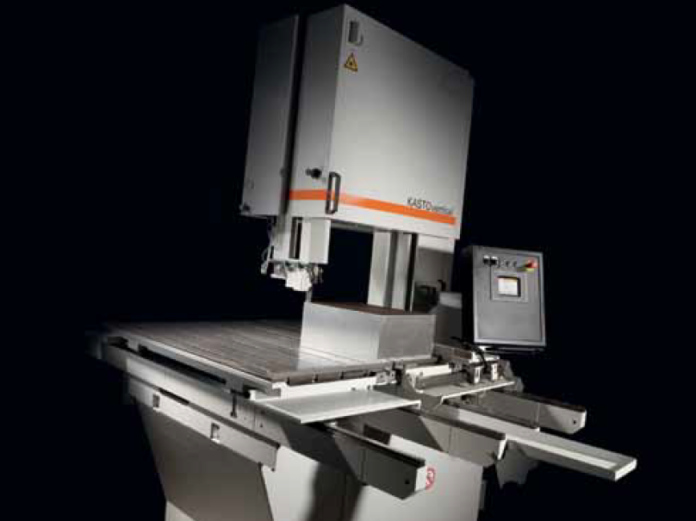
The KASTOvertical semi-automatic vertical band sawing machine is for sawing square or flat materials with different cross sections from small rolled blocks or rolled plates.

The KASTOvertical has a cutting depth of up to 680mm and a cutting height of 600mm. The maximum cutting length is 1,260mm. It can efficiently saw all commonly used materials, including those that are very hard to machine, at a high level of quality. Its robust welded structure ensures quiet operation and precision. The saw has a movable material support table with a height of 1,150mm, allowing fast and safe handling of bulky workpieces with weights of up to two tonnes. In contrast to conventional machines for making longitudinal cuts, which have stationary tables and a moving saw head, the KASTOvertical has a movable material support table.

The saw, which is designed for longitudinal cutting, has a movable material support table that permits fast and safe handling of bulky workpieces with weights of up to two tonnes.

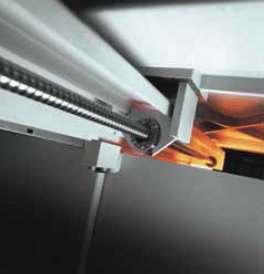
Thanks to this special feature, users can position, align and anchor the material outside the machine’s working area, and these tasks can be done safely, easily and quickly. The table and its guide have a cast-iron structure to cope with the rough conditions encountered in everyday operation. Support rails with T-slots allow quick and secure clamping of workpieces, and they are suitable for a wide range of clamping and fastening devices. Linear guides with zero-play carriages guide the material support table on the machine bed. They are driven by a ball screw spindle with servomotor, which comes as standard.

The KASTOvertical has an amply dimensioned frequency-controlled saw band drive. The cutting speed and saw feed rate are infinitely variable. For this purpose the KASTOvertical is equipped with KASTO BasicControl, an intelligent controller with easy touchscreen operation. A swivel-mounted operating panel allows users to keep their eyes on the workpiece and saw blade from any position.

A durable, low-maintenance ball screw spindle moves the saw with very high precision.

In addition, KASTO offers an extensive range of saw accessories. A wide range of measuring stops are available for aligning blocks and plates. The simplest version is a manually adjustable clamp-on measuring stop. For longer materials there is also a stop bar which extends the entire length of the table and can be adjusted by means of a hand wheel with a digital display. Alternatively, this stop can be moved by means of an electric motor. The KASTOvertical is a powerful, compact sawing machine with outstanding value for money.

For more information, contact Retecon – Tel: 011 976 8600.

Whisperline Anti-Vibration Boring Bars With Exchangeable Turning Heads

The maximum overhang for solid steel boring bars is up to 4 x BD. Machining with a longer length of steel shank (more than 4 x BD) can induce unwelcome vibrations due to the elasticity and characteristics of the steel.

Solid carbide boring bars can limit vibrations on a higher overhang of more than 4 x BD and up to 6 x BD and offer an excellent, highly efficient option for boring applications of up to six times the tool’s machining depth. However, even the use of a solid carbide shank can cause vibrations when machining with high overhangs of more than 6 x BD.

WHISPERLINE anti-vibration boring bars have been designed to significantly reduce and even totally eliminate vibrations when working with a high overhang from 7 x BD to 14 x BD, thanks to a unique damping mechanism inside the tool, consisting of a heavy mass supported by a rubber spring element containing oil to increase the required dampening effect.

In addition, the system contains other elements which help to further reduce vibrations. The reactive damping mechanism comes into action during machining with high overhang work depths and acts as an effective counter to vibrations.

The highly effective, anti-vibration damper effect is applicable for large D.O.C and high feed rates and ensures continuous, efficient machining. ISCAR’s inspired WHISPERLINE anti-vibration tools considerably improve machining stability and enhance insert life. These factors enable meaningful increases in productivity to be achieved, improvements in surface quality on high overhangs to be attained, scrap levels to be reduced and users’ profitability to be enhanced.

WHISPERLINE anti-vibration tools enable the delivery of internal coolant to be supplied directly to where it is required – the insert’s cutting edge. Efficient distribution of coolant increases the insert’s tool life by reducing temperature and also improves chip control and chip evacuation.

The WHISPERLINE boring bars represent a cost-effective, modular system with a wide range of standard shanks and eight different interchangeable boring heads.

For more information, contact ISCAR South Africa – Tel: 011 997 2700.

TDM Powered Skills Development Programme Celebrates Milestone

During the past decade, it became clear that the knowledge economy and 4th Industrial Revolution require a different, more flexibly-skilled worker who can contribute to greater profitability and productivity. It was evident that the skills development programmes should align with the needs of industry to ensure successful employment of workers.

The TDM (Tool, Die and Mouldmaking) Powered Skills Development Programme was initiated as a solution to counter the skills erosion and job losses hampering the TDM sector by addressing the challenges identified. This Programme forms part of a multistakeholder initiative that was established in 2009 under the auspices of the Department of Trade and Industry (the dti) and the Toolmaking Association of South Africa (TASA) to implement a turnaround strategy for South Africa’s distressed tooling industry.

To this end it was decided to introduce a comprehensive articulated skills delivery system in South Africa to provide the basic and advanced skills required by the TDM sector. The intervention is based on the following guiding principles: Dedicated career guidance, assessment and selection processes, specialized student support services, strengthening of students’ entry into the Programme, the new qualification structures, new qualification design principles, capacity building through partnerships, deployment of newly skilled resources and sustainability.

Dirk van Dyk, CEO of NTIP said that the training of sufficient skilled people for the tooling industry is of critical importance as manufacturing is one of the cornerstones of a South African economy, facing serious growth challenges. “South Africa has to build its tooling manufacturing capacity to become globally more competitive if the country wants to create more jobs. The TDM Powered Programme plays a pivotal role in providing sufficient skilled people to the aerospace, automotive, chemical, electronics, leisure, marine, medical, mining and packaging industries,” Van Dyk added.

“The programme is a strategic growth stimulator for manufacturing and technical skills development and is a complement to the South African government’s commitment to eradicate poverty and unemployment,” explained Van Dyk. He added that the accomplishment of these candidates receiving their Occupational Certificates: Toolmaker, will contribute towards adding better workmanship, techniques and high standards of knowledge into the somewhat stale and old-fashioned manufacturing industry.

Van Dyk said that handing out these first Occupational Certificates: Toolmaker is a milestone for the TDM Powered Programme, as manufacturing industry has been waiting for qualified Toolmakers with international standards. This group of new-generation Artisans will bring advanced Toolmaking skills to the manufacturing industry. “Our candidates are innovative and can operate independently. During the TDM Programme, they were encouraged to be aware of and adapt to global manufacturing trends. This group of candidates is playing an important part in our company’s mission to alleviate skills shortage in South Africa,” Van Dyk concluded

From left: Aletta Zikalala (Employment Coordinator NTIP), Allen Sithebe (Toolroom Foreman at WaterTech and one of the speakers at the event), Christie Lennon, Travers Gallent, Keiven Kwinda, Ruan Steenekamp, Marie Oosthuysen (TCOE Coordinator NTIP), Juanay Johnson, Andy Berger (Lecturer), Jan Sephalane Mokwena, Moses Cindi, Matthys Uys (Lecturer) Wele Gcwabe, Sizwe Manana and Sandile Lthuli.

Looking Inside Materials The Smart Way

Just as cars in Germany need to be inspected every two years to ensure they are safe, other safety-critical objects – turbines, generators or high-pressure containers, for example – have to be examined regularly as well.

This is especially important when the materials and products used are pushed to their outermost performance limits in order to increase economic efficiency. To carry out these assessments, inspectors receive a printout map of the factory grounds to help them find their way. Once they locate the structure to be inspected – say, a highpressure container – they inspect it with help from a sensor. The difficulty is that they have to inspect the entire surface. But which parts have they already evaluated with the sensor, and what still needs to be done? Inspectors also have to undergo a lengthy training process and need a great deal of experience in order to reliably gauge the condition of the various objects to be examined. It is hard to find experienced engineers for this.

Recording 100 percent of the data

Support is on the way – the Fraunhofer Institute for Nondestructive Testing IZFP has developed 3D SmartInspect for intelligent inspection and quality control. “With it, inspectors know exactly what has already been measured as well as the results of those measurements. The system also automatically generates a digital protocol,” explains Prof. Bernd Valeske, head of department at IZFP and head of the Fraunhofer Innovation Cluster Automotive Quality Saar AQS. Compared to existing processes, 3D SmartIn-spect is a quantum leap. Even relatively inexperienced inspectors could be employed in the future, and the training process could also be shortened significantly.

In day-to-day work, the process would look like this – inspectors wear augmented reality (AR) glasses, though the system works with a tablet PC or a smartphone too. They view the object to be examined – let’s take the high-pressure container again – through the glasses. As the inspectors run the sensor over the object, the corresponding area on the glasses’ display changes to green while the rest of the container retains its original color. This assures inspectors that they have examined every inch of the object. At the same time, the system constantly verifies that the sensor data has been recorded correctly. “Not only can inspectors be sure that they have collected 100 percent of the data, they also know that the measurements are valid,” says Valeske.

A direct route to the digital age

Once all data has been acquired, inspectors can see the results immediately on their AR glasses. Areas with any kind of a defect – a cavity where it doesn’t belong, or corrosion – appear red on the display. Inspectors can immediately indicate where the repair team needs to intervene, either by using chalk on the actual object or via digital means. Control center experts can also examine all the data as soon as it has been collected – how serious is the detected flaw? Does the repair team need to be called out at once, or can maintenance wait a few days?

Digital testing memory

Generating a test protocol will also be much simpler. Currently, inspectors have to laboriously document their work and then allocate the data to the object measured – a method prone to errors. With 3D-SmartInspect, data is automatically and clearly assigned to the object and writing a protocol is unnecessary. Using the smart assistant sensor systems, engineers can accurately collect the relevant data and capitalize on it in the digital product memory – at every stage of the product lifecycle. “Until now, transferring data to the digital world was not a high priority. In the future, we will have a digital testing memory and can embed data automatically in digital systems. This is a very important step, particularly in the context of Industrie 4.0,” explains Valeske. Digital approaches such as these offer enormous economic advantages because they significantly reduce – if not completely eliminate – downtimes.

An initial prototype of 3D SmartInspect has been completed. Fraunhofer researchers recently presented it at Hannover Messe. For the next step, the researchers are working on transferring the system to AR glasses.

Components With Responsibility

Industrial manufacturing usually follows rigidly programmed processes, in which individual work steps and machines are tightly scheduled.

This makes production inflexible and causes problems if devices fail or unscheduled components need to be processed at short notice. Recently, Fraunhofer developers presented new software that allows each individual component to tell the machine what has to be done. By breaking away from central production planning, factories can achieve unprecedented agility and flexibility, very much in the spirit of Industrie 4.0.

In today’s factories, components such as engine blocks or blanks for a turbine blade are processed in linked processes by multiple machines. The systems turn and mill each component and repeatedly measure it automatically as they do so. A timetable precisely defines the sequence of work steps and the machines and devices required to carry them out. However, such timetables work through the individual steps in rigid sequences. If machines fail or other components have to be prioritized because of customer requests, the manufacturer has to laboriously reschedule production or re-tool the machines. This costs time and money.

The component knows

Everything would go much faster if production and the requisite machines were not rigidly set by a control program, but if every component itself knew the best way for it to be moved quickly through the process chain. This is similar to a car’s navigation system, which is able to calculate the fastest route with the latest real-time data. Impossible? Not at all, as developers at the Fraunhofer Institute for Production Technology IPT in Aachen intend to demonstrate. The institute’s engineers are developing a production system in which every workpiece itself carries the necessary information about concrete manufacturing steps it needs to complete. This is what the engineers call service-oriented architecture for adaptive and connected manufacturing. The basic idea is this – the component behaves like an individual. First, the information outlining which production steps each component should pass through is stored. Here, it is deliberately left open just which machine should carry out a specific processing step. Only once a processing step is pending, the system does choose one of the various machines with suitable capabilities one that is available immediately or, failing that, the soonest available one.

The decisive point is that a record is kept for each production step, detailing what task was carried out and what each component has been put through – Hole drilled with machine parameter A and tool X, edge ground with machine parameter B and tool Y, surface milled with machine parameter C and tool Z. Hence, the software chronicles the manufacturing history of each individual component, creating what is known as a digital twin. The components bear a QR code so that they can be individually recognized.

One-of-a-kind production thanks to digital twins and a smart manufacturing network

The goal is to use the software to create a digital twin for every component. This way, manufacturers will always know how each component was processed, which machine or tool was used and which step is coming up next. This strategy is important for companies, for example, whose production machinery handles batches of different components. In conventional manufacturing setups, it is necessary to repeatedly stop, re-program and re-tool systems when switching to the new product. However, with the serviceoriented approach, it’s the product itself that tells the devices what needs to be done. “By connecting components and machines in the future, companies will be able to successively manufacture one-of-a-kind pieces, in other words even batches of one,” says Michael Kulik, who is helping develop the new software as a project manager at Fraunhofer. To this end, a component’s entire process data should be made available in the form of its digital twin in a smart manufacturing network. Subsequently, data sets can be analyzed and reused, thus increasing process robustness and product quality. Fraunhofer researchers used a small, representative production line to demonstrate the features of the digital twin, the service-oriented software and connection to the smart manufacturing network.

Service-oriented software leads to flexible production

What is unique about the service-oriented software is that the production process sequence can be easily configured using a menu – by means of drag and drop, users select individual work steps from a list of all services derived from the production environment – and ultimately from the manufacturing machines – and add them into the relevant process chain. They then line these work steps up in a row. In case a machine fails, a top-down, centrally controlled manufacturing set-up can – at worst – lead to a full production downtime. With serviceoriented software, this should no longer occur. Since the next step for each component is stored in detail in its digital twin concept, users can flexibly redirect the component to another machine that offers the next work step. “Many machines can fulfill multiple tasks in a production line”, says Kulik. “A technically sophisticated 5-axis milling machine, for example, can also do the job of a simpler 3-axis milling machine.” With central production planning, however, there is usually no provision for such switches, because the whole manufacturing process is set up for defined work steps and machines. “Within the smart manufacturing network, the service-oriented software will have the flexibility to decide whether or not to send the job to the 5-axis machine that is free at that moment.”

Plug and produce

Another important prerequisite for flexible manufacturing is the ability to integrate machines from different manufacturers easily into the smart manufacturing network. Consequently, Fraunhofer IPT is working together with partners from science and industry in the Fraunhofer High Performance Center for Connected, Adaptive Production, focusing on the integration of the various manufacturer systems into a shared superordinate software and data platform. “As of yet, there is no equivalent for the sort of plugand- play approach that we’re so familiar with from everyday technology,” says Dr. Thomas Bobek, coordinator of the Fraunhofer High Performance Center. “Our goal is to pave the way for plug and produce.”

Omron Mobile Robots Ramp Up Efficiency In African Warehouse, Distribution Sector

This has resulted in Omron introducing its first industrial mobile robot product line, the LD platform.

“The fact that this latest technology is now available to the broader African market bears testament as to how highly we regard the opportunities presented by the continent to accelerate its uptake of innovation,” Omron Field Application Engineer Evert Janse van Vuuren comments.

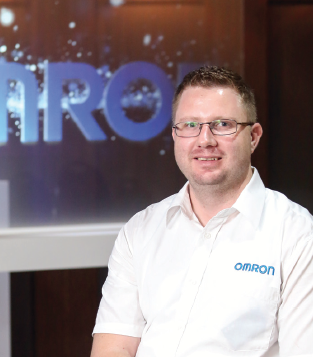
Omron Field Application Engineer Evert Janse van Vuuren

Omron mobile robots provide a new level of efficiency and cost-savings when it comes to moving goods around large facilities. This unique family of mobile robots is developed for rapid and reliable materials transport on a 24/7 basis.

Ideal for conveying goods throughout warehouses, distribution centres and manufacturing facilities, the LD mobile robot platform has a payload capacity of up to 130kg, depending on the model. Compared to traditional Automated Guided Vehicles (AGVs), Omron mobile robots can self-navigate entirely based on the natural features of the facility.

No costly and time-consuming infrastructure modifications are necessary, which means no need for floor magnets, tapes or laser beacons, all typically associated with classic AGV deployment.

“The simpler the technology is to get upand- running, the sooner the end user can start to reap the benefits. This is of particular importance in Africa, where skill levels in terms of automation and robotics are scarce,” Janse van Vuuren highlights.

Flexible factory layouts are now also possible, taking into account space and size constraints in industrial areas. “This is now possible as delivery points can be modified for the mobile robots. Omron mobile robots also complement traditional automation, such as conveyors and provide traceable movement of goods,” Janse van Vuuren adds.

This means that the latest Omron technology can integrate seamlessly with the older systems that are quite prevalent in Africa, where technological development lags mature markets like Europe and the US by a significant margin.

Equipped with patented Acuity technology, Omron mobile robots have a robust selfnavigation system, even where there’s constant movement of people, pallets, carts and forklifts and shelves being emptied and restocked.

On-board intelligence allows them to not only avoid obstacles, but also to choose the best path in order to complete a task. This smart movement also makes them safe to operate alongside people.

A typical fleet can comprise up to 100 vehicles, which can now be managed centrally by fleetmanager software, who can interact with the factory or warehouse management software such as MES (Manufacturing Execution Systems) or WMS (Warehouse Management Systems).

In addition, the LD Cart Transporter is an automated materials-handling solution. It includes an automatic engagement device, and is able to adjust its approach path to engage the cart automatically. This makes it an ideal solution to provide lineside replenishment for assembly line or for e-commerce order fulfilment in any distribution centre in Africa.

For more information, contact Omron Electronics – Tel: (011) 579 2600