
Home Blog Page 81

MEM Industries Well Placed For Positive Development

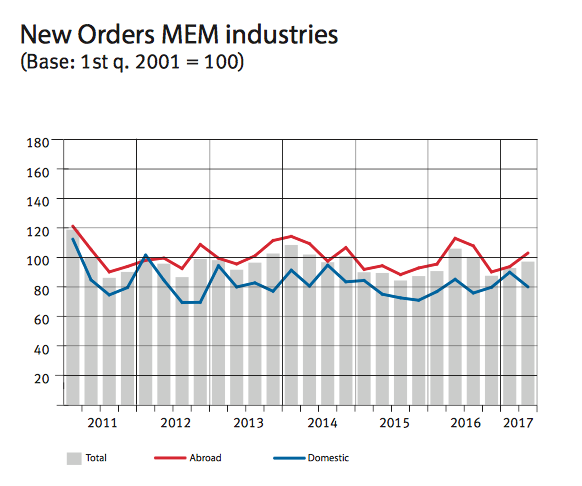
Sales by the Swiss mechanical and electrical engineering industries (MEM industries) performed very positively during the first half of 2017, increasing by 6.2% year-on-year.

A little disappointingly, new orders received fell by 3.4%. Overall, however, the key indicators point to a positive trend for the MEM industries over the coming months, while the purchasing managers’ index for the industry promises robust growth almost worldwide. MEM employers’ business expectations are optimistic. And last but not least, the weakening of the Swiss franc against the euro is generating additional momentum and allowing MEM companies to improve their margins again.

Sales in the Swiss mechanical and electrical engineering industries (MEM industries) rose by 3.3% year-on-year in the second quarter of 2017. For the first half of the year as a whole, sales rose by 6.2%. This is the second-strongest first-half increase in ten years. New orders received fell by 8.3% in the second quarter of 2017 compared with the same period of 2016 after having risen by 2.3% in the first quarter. Overall, order intake in the first half of 2017 fell by 3.4%.

In comparison with the higher sales figure, this trend is a little disappointing. However, order intake in the second quarter of 2016 was so substantial that the current decline can be attributed in large part to this high baseline. The index figure for new orders had reached a comparatively high level at end- June 2017 and now exceeds the previous year’s average.

MEM industries employed 317,300 people in the first quarter of 2017 – 1.0% fewer than in the same period a year ago. The FSO (Federal Statistical Office) employment figures for the second quarter of 2017 are not yet available. Capacity utilization among MEM companies reached 88.0% in the second quarter of 2017, exceeding its long-term average of 86.4%.

According to figures from the Swiss Customs Administration, exports by MEM industries collectively rose by 2.3% year-on-year in the first half of 2017. Total merchandise value was CHF 32.4 billion. Exports grew in all key sales markets. Exports to the USA (+6.8%) and EU (+2.7%) performed particularly well. The growth in exports to Asia was considerably weaker (+0.2%). Looking at individual product segments, metal industry exports rose by 11.0%, electrical and electronics exports by 1.7%, and precision instruments exports by 1.5%. Only in the mechanical engineering segment did exports fall in the first half of the year (-0.3%).
Sales figures have now been improving, in some cases significantly, for three consecutive quarters compared to the respective yearback periods. The majority of indicators are signalling that the positive trend is set to continue in the coming months too. The PMI (Purchasing Managers’ Index) for the industry, a key leading indicator, currently points to robust growth almost worldwide. Swissmem member companies’ expectations are optimistic. According to the latest survey, 51% of companies are anticipating increases in orders from abroad in the next 12 months. Just 8% fear a decline in orders. And last but not least, the latest development in the Swiss franc-euro exchange rate is providing additional momentum.

Should the weakening of the franc prove sustained, margins for MEM industry companies may well finally start to pick up again. For Swissmem President Hans Hess this is pivotal: “the weaker franc is giving MEM companies the chance to finally start earning some money again after ten challenging years, and to invest this in the future.”

To ensure a successful recovery for the MEM industries, the action areas of innovation, digitalization, the labour market, access to markets, growth finance, and training and development will be paramount. Companies should invest primarily in innovation and digitalization so as to boost their competitiveness and Switzerland’s status as a production hub. The Swiss government can support innovation in industry by extending knowledge and technology transfer into businesses still further.

With regard to digitalization, Swissmem expects the government to exercise restraint in its regulation of the digital environment, to invest in cyber security and cyber defence, and to rapidly expand the administration’s portfolio of digital services. Moreover, policymakers need to ensure that the liberal labour market is preserved, and to secure and further extend access to the world markets – as far as possible on a completely non-discriminatory basis.

What’s Driving The Future – Continental Cockpit Vision

Entirely new cockpit designs are also needed for automated driving to succeed if drivers wish to be relaxed and entertained in equal measure in their new environments.

Knowledge of this automotive future is essential for keeping up with the times in delivering developments. With these requirements in mind, Continental used the 2017 IAA in Frankfurt to showcase its vision of the cockpit of the future.

“Numerous innovations in vehicle interiors await us on the path to the automated and fully interconnected future of mobility. Interfaces that can change and seamlessly take on new forms; digital mirrors and large-scale augmentation of the vehicle environment will all be available to drivers in the future,” commented Dr Frank Rabe, head of Continental’s Instrumentation & Driver HMI business unit. “In our Cockpit Vision 2025, we are presenting designs that will revolutionize vehicle interiors before very long,” he added.

Mixed-reality model fuses the present and the future

Using a mixed-reality model, an unremarkable clay shape without any instruments transforms into the cockpit of the future thanks to the use of an augmented-reality headset. In addition to the controls and entertainment elements that this reveals, the vision includes brief, animated scenarios illustrating the innovative solutions.

“As soon as users are immersed in our vision, they find out that the cockpit of the future will adapt smoothly and dynamically to the specific driving situation,” explained Rabe. “During automated driving, for example, certain controls and displays will remain hidden. They will only become visible and accessible when requested, thanks to the changing, intelligent interfaces. “This creates a completely flexible, all-encompassing cockpit.”

For Continental, the Cockpit Vision includes a wide array of functions for comprehensive human-machine interaction that can dynamically and flexibly adapt the vehicle interior to the specific situation. For example, in its mixed-reality demonstrator, the company shows a retractable steering wheel, as well as expanded functions on its screens and augmented-reality head-up displays. Mirror displays replace the traditional exterior mirrors and extend only when required.

With smart control, a special input device is provided for automated driving that clearly and intuitively assists drivers in the transition to the role of users. The device provides information as to whether the vehicle will drive itself or can be driven on the current stretch of road and is used to control vehicle manoeuvres.

Additional highlights include morphing interfaces that can reveal or hide displays as required, for example, or a windshield that can be used as a monitor to show information about certain places in the area or to play films.

Control centre for the cockpit of tomorrow has already been developed

To make the vision a reality, Continental has already developed the necessary hardware, which controls all the vehicle’s input and output devices, plus mobile devices with a single electronic control unit (ECU).

The Integrated Interior Platform (IIP) is an important step toward a comprehensive human-machine interface and links the vehicle cockpit, which acts as a central computer in itself, with the driver and his or her mobile devices, other road users, infrastructure and the cloud. The vehicle is therefore a digital companion and is completely interconnected at all times. The IIP thereby manages to securely and stably operate safety-relevant functions such as instrumentation, as well as cloud-based or infotainment functions, using a single piece of hardware.

By merging hitherto separate domains in the cockpit of the future, not only is Continental laying the groundwork for a fully updatable interior, but the driver can use functions flexibly across all applications, even if these were previously restricted to the instrument cluster or the displays on the centre console. Information that can be positioned anywhere, and the option to move content dynamically, means that there is now nothing standing in the way of personalized cockpits.

To develop Cockpit Vision 2025, Continental took an approach of strategic foresight, looking at the development of trends and the future. This involved initially identifying seven automotive scenarios for the year 2030 that differed in terms of attitudes to vehicle ownership, environmental awareness and price-consciousness within a society, for example.

The next step was for the researchers to determine which scenario was most applicable to each market and to hold workshops in six countries over three continents to generate the most diverse visions possible for the various scenarios. Panels of experts compared the content obtained by these processes with current trends and forecasts by visionary insiders in the industry and added such contributions as trend and technology analyses, country profiles and information on applicable legislation.

“This produced fascinating ideas for new products, services and design elements, all focused on one thing: the driver’s user experience. We are going to be showcasing the promising visions with our Cockpit Vision 2025 study and will now be gradually putting them into practice for real,” Rabe concluded.

South African Manufacturing Gets International Recognition

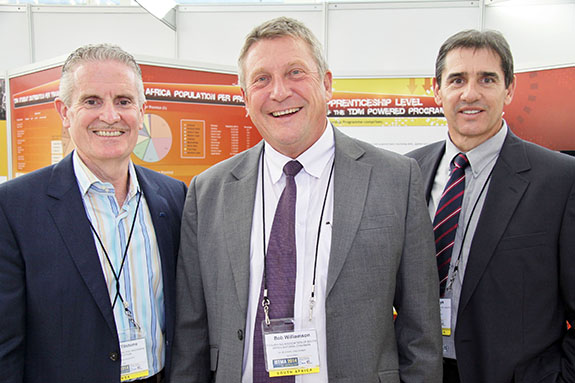
South African manufacturing received international recognition with the election of Bob Williamson as world president of the International Special Tooling and Machining Association (ISTMA) at the Association’s 15th World General Assembly in Brazil.

Williamson, Executive Chairman of the South African National Tooling Initiative was elected as new President of ISTMA World for a three-year term. ISTMA represents associations from 20 countries and serves as the centre of expertise for the worldwide special tooling and precision machining industry, a key support function for global manufacturing. Collectively, ISTMA member associations represent over 8,000 companies with an estimated $70 billion US$ in annual sales. ISTMA World is responsible for the central coordination and organization of all international activities and assists national industry associations and their member companies to achieve business success in the global economy through advocacy, networking, information, programmes and services.

Williamson was instrumental in the establishment of the Intsimbi National Tooling Initiative (NTI) in South Africa. The Intsimbi NTI (a multi-stakeholder initiative introduced by the Toolmaking Association of SA (TASA) and the Department of Trade and Industry (the dti) sought to not only halt the decline of the tooling sector but to embark on a robust rehabilitation programme. The NTI Pilot Programme – 2010 to 2022 was therefore introduced to pilot the advanced manufacturing sector solutions required for skills, enterprise development and transformation of the local direct tooling industry. Direct tooling in South Africa represents a R15 billion market.

Williamson says being elected as the President of ISTMA World is not only an honour and privilege but an acknowledgement by the international tooling industry of the pioneering work done by the South African National Tooling Initiative and the team that pulled it together. “The recognition by our Government and all key industry sectors of the strategic importance of a strong and vibrant tooling industry for the development of a sound manufacturing economy based on talent driven innovation is without doubt the building block that has led to the success of the NTI”.

Williamson points out that the strong focus on Industry 4.0 or the fourth industrial revolution and the new smart factory concept will present new challenges to ISTMA World to maintain and extend its position as the centre of expertise of the worldwide tooling industry. Industry 4.0 represents a confluence of new automation concepts in the production environment and will require the development of the new innovative production technologies sciences associated with Industry 4.0. To enhance its position as a global centre of expertise ISTMA World will over the next three years under Williamson’s leadership focus on an innovative approach to provide its members with an attractive and sustainable value proposition. ISTMA World will strive to develop strong and viable global partnerships and regional clusters and to be the prime source of statistical and technical information regarding the worldwide tooling industry.

The newly elected members of the ISTMA Board of Directors for the period 2017-2020 are President: Bob Williamson (South Africa), Vice-presidents: Christian Dihlmann (Brazil) and Joaquim Menezes (Portugal) and Board Members are David Tilstone (USA) and Markus Heseding (Germany).

New Slitting Cutters With Coolant Channels Carrying Tang-Grip Inserts

ISCAR is expanding the TANGSLIT slitting cutters by adding TGSF-JHP cutters with coolant channels directed to each and every cutting edge and SW/S-JHP driving shanks that can convey the coolant to the cutters.


Coolant channels directed to each and every cutting edge facilitates efficient cooling to prevent built-up edge, substantially prolonging tool life. With very efficient chip disposal, improved surface finish, and advantages for both low (10 bar) and high (340 bar) coolant pressure, the new slitting cutter represents an ideal solution for machining high temperature alloys and stainless steel, offering higher productivity as cutting speed can be raised up to 50%.

The TGSF-JHP cutter features 63-125mm cutter diameter and 3.0 and 4.0 mm slitting widths. The SW/S-JHP shank features 25.0 and 32mm shank diameters and shell holder with 32.0mm adaptation.

For more information, contact ISCAR South Africa – Tel: 011 997 2700

Radan 2017 Heralds Start Of Major Engineering Functionality

This 3D engineering of parts is becoming increasingly important. It will enable manufacturers to break assemblies down from CAD systems, into their constituent components and fully understand everything about them.

Product Manager Olaf Körner says, “we are on the verge of reorganizing how manufacturers will be using Radan in future and important updates to Radmanager in the new edition are the first steps towards this.”

Developers are working on separating Radan into two distinct aspects; first, traditionally creating NC code to drive CNC machines and second, what they call engineering of parts. Radmanager’s strength is that it creates nests without the user necessarily needing to know where the parts come from, what the order numbers are or which customer they are for.

“To achieve this, it relies on the parts being completely ready for nesting,” says Körner. “And that means more than just having flat parts with the right geometry. We need to know as much as possible about the parts – whether they can be cut on any machine tool and the cycle times for all of those solutions. For example, it may be feasible to cut a part on either a laser or water jet, but while it would take only minutes on the laser, it may take two hours on the water jet.

“In Radan 2017, Radmanager’s ability to manage both 2D and 3D engineering of parts is the precursor to the entirely new forthcoming engineering system for any type of parts, including 5-axis laser-cut sheet metal, tubes, flat and bent.”

The forthcoming Radquote, which is now available as a preview will be demonstrated at exhibitions and pilot customer sites ahead of its official launch. Radquote will also rely on engineered parts.

“This 3D engineering of parts is becoming increasingly important. It will enable manufacturers to break assemblies down from CAD systems, into their constituent components, and fully understand everything about them.”

2D CAD files can also be imported automatically into Radmanager now, without the need to convert them.

CAD/CAM Updates

Radan 2017 addresses danger of scrap flying off, sliding under the sheet, or damaging the tools on punching machines, by flagging up where floating scrap will occur. The Automatic Order Style Editor now shows graphically what the program is going to do, enabling users to home in on a particular operation to make changes. This is seen as a major improvement on the previous text-based system.

Still with punch presses, Radan 2017 configures machine tools with all available cutting tools, so that new customers have commonly used tools immediately available.

3D

A side panel was introduced in a previous version of Radan which aids navigation around complex assemblies, but there was still a need to travel between the two. A new facility in Radan 2017 allows the user to stay with the model and to immediately switch between front view, side view, top view etc.

The graphics drawing has been speeded up. As an example, Körner explains that in earlier releases, deleting all screws in an assembly may take a while after they were selected, but now he says the software will always deliver a quick and consistent frame rate. The 3D function also supports modern graphics cards more efficiently, improving performance on tablets.

The process of updating information between Radbend and Radan 3D has now been automated. “A design is analysed in Radbend and then the bend information it provides fed back into the 3D model. This used to be a process that the user performed in a number of steps. Now, once the part has been identified, it’s a simple mouse click to update the information.”

Nesting

Improved algorithms have led to an important enhancement of Radan’s powerful nesting capabilities. “Continuous effort is applied to further strengthen the nesting engine to achieve a better fit and therefore, a potentially better material yield.” With an increasing number of users adopting project nesting, a new reporting engine ensures users can easily customise the content and design of their reports.

It is also easier now to create nest projects, thanks to the new template function. Körner says, “existing project settings can be stored with a given name and recalled at any time. “Even creating nest projects for the same machine tool sometimes required repetitive work, but now everything the user needs will be there, saving quite a number of steps.”

Profiling

Autotooling routines are now more efficient in placing tags, or microjoints, for common cutting, and the foil cutting function has been extended to scrap, ensuring that where sheets are covered with a protective foil for laser cutting, clean cuts can be made for scrap, too.

Radbend

Radbend now highlights where holes are at risk of deforming by being close to bends.

The operator can switch between Design and Result Values. “This is particularly valuable where Radbend shows the end result of a radius, for example, may be different from how it’s designed. Selecting which values gives the user more control over the finished bend, depending on whether it’s vital that they stay with the design values, or if the end result values are acceptable.”

For the first time, the user can now check with different maximum allowed force for the pre-bend and the hemming operation done with same tools.

Improved communication between 3D and 2D parts ensures that Radbend can now link to the 2D flatblanks created by Radan 3D. It also means that with more information going to the flatblank, 2D bends can easily be seen – the tooling and sequence number, as well as the radius, angle and setback.

Radbend now supports the new user interface, Touchpoint TruBend, which combines the advantages of multi-touch technology with industrial control…as all Trumpf pressbrakes will move to this state-of-the-art controller.

Radtube

While Radtube has traditionally been used for simply cutting tubes, it can also program any extruded shape for tube cutters, including I-beams, H-beams and C-beams, along with L-shaped profiles. “Because cutting a round or square tube is completely different from working with more complex beams and profiles, we’ve assisted the user with this by vastly improving automation and support.”

Summing up Radan 2017, Körner says the items of new and enhanced functionality provide immediate improvements for sheet metal manufacturers, while underlining the intention to continue investing heavily in the software.

“Developing Radan to engineer and fully analyse parts in this way is the biggest step forward we’ve ever taken. The future is very exciting, as the level of automation we’ll be able to achieve is phenomenal.”

For more information, contact Stillam CNC Programming – Tel: 011 663 2600

Edgecam 2018 R1 Reduces Regeneration Time

It is this latter update which is seen as being the most important for manufacturers. When a user makes an edit to an existing command, Edgecam 2018 R1 will not automatically regenerate the remaining instructions.

Edgecam Brand Manager John Buehler says when editing a tool command, there will now be no regeneration if the alteration does not affect the corresponding cycles with aspects such as coolant or high-speed.

Two new items of functionality in the Roughing Cycle provide time savings in the milling, turning and MTM environments.

“Detect Undercut Stock enhances the already powerful stock detection command, by analyzing previously undetected areas of stock. This option helps to avoid fresh-air cutting, reducing machining time – in some cases by up to half.”

The game-changing Waveform Roughing Strategy now gives users the ability to determine the radius size when using the helical approach option, by simply entering maximum and minimum values, which will aid the tool’s entry into the component.

Automatic collision detection has been added to the Rough Turning Cycle. In previous versions of the software, it was necessary to manually apply profile extensions to avoid collisions. Buehler says as users no longer have to do it themselves, time will be saved in initially creating the CAM instructions. “An additional benefit is that this new function can be used to produce safer toolpaths in Strategy Manager.”
Edgecam 2018 R1 provides support for Deep Hole Drilling – also known as Gun Drilling. The new strategy empowers the user to control entry, exit and intermediate drilling conditions. “This will be particularly important where specialized Gun Drilling tools are used and the process requires absolutely precise NC code.”

The Profiling cycle used in both milling and turning, now has two new items of functionality. A Spring Cuts field has been added to the Multi Passes tab, which means tool deflection can be removed where necessary, by adding extra neutral passes, known as Spring Passes. This will be used typically when machining hard materials…repeating the profile pass can result in improved accuracy and surface finish.

And secondly, the new Adjust Feedrate on Arc command improves cycle time calculation. In previous editions of Edgecam, the postprocessor adjusted circular interpolation feedrates, which gave correct NC output, but not the best cycle time calculation.

Support for JT Open files is incorporated for the first time. This is a lightweight 3D model format developed by Siemens PLM Software. “As this file format is expected to become increasingly popular, more and more Edgecam users will benefit with the files now being supported in the Solid Machinist for Parasolid license. And there’s also support for AutoCad 2018 DWG/DXF files.”

An Editing Manual Milling function provides for editing a manually created milling feature, instead of having to recreate an entire feature when extra edges are required. This is expected to give considerable time savings to Solid Machinist users.

First released in Edgecam 2017 R2, the Edgecam Inspection module has been significantly enhanced, which Buehler says brings many new features to the software. “Considerable progress has been made with the postprocessor development and NC output, through new Code Wizard options. This includes support for Fanuc macros.

“Users now have full control when editing an Inspection feature, including a calibration technique. They can also determine both feature and properties characteristics.”

In addition, the Move Point function within the Inspection module has two further options: Fixed Axis and Fixed On Surface, giving the ability to align a measurement point along a fixed axis, or a solid face. And the Plane Feature command has been enhanced enabling users to choose to evaluate flatness on more than four probe touches.

Edgecam 2018 R1 continues the evolution of updating cycle dialogs with pictures and context-sensitive help, by updating the B-Axis Contouring Cycle and 3- and 5- Axis cycles. This not only assists experienced users to easily interpret an infrequently used command, but also helps less familiar users to rapidly understand fundamental functionality.

Another new feature that delivers significant time savings is the Pass Boundary To Cycles function, in the Feature Properties window. An improved toolpath is generated when the user engages Current Stock and picks a solid feature. Rather than use the stock limits, which can sometimes lead to unwanted passes, the toolpath is now clipped back to the feature’s natural boundary … particularly useful when creating automatic toolpaths in Strategy Manager.

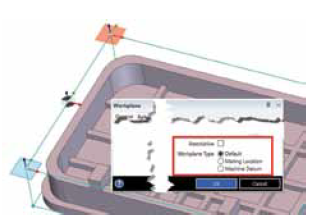
Buehler says the new release includes several user experience enhancements, one of which is the improved visibility and consistency of the Datum Workplane marker. “The new datum is more prominent and will change appearance to signify its usage – default, mating location, or machine datum. This is particularly useful when working with multiple component parts, on tombstones and multi-face machining.”

Finally, additional functionality has been added to the B-Axis Contouring Cycle, which was introduced in the 2017 R2 edition. “Maximum Angular Increment will improve the surface finish by refining the NC output, while machining complex turned profiles,” concludes Buehler.

For more information, contact Stillam CNC Programming – Tel: 011 663 2600

MV-R Connect Wire-Cutting Machines With New Generation Control

A new option that displays the output of numeric values as easy-to-read graphics – much like in an aircraft’s cockpit – is now available.

Hans-Jürgen Pelzers, sales manager Europe, explains, “operation has to be simple, quick and flexible so that the user is able to achieve precise results with little effort – even when working to the highest standards.” The new manual control box of the MV-R Connect features a bright, user-configurable display and is equipped with all the important functions. With a freely rotating and pivoting 48cm multi-touch display, the operator can comfortably make settings according to his needs.

Thanks to the built-in cost and performance monitor, the operator can analyse machine profitability and uncover reserves to optimise processes and boost efficiency at all times. Diagrams depict operating costs and output. All operating material statuses and maintenance cycles can be called up at a touch – and if desired, read out. The machine comes with a network connection, USB, FTP, DNC and open data interfaces, and can be linked up to existing production planning and analysis systems.

In tune with the anticipated future requirements of Industry 4.0, the abundance of processable data available with these machines ensures transparency throughout the production stages. Intel Security is pre-integrated to provide security. Product Manager Stephan Barg says, “transparent production is now possible and is proving to be appreciably more profitable and cheaper with the MV-R Connect series.”

The newly designed job planner makes it possible to simply bring forward urgent jobs, with automatic saving of the parameters of the interrupted jobs; meaning work can be resumed later on, immediately from the point of interruption. Countering the shortage of skilled labour, the control guides less experienced users through the cutting process step-by-step and thereby teaches them the points to bear in mind while they are working.

Expert mode takes a more direct approach, and the flexible configurability of the control interface makes it possible to attune the machine entirely to typical applications and the operator’s personal focus. The MV1200R Connect and MV2400R Connect premiered at EMO in September 2017 and are expected to be available from November.


For more information, contact WD Hearn – Tel: 021 534 5351

AgieCharmilles Cut E 350/600 Wire-Cutting EDM Machines


Solutions to advance customers’ performance and productivity, secure their processes and accelerate their time to market are engineered into GF Machining Solutions’ AgieCharmilles CUT E 350/600 wire-cutting EDM machines.

Driving the machines’ accuracy and efficiency are onboard collision protection, new builtin machining strategies and flexible job management, within an easy-to-use humanmachine interface (HMI). The machines’ ergonomics and improved design minimize their workshop space requirements, and their high rigidity allows accurate cutting of large and heavy parts. Their compact, spacesaving layout ensures efficient workshop integration, and the drop door system allows easy, convenient access to the working zone.

The CUT E 350/600 machines boast a reliable wire circuit system for perfect unrolling that does not disrupt the EDM process during machining. The filters, positioned side by side, make maintenance fast and easy, and ease of use is also a factor in the remote control, designed for one-handed use – a real help in fine tuning workpiece preparation.

Integrated glass scales preserve long-term, repeatable accuracy, require no recalibration, and eliminate classical screw system errors related to backlash and wear. A large, 25kg spool is available to extend running hours and allow continuous production.

The machines’ AC CUT human-machine interface features powerful job management. Information about geometries, machining processes and command programs are processed in one file, so jobs can be transferred between CUT E series machines and all modifications are managed automatically. More than 10 automated measurement cycles are available to ease workpiece preparation, and with standard, onboard AC CAM Easy, the operator can prepare an ISO file and post-process it into a job during machining.

Efficient production is at the heart of the modern Intelligent Power Generator (IPG). Its integrated technologies boost cutting speed, precision and surface quality. The CUT E series machines can use dedicated wire for decreased part costs and increased turnover, and the POWER-EXPERT module decides the optimal power to send in the wire – especially efficient for stepped parts. The corner strategy module automatically adjusts parameters during change of direction to produce sharp angles and small radii. Integrated speed dedicated processes can reduce cutting time up to 18 percent compared to standard machines, and the CUT E series demonstrates its versatility by offering cone cutting capability up to 30 degrees over 45 mm.

The Intelligent Collision Protection (ICP) on the X, Y and Z axes eliminates costly collision-related downtime and protects your machine and workpieces, so your machine operators can work with confidence. Unique on the market and arising from GF Machining Solutions legacy of more than 60 years of EDM expertise, ICP detects even the slightest abnormal forces and halts X, Y or Z axis movement in order o avoid collisions and the costs and damages than can follow a collision. At the same time, the machines’ ThermoCut module provides for successful, efficient threading by preparing the wire properly before threading.

For more information, contact Retecon – Tel: 011 976 8600

Studer – Experts In Internal And Radius Grinding

New market segment opened up

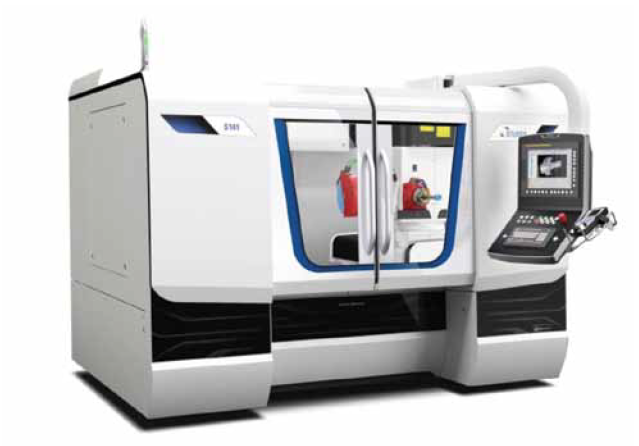
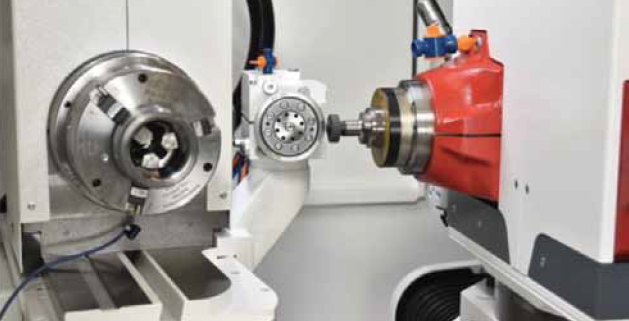
In the past, this range of parts was successfully covered by STUDER universal internal cylindrical grinding machines CT750 and CT960. With its market entry, the new S121 radius grinding machine will now take over the range of applications of the CT750, while the S131 has been designed for the previous component range of the CT960. New with the S141 radius grinding machine is that the machining of larger work pieces is also now possible. For the user, this means in figures – the swing diameter above table is 250mm for the S121, 300mm for the S131 and 400mm for the S141. External diameters up to 160mm can now be machined with an external grinding wheel 250mm in diameter. The maximum length of parts including clamping device is 300mm for all three radius grinding machines, and the maximum work piece weight including clamping device is 100kg.

There are good reasons why STUDER is replacing the successful CT models, which translate into increased customer benefit. First and foremost, a higher level of technology has been achieved with the new radius grinding machines. This is evident in the machine bed, which now comprises of Granitan® and thus offers higher dampening levels, thermal stability and guidance accuracy. It is also reflected in the StuderGuide® guideway and drive system with linear motors, which features high wear resistance, a long working life and high dynamics (interpolation possibility).

The main benefit which customers can derive from the new machines is the extended range of parts possible due to the larger size of the machine, and the new dressing concept which, thanks to the new arrangement on the B-axis (simultaneously swiveling work piece table) is not only simpler, but also offers greater thermal stability and mechanical rigidity. The fact that the new S121, S131 and S141 are now also manufactured according to the Thun modular principle also means non-variable parts in maintenance and service and consequently a higher availability of service technicians. It also means harmonization of the components and with the new design and improved ergonomics, an increase in the machine’s value.

The S141 radius internal cylindrical grinding machine for larger work pieces has a swing diameter of 400mm and grinds work pieces up to 300mm.

Powerful software

Special mention should be made of the StuderSIM software in regard to the new radius grinding machines. With this software, STUDER answers the question of what an operator needs in order to be able to machine complex parts – often in a single clamping. The answer – an assistant, with which work pieces – derived from a drawing – can be completely defined, all necessary geometric data for the grinding cycles can be generated and with which the grinding process can be checked and visualized by means of simulation on a PC or on the machine; StuderSIM is this powerful assistant. It is complemented by hardware which features the previously mentioned Granitan® machine bed and the StuderGuide® guideway and drive system with linear motors. It also includes X and Z-axes in a cross-slide arrangement as well as a cross slide, which in the case of the S121 can either take one spindle, two spindles in parallel or two spindles on a hydraulic turret and in the case of the S131 and S141 comes with a 4-position turret with direct drive.

The machines are also equipped with a work-head on a simultaneously swiveling B-axis, a dressing spindle or a fixed dresser on the B-axis and a measuring probe on the grinding head. Other new features are, finally, the enclosure and the control console in the STUDER design.

The S121, S131 and S141 radius grinding machines differ from the universal cylindrical grinding machines of the same name in a number of technical details. The B-axes of the radius grinding machines are set up simultaneously and offer interpolation (from -60° to +90°), while the universal cylindrical grinding machines have a swiveling table, which can be positioned from -10° to +20°. In addition, the spindles on the radius grinding machines are arranged at the rear of the turret, while this is the other way round on the cylindrical grinding machines – they are at the front. There are also differences in the dressing concept. The radius grinding machines have the dresser on the B-axis, while the cylindrical grinding machines are equipped with two swivelling dressers. Last but not least, the S121 to S151 cylindrical grinding machines use the STUDER operating system StuderWIN, while the new radius grinding machines use the StuderSIM operating system.

Platform is complete and rounded

With the market entry of the S121, S131 and S141 radius grinding machines, the platform of STUDER internal cylindrical grinding machines is now complete and rounded. In addition to the new radius grinding machines, the platform includes the simple S110 and S120 machines, the S121 to S151 universal internal grinding machines and the S122 production internal grinding machine. Five machines have been replaced (S120, S145, S151, CT700, CT900), enabling four new market segments to be opened up. The S121 universal internal grinding machines are small machines for a large application range, the S122 production internal grinding machine is a machine for large component output and high availability and the S141 and S151 universal internal grinding machines (700 and 1300mm) are machines for long work pieces. Finally, a fourth market segment is opened up with the new S141 radius grinding machine for parts up to 400mm in diameter.


For more information, contact Retecon – Tel: 011 976 8600

Makino Updates MMC2 Automated Pallet-Handling System

New design configuration enables up to 95 percent machine utilization rates in 5-axis machining applications

Automation is essential in helping manufacturers achieve maximum return on investment (ROI) from their machine tools. Makino is pleased to share the availability of a new design configuration for its popular MMC2 automated pallet-handling system which enables full compatibility with the company’s uniquely designed a61nx-5E 5-axis horizontal machining center. Together, these technologies offer a powerhouse combination of processing speed and flexibility, giving aerospace manufacturers more control over their workflow and the ability to adapt quickly to customers’ just-in-time needs for complex, multi-dimension part applications.

The updated MMC2 retains the same modular design and capabilities of its predecessors, but with a new pallet-transfer interface on the system’s rail-guided vehicle (RGV). This interface can handle the unique pallet designs used on the a61nx-5E. As a result, manufacturers are able to achieve spindle utilization rates upwards of 95 percent to further maximize the value of their a61nx- 5E investment.

“Based on feedback from current a61nx- 5E owners, we’d come to realize that the machine’s productive capabilities were so high that most operators were struggling to keep their machines fed with raw materials,” said David Ward, product marketing manager at Makino. “While we see this as a good problem to have, it is still an issue that we wanted to address. By providing this optional pallet interface on the MMC2, we’re able to help manufacturers keep up with the productivity rates of the a61nx-5E to get the most value out of their investments.”

Capacity for Future Business Development

The MMC2 is designed to accommodate up to 15 machining centers and four worksetting stations into a single system. Each system can hold up to 200 pallet stockers – stacked either one, two or three layers high – with a virtually unlimited variety of parts and fixtures.

The system’s RGV is supported by a floor rail and upper-guide rail for enhanced stability and simultaneous, high-speed movement. The system’s work-setting stations (WSS) provide easy access for operators to load and unload parts either by hand or crane. Each WSS has 180-degree pivoting doors to save space and prevent a cluttered work area. The MMC2 can be equipped with optional workpiece washing guns.

Users of the MMC2 frequently report spindle utilization rate improvements of up to 95 percent, leading to dramatic increases in production without adding staff or equipment. The MMC2 system permits users to virtually eliminate part setup time, reducing non-valueadded time in their machining operations. By providing a continual flow of parts to the a61nx-5E, the system can run for extended periods unattended, including over nights and weekends.

Flexible Scheduling and Cell Management

The updated MMC2 retains the same Microsoft Windows-based MAS-A5 control software, which helps maximize production output while monitoring multi-machine production requirements. The MAS-A5 main PC hard drive stores and manages all NC programs for optimum machine utilization, including NC programs that exceed CNC memory. With these storage capabilities, there is practically no limit to the number of fixtures and associated process sequences and offsets that can be logically assigned to an individual pallet.

Tool data, both in and out of the a61nx-5E machines, can be accessed and modified from the MAS-A5 user interface. A variety of file formats for tooling and part information are supported and can be displayed to assist with part loading/unloading and tool-setting operations. The Tool-Life Predict function enables the MAS-A5 to gather tool-life data per NC program. When a request is opened, this function informs the operator of how long a tool is used in each NC program execution, as well as how many spare tools per machine are required to finish any work that is currently loaded or awaiting processing at the time that the request was placed. The MAS-A5 then schedules work only for the machines that meet tool-life and availability requirements for the desired process sequence. Interfacing with a tool presetter also reduces errors by automatically capturing tool-offset data, which can be transferred from the presetter to the MAS-A5 system control.

Standard control features include in-cell production scheduling, equipment status monitoring, NC program management and on-board reporting. These capabilities enable the MMC2 to assign work and initiate operations automatically, based on machine and material availability, using maximum spindle capabilities and monitoring all automated procedures.

For more information, contact Rothco – Tel: 011 970 1930