Daimler recently announced plans to build a Research and Development Tech Center China with a total investment of over 1.1 billion RMB (approximately 145 million EUR). This marks the further expansion of the company’s footprint in its single largest market and will be its second major R&D site in Beijing, following the Mercedes-Benz R&D Center established in 2014.
Located on the premises of the local production hub Beijing Benz Automotive Co. Ltd. (BBAC), the R&D Tech Center will allow Daimler to accelerate the localization of new Mercedes-Benz products in China. Scheduled to start operations in 2020, the R&D Tech Center’s proximity to the production hub will enable the integrated campus concept of local production with R&D, through the existing pilot plant, test track and test benches at BBAC, together and new test labs and workshops at the R&D Tech Center for testing in new energy vehicle technology, powertrain and chassis, emissions and invehicle air quality.
Covering a gross floor area of 55,000 m2, the Daimler R&D Tech Center China will consist of a test building and an office building. The office building with a canteen and social areas will be capable of accommodating up to 600 employees, while the two-story test building will include a warehouse and parking area for 250 test vehicles. It will house a widearray of cutting-edge test facilities for overall vehicle and component testing, ranging from electric drive and charging, powertrain, chassis, in-vehicle air quality, emission to noise, vibration and harshness (NVH), as well as a consolidated workshop for all functions including overall vehicle and endurance testing. New test labs will have the capacity to carry out a wide-range of basic to complex tests, such as system calibration, durability and thermodynamics. The facilities will incorporate road simulators and climate simulation, making testing as accurate and as optimized as possible.
Pioneering digital technology company ABB recently announced a major, new US$150 million investment in Shanghai, China to build the world’s most advanced, automated and flexible robotics factory – a cutting-edge center where robots make robots.
The new Kangqiao manufacturing center, near ABB’s expansive China robotics campus, will combine the company’s connected digital technologies, including ABB AbilityTM solutions, state-of-the-art collaborative robotics and innovative artificial intelligence research to create the most sophisticated and environmentally sustainable factory of the future. It is expected to begin operating by the end of 2020.
The announcement marks a significant milestone for ABB as China’s #1 robotics manufacturer as well as a critical global growth investment for the company in the world’s largest robotics market. In 2017, one of every three robots sold in the world went to China, which purchased nearly 138,000 units. Today, ABB employs approximately 5,000 people in Shanghai and the company’s robotics businesses in China employ more than 2,000 engineers, technology experts and operational leaders in 20 locations across the country. ABB has invested more than US$2.4 billion in China since 1992, with over 18,000 employees in total.
The new Shanghai factory will feature a number of machine learning, digital and collaborative solutions to make it the most advanced, automated and flexible factory in the robotics industry, and an onsite R&D center will help accelerate innovations in artificial intelligence. Using a new, global design approach that ABB announced earlier this year, the factory will be able to dramatically increase both the breadth (type of robots) and depth (variants of each type) of robots that can be made onsite, allowing greater and faster customization to meet the needs of customers.
The entire Shanghai factory will be modelled as a digital twin, which will provide intuitively tailored dashboards for management, engineers, operators and maintenance experts to make the best decisions. This includes gathering and analyzing intelligence through ABB AbilityTM Connected Services on the health and performance of ABB robots in the factory to ensure early identification of potential anomalies. In addition to avoiding costly downtime, ABB AbilityTM offers advanced digital solutions that can improve performance, reliability and energy usage, as well as providing access to the world’s best platforms, such as the Microsoft Azure enterprise cloud, which is the first international public cloud service operated in China.
The new factory will have an innovative, flexible floorplan based on interlinked islands of automation rather than fixed assembly lines. ABB logistics automation solutions will be used throughout the plant, including automatic guided vehicles that can autonomously follow robots as they move through production, supplying them with parts from localized stations. This will allow production to adapt and scale efficiently to changes in China’s robot market without additional capacity expansions.
To aid the move to mass customization in manufacturing and to ensure the highest levels of productivity and flexibility, the new Shanghai factory will make extensive use of ABB’s SafeMove2 software, which allows people and robots to work safely in close proximity. In addition, ABB’s YuMi robots will allow close collaboration on many of the small parts assembly tasks needed to manufacture an ABB robot.
Another example is TANG4FEED, a family of fast feed shell mills carrying tangentially clamped rhombic inserts (Pic. 2). The mills are designed mostly for rough machining medium- and large-size cavities and pockets.
The tangential clamping principle, combined with a dovetail profile of matching surfaces for secure insert mounting, ensures a durable mill structure. The insert’s rhombic shape significantly improves mill performance in rampingdown and side-plunging operations. The TANG4FEED inserts are double-sided, resulting in 4 cutting edges.
The inserts of both mentioned families are provided in several cutting geometries for optimal milling of different engineering materials.
The variety of HFM tool family options inevitably raises the question how to choose the most suitable tool. In addition to ISCAR’s ITA (Iscar Tool Advisor) software, the company developed a quick tool selector guide, a compass for manufacturers to find the most effective solution for fast feed milling.
The case of ISCAR’s HFM line is good evidence that developing FF milling cutters is still far from its high point. The newly introduced tool families offer logical answers to real manufacturer demands. HFM, as a productive method of rough machining, has optimistic prospects and the metalworking industry will continue to require faster and faster milling cutters for high metal removal rates.
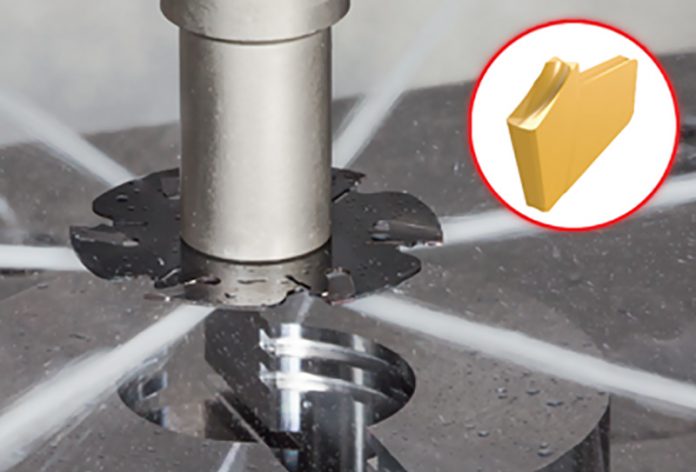
ISCAR is expanding its parting line by adding LOGIQ-5-GRIP pentagonal adapters with 5 pockets for TAG 2 and 3mm widths.
A new family of tools and economical 5 pocket adapters for existing TANG-GRIP inserts in sizes of 2 and 3mm, the adapters allow parting applications of bar diameters up to Ø45.
LOGIQ-5-GRIP features include no setup time after pocket replacement. The back of the adapters is designed with V shape geometry (wedge effect) to ensure maximum clamping forces and tool stability and several adapters can be clamped on one holder. The tools and adapters are designed for JET-CUT cooling up to 340 bar.
For more information, please contact ISCAR South Africa – Tel: 011 997-2700
A piece of integral technology able to advance productivity is AMADA’s innovative ATC (automatic tool changer). The HGATC is the company’s flagship press brake and is unique in the marketplace.
ATC technology facilitates the automatic locating and precise loading of punch and die profiles using an independent four-axis tool manipulator, delivering dramatic time gains. In fact, using a clever algorithm to guarantee the best set-up time means the HG-ATC can load even the most complex tool layout within just 3 minutes.
HG-ATC press brakes can be equipped with AMADA SF75 sheet followers. These handy devices, which fit to the front of the machine, make it easier to handle large, heavy parts, which perhaps would have previously required two operators. As a result, labour costs can be immediately halved.
Of course, most people associate automation with robotics, and here AMADA’s latest offering is the HG-ARs. This robotized bending cell, which is equipped with the AC-300 automatic pallet changer and ATC, perfectly illustrates all the productivity and flexibility gains that can be achieved using the latest automation technology. Material load/unload and bending functions are performed by a seven-axis articulated robot, which is capable of a complete range of motions.
A seven-axis robot also features in AMADA’s HG-Rm press brake system for bending large-scale parts featuring complex rib and panel shapes. Here, special grippers dedicated to rib parts are used to process complex shapes in short cycle times. The automatic re-gripping device, which does not require any manual set-up, is equipped with two motorized arms and automatic scissor supports.
From a software perspective, AMADA offers its advanced VPSS 3i suite for the provision of streamlined workflow from initial 3D CAD model to finished product, taking in processes such as cutting, punching, bending and welding. The key to the success of the VPSS 3i system is the constant data link between the separate software modules (such as Blank CAM, Bend CAM and Weld CAM), the machines and the central database. This database stores all parts, machines, tools, materials and technology-related information in a consistent way, distributing the data quickly and reliably. All of AMADA’s automation solutions incorporate the latest digital technologies in line with smart factory concepts.
AUTOMATIC TOOL CHANGER
Equipped with an ATC (Automatic Tool Changer) the HG-ATC provides unmatched flexibility and productivity. The ATC is capable of storing 15 punches and 18 dies (1003 model) or 18 punches and 25 dies (2204 model). Locating and loading the appropriate tooling is quick and efficient. The system’s fouraxis manipulator precisely selects and places punches and dies from the tool magazine – avoiding costly delays typically associated with conventional tool changes. The manipulators can move independently and a clever algorithm guarantees the best setup time. HGATC features and benefits include much quicker and more precise tool setup compared to manual operation plus the possibility to introduce rush jobs seamlessly. Add to this the perfect suitability for small batch sizes and complex tool layouts and a huge ergonomic advantage for the operator.
For more information, please contact AMADA – Tel: 011 453-5459
With the huge investments at FAMOT, DMG MORI on the one promotes increased capacities, on the other hand the machine tool manufacturer concentrates on further developing its universal machine portfolio made in Poland. The latest example is the CLX 450 with its larger turning length of 800mm.
Automation solutions ex work from a single supplier are another focus at FAMOT. The portfolio includes the flexible robot Robo2Go for CLX turning centres, the WH CELL, a robot solution for CMX V and CMX U machines, and the PH 150 pallet handling, also for the CMX machining centres.
DMG MORI extends its portfolio of universal turning centres adding the new CLX 450 with its longer turning length. The turning centre will be presented in a version with an 800mm turning length and counter-spindle for 6-sided machining. It has a turning diameter with Y-axis – which has a travel range of around 120mm – of ø 315mm. Without the Y-axis its spacious work area can accommodate components up to ø 400mm. Bar machining up to a diameter of ø 80mm is possible and ø 210mm, ø 250mm and ø 315mm chucks are available. With its counter spindle the CLX 450 enables 6-sided complete machining of complex parts. The main spindle impresses with a high torque of up to 426 Nm. Direct travel measuring systems from MAGNESCALE in the X- and Y-axis ensure high precision, optionally also in the Z-axis. On the control-side, DMG MORI offers both SIEMENS and FANUC.
CLX 450 with a higher turning length for workpieces up to ø 315 × 800mm in the version with Y-axis and counter spindle.
This strong total package requires a mere footprint of 6.7mÇ, which means that all CLX universal turning machines from DMG MORI are available in all technological levels, starting from turning operation up to sub-spindle operations, and with numerous technology cycles as well as hard and software options – and can be configured individually in accordance with the application-specific requirements of our customers. The new CLX 450 will be produced in the Polish factory FAMOT as well as in the Italian factory GRAZIANO that has a long-lasting FANUC experience.
Automation ex works from a single source
Automation solutions are one of the most important key topics for DMG MORI, so that FAMOT has also expanded its range in this field. Customers receive a wide range of productive standard automations here ex-works from a single source. All CLX lathes can be automated by means of the new Robo2Go 2nd Generation. The robot is optionally available with 10 kg, 20 kg or 35 kg load capacity and moves workpieces up to ø 170mm. Its dialog-guided control is easy to operate even without previous robot programming skills. Additionally, the CLX series can be equipped with the gantryloading system GX6 that can be individually customized to the customers’ needs.
A robot solution for the milling machines of the CMX V and CMX U series is the WH CELL. The modular automation system is designed for many different workpieces and is available with single or double gripper – including customized gripper jaws. The CMX V and CMX U series can also be automated by means of the PH 150 pallet handling. The load capacity is 150 kg or optionally 250 kg, while two pallet sizes are possible: ten pallets with 320 Å~ 320mm each or six pallets with 400 Å~ 400 mm each.
For more information, please contact Retecon – Tel: 011 976-8600
With the Production Line, Bystronic presented a highlight in terms of laser cutting automation at EuroBLECH 2018. Pre-process, cut, handle and store sheet metal parts sorted by order – all this is accomplished by a fully automated system solution. In the background an end-to-end software architecture allows all the other process steps of sheet metal processing to be seamlessly integrated.
How does sheet metal processing work in the age of automation and digital networking? With the Production Line, Bystronic presents a high-end solution that provides an answer to precisely this question. The Production Line is a fully automated manufacturing solution revolving around a fiber laser cutting system. The digital Shop Floor Control System integrates the Production Line into the existing sheet metal production environment. This guidance system enables users to set up a production landscape around the Production Line in which all sheet metal processing steps are seamlessly integrated. Thus, Bystronic is taking the next logical step towards integrated automation and networked system solutions.
The Production Line is capable of processing sheet metal parts both in large series and on a small scale. The integrated laser and automation technologies adapt flexibly to changing order situations while also enabling customized expansion with modular options. The idea behind this manufacturing concept is to combine versatility and productivity. Both are important requirements for industrial sheet metal processing. This combination is possible thanks to the modular design of the integrated systems and the software that digitally networks all the process steps.
10 kilowatt fiber laser accelerates the workflow
The heart of the Production Line is the ByStar Fiber 3015 laser cutting system. Powered by a 10 kilowatt aggregate, this is where the speed of the entire production process originates. Inside the ByStar Fiber are patented fiber laser optics. A cutting head developed inhouse by Bystronic that precisely adapts the focal point of the laser beam to match the sheet thickness and material. This enables the fiber laser cutting system to consistently achieve the optimal processing quality in spite of varying sheet metal thicknesses and materials. Within the Production Line, the ByStar Fiber processes steel, stainless steel, aluminum and non-ferrous metals such as copper and brass in sheet thicknesses from 0.8 to 25 millimeters.
Flexible automation directs the material flow
The ByTrans Cross loading and unloading automation is connected directly to the fiber laser. The automation unit’s purpose is to ensure that the supply and removal of materials keeps up with the fast fiber laser. To achieve this, the ByTrans Cross supplies the necessary raw metal sheets and removes the parts and residual sheets from the fiber laser’s shuttle table after the cutting process. For this purpose, the ByTrans Cross is connected to a material storage system. Here, all the raw metal sheets required for the cutting jobs are kept ready. The material storage system also handles the storage of finished cut parts and residual sheets.
In order to make the unloading of the laser cutting system even more flexible, Bystronic expands the unloading function of the ByTrans Cross with the BySort module. This makes it possible to deposit finished parts on additional unloading positions next to the laser cutting system. Among other things, this supports users with the processing of large series where the individual cut parts need to be sorted separately according to jobs outside of the storage system. BySort stacks the parts on material trolleys, pallets, conveyor belts, or even autonomous transport vehicles, depending on the requirements of the production landscape.
Showcase of new pre-processing solutions
Exclusively at EuroBLECH, Bystronic showcased solutions that in the near future will enable the Production Line to be expanded with value-adding processes for the preprocessing cut parts. ByFlex, an additional integrated system, drills and deburrs holes and cuts threads, if required even with countersinks, into sheet metal parts prior to the laser cutting process. The integration of this solution, even before the actual laser cutting process, allows users to make optimum use of secondary processing time within the Production Line.
Guidance system controls networked production
In view of ever-increasing networking and automation, sheet metal processing companies are faced with the question: How can complex production landscapes in which automated manufacturing solutions, such as the Production Line and individual machine systems are networked with each other be controlled and monitored? With the Shop Floor Control System, Bystronic showcased at EuroBLECH a newly developed software architecture for just this purpose.
Networked with sheet metal processing stations, the Shop Floor Control System assumes the centralized control function and helps users to always maintain an optimal production flow, in which scheduled production times and delivery periods are reliably upheld. Laser cutting systems, bending machines, automation solutions, integrated robotics and machines from third-party suppliers – all these must be coordinated in a networked production environment. In complex manufacturing landscapes, this is the only way to ensure that production orders progress smoothly through each process step.
Within the Shop Floor Control System, each integrated system provides real-time information on the current order status, on necessary maintenance measures and updates, or on any malfunctions. All this information can be visualized on a control station. Here the production managers can see on screens whether all integrated systems are running smoothly and whether there are any warnings, which can then be swiftly dealt with.
For more information, please contact First Cut – Tel: 011 614-1112
Where am I? Like humans, robots also need to answer that question, while they tirelessly glue, weld or apply seals to workpieces.
After all, the production of precision products depends on robot control systems knowing the location of the adhesive bonding head or welding head to the nearest millimeter at all times. This means the robot needs some sort of eye. In the automotive industry and many other sectors, specialized sensors perform this function, most of which operate on the principle of laser triangulation. A laser diode projects a line of red light onto the workpiece, from which the light is reflected at a specific angle before being detected by a camera. From the position of the light striking the camera chip, the position and distance of the sensor with respect to the workpiece within the coordinate system can be calculated.
However, there is a problem with such systems, “shadowing effect limits the flexibility of existing sensors. They also restrict the freedom of movement of the robot systems and integrating them is very labor-intensive,” says Mauritz Möller, head of the additive manufacturing systems department at the Fraunhofer Research Institution for Additive Manufacturing Technologies IAPT in Hamburg. The only way to measure height with conventional sensors is to mount them along the direction of processing. With these sensors, however, the robot is blind when it changes its direction of movement. Having to predefine the processing direction significantly limits the flexibility of the handling systems. The only alternatives are to use several sensors or additional axes – either of which, given today’s state-of-the-art technology, can sometimes cost more than the robot itself.
Patented measuring technique
Möller and his colleagues Malte Buhr, Vishnuu Jothi Prakash and Julian Weber have developed an innovative solution called SensePRO. This compact sensor system measures 15 centimeters in diameter and is equipped with specially developed image processing algorithms, thus providing a shadow-free all-round field of view, and generating a 360° measurement field, offering complete flexibility with regard to the direction of measurement. No matter where the robot moves, at least one laser line is always optimally positioned, supplying precise positional information to the camera.
This approach also solves another problem – shadowing of the laser light by components with complex shapes. The researchers have now patented the technique. No additional programming is required to integrate the new sensor system in existing robot systems. It can be employed completely flexibly and above all, reliably in all adhesive bonding and welding processes. The technique significantly simplifies process control and quality assurance – with just one sensor.
To operate over long periods in harsh production environments, the sensor contains a cooling module, which utilizes either water or air. To enhance cooling, the optical bench on which the laser diodes and cameras are mounted has an internal cooling structure. Due to its highly complex shape, the only way to produce it is by 3D printing. This intelligent thermal management system extends the sensor’s service life. The sensor is designed to fit robots made by all leading manufacturers, from Kuka to Fanuc and is well suited for any conceivable application scenarios. As a result, it can be easily integrated into existing production systems.
SensePRO is expected to be ready for fullscale production in 2021. Since no competing systems are currently available, SensePRO has a good chance to successfully establish itself in the rapidly growing industrial robot market. In Germany, around 1,300 new robots for welding or adhesive bonding applications that require such a sensor are sold every year.
The latest manufacturing production data released by Statistics South Africa confirms the resilience of the Metals and Engineering (M&E) cluster of sub-industries, despite the country officially stuck in a technical recession, says SEIFSA.
SEIFSA Economist Marique Kruger.
SEIFSA Economist Marique Kruger states, “surprisingly, production in the M&E cluster of industries continued to trend upward in August 2018 from July 2018, in line with the broader manufacturing sector, despite signs of headwinds underpinned by weeks of uncontrollable petrol price increases, generally weak exchange rate, high energy costs and municipal tariffs.
“The official output statistics released recently is good and encouraging to businesses in an environment interlaced with doses of economic, policy and political uncertainty,” she says.
Output for August 2018 in the M&E cluster improved to 3.9% on a month-on-month basis, from a lower 3.2% recorded in July 2018, while there was a corresponding year-on-year increase of 4.6% in August 2018 from 3.4% in August 2017. The annual performance of the sub-industries was generally in line with the broader manufacturing production which increased on an annual basis by 1.3% in August 2018 when compared with August 2017.
“Moreover, it is encouraging to note the dominant performance of key M&E cluster of industries, which were the largest positive contributors to the improved performance of manufacturing. Specifically, the basic iron and steel, non-ferrous metals products, metal products and machinery all registered 2.1% improvement in the volume of production and contributing 0.4 of a percentage point,” Kruger says. She adds that the improvement in manufacturing output was generally good for the economy.
The current subdued domestic demand is likely to constrain manufacturing production outlook. The expectation is for its cluster of sub-industries, including the metals and engineering industries, to continue to benefit from a possible up-turn in domestic demand (albeit mild) in due course. However, the continuous improvement in domestic growth will depend, amongst other factors, on the rapid implementation of the President’s stimulus plan – with the detail to be revealed in the upcoming Medium-Term Budget Policy Statement.
The Germany-based lighting and electronics specialist HELLA is now embarking on strategic decision with their operations in Sub- Saharan Africa that will enable them to serve as the gateway into Africa.
The local operations office HELLA Automotive South Africa (Pty) Ltd. is currently situated in Uitenhage in the Eastern Cape and has been in existence in the Nelson Mandela Bay region for over 40 years. The HELLA brand, which has a stronghold and linkages within the automotive industry in South Africa, will with this new facility further strengthen its operations by building a facility that will cater for both the administration and logistics operations under one roof. The state of the art operations hub, to be built at the Coega Special Economic Zone (SEZ) in Zone 2 is valued to be over R30 million. HELLA is set to start operating out of their new facility middle next year.
“Nothing brings us greater joy than to diversify our value proposition with a focus on becoming a powerhouse in Africa, increasing both business and efficiency into the 18 Sub-Saharan African countries which we are already supplying to,” says Theo Theuner the Managing Director of Hella Automotive South Africa (Pty) Ltd. “Our move to the new facility will see HELLA strategically neighboring with some of the biggest automotive companies already in the development zone, namely First Automotive Works (FAW) and Beijing Automotive International Corporation South Africa (BAIC SA).”
HELLA consequently develops its aftermarket business which constitutes an important complement to its core automotive business. Thanks to central market trends, such as autonomous driving, electrification and digitalization, the demand for innovative electronics solutions on the independent aftermarket will further increase. Already today, HELLA has a comprehensive spare part range spanning more than 40 000 products of which 5 000 are stocked items.
The JEC reached agreement to cooperate on various areas ranging from Energy, Industry, Mineral resources, Finance and Banking, Agriculture, Tourism, Transport, etc. An agreement was also reached to cooperate on social areas like Education, Sport, Health and Labour, amongst others.
A key outcome was encouraging discussions around investment in the energy sector by Saudi Arabia into South Africa. Saudi Arabia is keen to collaborate with South Africa in developing its mining sector. According to Davies, progress was made in advancing discussions on investment in the energy sector in line with the investment pledge of $10bn by Saudi Arabia. A technical team on energy will be visiting South Africa to conduct a feasibility study shortly in accordance to the $10bn pledge.
In the area of Energy, agreement was reached to finalise an MOU on renewables between the two countries. This will advance closer cooperation and exchange of expertise in this field. ACWA Power from Saudi Arabia already invested in a solar plant in Bokpoort, Northern Cape which is operational. ACWA Power is at an advanced stage to build another renewable energy plant in the Eastern Cape.
The investment relationship between South Africa and Saudi Arabia was further strengthened with the signing of an investment cooperation agreement between Invest South Africa and Saudi Arabia General Investment Authority (SAGIA).
Davies addressed a South Africa-Saudi Arabia Business Forum that was hosted by the Riyadh Chamber of Commerce. His programme in Saudi Arabia included a number of bilateral meetings with relevant Saudi Ministries and Investors such as ACWA Power International Chairman Mr Mohammed Abunayyan and the Vice President of Islamic Development Bank Dr Mansur Muhtar.
South Africa and Saudi Arabia maintain good political and economic relations and cooperate in a number of fields. Saudi Arabia continues to be SA’s strategic partner in the Middle East region and is South Africa’s 2nd largest trading partner and largest source of imports from the Middle East region. Globally, Saudi Arabia is among South Africa’s top 5 import partners, largely due to the amount of the oil we import from the Kingdom. SA’s exports are led by mineral product, automotive, base metals, machinery and mechanical appliances.
In terms of bilateral trade, total trade between South Africa and Saudi Arabia amounted to R55.4 billion in 2017, with a trade surplus in favour of Saudi Arabia due to oil imports. The total trade has shown consistent increase from R39.1 billion in 2013 to R55,4 billion in 2017.