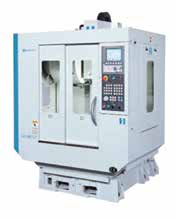
Thousands of GX-Series vertical machining centers are installed worldwide. These 40-50 taper spindles VMCs include superior design characteristics to ensure many years of accurate and reliable performance. GX-Series machines are ideal for mold and die manufacturers, aerospace, medical, defense, 3C, automotive and other industries, requiring high-value, complex parts from difficult to machine materials.
Superior design characteristics ensure Bridgeport 40-taper spindle GX-Series vertical machining centers deliver many years of accurate and reliable machining performance. These VMCs include a stiff and thermally-stable spindle, a rigid C-frame fixed column design and fixed pre-tensioned double-nut ball screws on all axes. The unique Bridgeport-designed linear guide and guide truck configuration provides added stiffness, damping and surface contact area. The unit is configured with three guideways and five guide trucks on both the X- and Y axis, two guideways and six guide trucks on the Z-axis.
For more information, please contact F&H Machine Tools – Tel: 011 386-5840.
A high column design, CAT 40 spindle and intelligent technologies enhance this CNC machine’s ability to cut a variety of exotic metals.
The GENOS M560-V vertical machining center, combines a high column design and CAT 40 BIG- PLUS® spindle to cut large, complex parts. The larger work envelope minimizes restrictions on workpieces, tool lengths and the rotary table. A highly rigid, thermally-stable, double-column construction gives this CNC machine the ability to withstand thermal deformation, resulting in improved machining performance. It’s also one of the heaviest machines in its class.
A powerful 30 hp spindle with 146 ft. lbs. of torque allows this machine to cut challenging metals such as titanium and Inconel as well as stainless steel and aluminium. A separate automatic tool changer door makes tool changing seamless without interrupting the machining process. The table moves only in Y, while the spindle moves in X & Z, enabling a smaller machine footprint, rapid feed rates, precise cutting and smooth surface finishes. Coupled with a user-friendly design and energy-saving technology, the GENOS M560-V truly delivers machining excellence.
Thermo-Friendly Concept, Okuma’s proprietary thermal deformation compensation technology is standard on this machine. Pretension ball screws and bi-directional spindle cooling allow for better control of the machining process. Optional Collision Avoidance and Machining Navi Intelligent Technologies are available.
Key specs of the GENOS M560-V vertical machining center include a max machining volume of 1,050 x 560 x 460mm, table size of 560 x 1300mm and a max. load capacity of 900kg. Add to this a spindle speed of min-1 15,000, spindle motor power of 22/18.5 kW (hp), a rapid traverse of X-Y 40 m/min and Z: 32 m/min and magazine capacity of 32 tools.
For more information, please contact F&H Machine Tools – Tel: 011 386-5840.
The DMU 75 monoBLOCK® combines top features for five-axis simultaneous machining and a large working space with 750mm X-travel. Equipped with CELOS® with MAPPS on FANUC from DMG MORI. Highly demanding industries require machine tools that are up to the challenge of realizing best quality in the most economical way. The monoBLOCK® series developed by DMG MORI has set a benchmark in almost every sector: aerospace, automotive or medical, among others, relies on the machine tools’ precision, stability and flexibility. With the new DMU 75 monoBLOCK® the world leading machine tool manufacturer addresses in particular price-conscious as well as innovation oriented customers. Therefore, the package contains the latest five-axis simultaneous machining technology, 60 pockets as magazine, speedMASTER® spindle with 20.000 rpm and as CELOS® with MAPPS on FANUC.
The extremely compact footprint of less than 8m2 and the spacious working area (X/Y/Z: 750/650/560mm) suitable for various work pieces of up to 840mm diameter and 600kg are the most obvious characteristics of the DMU 75 monoBLOCK®. Since the easily accessible working area can be loaded with a crane from directly above, the table users are provided with a maximum of comfort during their work. Apart from that the working area is cased with durable stainless steel for a longterm value. Another user-friendly factor that additionally guarantees best working results is the optimized chip fall and chip disposal from the machine to the rear.
Looking at the inner values of the DMU 75 monoBLOCK ® DMG MORI has ensured a maximum of precision. Whereas direct scale feedback allow exact machining, a one-piece stand, stable slides, 45mm roller guides in all axes plus a FEM optimization of all components stand for highest rigidity. The stability is continued in the swivel rotary table with its large bearing as well as the large ball screws in all axes, whereas weight optimized X- and Y-slides as well as the Z-ram promise highest dynamics. The linear axes achieve rapid traverse speeds of up to 40 m/min and an acceleration of 6 m/s2. Consequently, the table is the basis for reliable and challenging five-axis simultaneous machining of complex work pieces.
The DMU 75 monoBLOCK® package is completed by a powerful SK40 speedMASTER® motor spindle with 20,000 rpm, 130 Nm (40% ED) and 35 kW (40% ED) and a vertical chain magazine for 60 tools. Offering CELOS® with MAPPS on FANUC, DMG MORI is able to meet the preference of even more customers.
For more information, please contact Retecon – Tel: 011 976-8600.
Included with the most important
technological innovations of the
ULTRASONIC 20 linear are a new,
completely digitally controlled ultrasonic
generator and the ULTRASONIC actuators
with higher capacity.
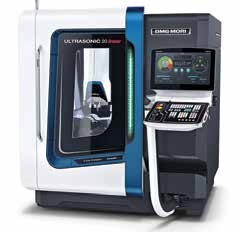
Sporting a new look, and more capacity throughout for all functions, the new ULTRASONIC 20 linear impresses with ultrasonic machining of advanced materials. For many years, DMG MORI has been offering high-performance machine tools with ULTRASONIC technology for 5-axis machining of complex workpieces made of advanced materials. With the new ULTRASONIC 20 linear, this series now captures a completely new class. Spindle speeds with optionally up to 60,000 rpm, more powerful drive motors, an even smaller footprint plus CELOS with apps specifically developed for the ULTRASONIC are all part of the innovations which users from the fields of optics, precision engineering and clocks, medicine and high precision mould manufacturing will benefit from in the future.
Reduced process forces for filigree structures, surface qualities up to Ra <0.1 μm and longer tool service life
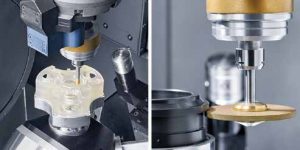
Included with the most important technological innovations of the ULTRASONIC 20 linear are a new, completely digitally controlled ultrasonic generator and the ULTRASONIC actuators with higher capacity and rotational speeds of up to 50,000 rpm. The tool holders with adapted actuator technology can be easily and fully automatically replaced in the milling spindle. Each of these holders is equipped with piezo elements, which are activated via a program-controlled induction system with high frequency between 20 and 50 kHz. The original tool rotation is thus superimposed with additional tool movement with defined amplitude in longitudinal direction. The resulting deflection of the cutting edges or grinding areas is controlled via the NC program and can be in a range of up to 10μm or even higher. During grinding, drilling and milling, these superimposed vibrations have a direct, positive impact on the process forces, the removal volume and the tool service life and thus result in reduced costs and higher productivity.
In detail, the ULTRASONIC technology achieves a higher removal volume, more precise edge processing and up to 40 percent reduced process forces during machining of advanced materials like glass, ceramics, sapphire, hard metal and composite materials as well as carbide. The precision of the workpieces and reliability of the process are increased at the same time. Furthermore, the oscillating interruption of the tool contact with the workpiece results in an improved lubrication and cooling of the cutting edges and the optimum removal of stripped particles from the work area. The outcome is longer service life of the tools and excellent surface quality of up to <0.1 μ for hard-brittle high-performance materials. The ULTRASONIC 20 linear ideally combines high speed cutting with highly efficient ULTRASONIC grinding of advanced materials on a single machine. It enables the machining of an unprecedented range of different materials.
Intelligent ULTRASONIC technology with process-optimized amplitudes
“ULTRASONIC Parameter Detection” of the ULTRASONIC 20 linear ensures automatic detection of the ultrasonic frequency most suitable for the actuator and tool with powerful functions for process monitoring. Another function used for the first time worldwide is the monitoring and tracking as well as of frequency and amplitude during the ongoing machining process. For this purpose, UAT (Ultrasonic Auto Tuning) automatically tracks the frequency response and compensates all exterior influences like the dampening of ultrasonic vibrations by means of the primary process forces. This way, a consistent readjustment to the nominal amplitude or the value specified in the NC program can be achieved. With this, users can fully exhaust their processes and increase tool utilization, reduce cycle times and, particularly by reducing the process forces, achieve even more filigree, precise and high quality machining results.
Highly dynamic, long-term stable 5-axis machine concept – compact on just 3.5 m² footprint
With the ULTRASONIC 20 linear, DMG MORI relies on a long-term stable gantry machine design, to be able to safely meet all demands of ultrasonic machining. Despite this, the machine tool manufacturer was able to reduce the footprint of the machine to only 3.5m². A double drive for the Y-axis and the concept of integrated cooling, which uses the temperature monitoring of drives, spindles and the control as well as all media guarantee highest precision and workpiece quality. The linear measuring systems from MAGNASCALE are a good example for the high-tech components which DMG MORI has used here. DMG MORI has significantly increased the capacity of the drives for the new development: by 47 percent for the A-axis, 27 percent for the C-axis and 34 percent for the Z-axis. The linear drives achieve maximum acceleration of more than 2 g and provide rapid traverse speeds of up to 40 metres per minute. Due to the large swivel range of the A-axis of the work table, ranging from -15° to 130° and the fully integrated 360° endless rotation axis – both with torque technology, the ULTRASONIC 20 linear is optimally suited to 5-axis simultaneous machining. The rotational speed of 1500 rpm that can optionally be achieved for the C-axis also enables circular milling/circular grinding as well as turning/ milling operations.
After the revamp, the ULTRASONIC 20 linear can now be used with larger tool diameters of up to 50mm and an increased maximum workpiece weight from 10kg to 15kg. The basic version of the machine is equipped with a powerful 15 kW motor spindle and a HSK-32 tool holder, the maximum rotational speed is at 42,000 rpm. Higher demands on the rotational speed can be achieved with an optional spindle, which reaches an impressive 60,000 rpm. The range in this segment is rounded off by an HSK-40 spindle with permanent lubrication.
The option MT for the internal and external cylindrical grinding of the ULTRASONIC 20 linear enables complete machining of rotational-symmetric workpieces with grinding and drilling as well as internal and external machining in a single setup.
The modular concept of DMG MORI enables a wide-ranging application-specific configuration of the machines – of course this also applies to the ULTRASONIC 20 linear. For example, the machine can be supplied with a 1,500 rpm turning/milling table, which extends complete machining of rotation-symmetric workpieces in a single setup to the operations of milling, turning and grinding. In addition to the tool magazine with 24 pockets and minute wheel, a 60-pocket chain magazine is optionally available.
Unique integration of technologies
The ULTRASONIC 20 linear with its special features enables the use of ultrasonic support for specific materials, namely the milling and drilling of nickel or titanium super alloys or of materials like magnesium, tungsten as well as composite materials. Process forces have been reduced for milling applications in titanium by up to 30 percent. For steel, double feed speeds are possible, for other materials, like magnesium, the feed speeds can be increased by up to five-fold. In addition, an improved surface quality can be achieved. The ULTRASONIC process has a significant impact on chip breaking behaviour and chip removal from the tool. Further to shorter chips, this also results in drastically reduced tool wear, making the technology interesting for almost all future-oriented target markets with high-tech products. The specific benefits associated with the option of using the ULTRASONIC technology have also taken the flexibility to a new level. It is now possible to machine workpieces from very different materials from soft to hard-brittle, in five axes for mould making, medical technology, the automotive and aerospace industry.
ULTRASONIC 20 linear with new design and CELOS
High-quality, long-lasting covers as an external distinguishing feature with functional added value thanks to optimum accessibility are the most important properties of the new standardized DMG MORI design. The ULTRASONIC 20 linear also has this new look, whose impact on value retention must not be underestimated and furthermore, the machines offer CELOS. This user interface with its unique multi-touchscreen can be used as easily as a smartphone. The user friendliness is further increased by CELOS apps which were specifically developed for ultrasonic machining. They visualise the ULTRASONIC technology cycles and the most important process parameters like frequency, amplitude and output power. At the same time, the apps monitor the process forces of the actuators and also support configuration of the tools.
NORIS STABIL UNI HSS-PS TiCN in
machining situation through hole: Chips
are evacuated in the cutting direction.
NORIS taps for processing a wide variety of steel alloys, cast iron and various nonferrous alloys are well known under the names SALOREX UNI for blind holes and STABIL UNI for through-hole. REIME NORIS now extends the UNI series to high performance taps made of HSSE-PM (HSS-PS) with improved cutting geometry and TiCN coating.
NORIS SALOREX UNI – the specialist for deep blind hole threads up to 3 x D thread depth – has 42° right-hand helix flutes. These provide secure chip removal against the cutting direction.
NORIS STABIL UNI stands for the production of through hole threads up to 4 x D thread depth. The special STABIL-flutes move the chips in the cutting direction.
The drills are available in metric sizes from M3 to M20 and M8 x 1 to M16 x 1,5 in stock.
In both versions, the use of powder metallurgical high-speed steel permits higher cutting speeds while increasing tool life. The user benefits by increasing the cycle times and a reduction in tool costs. With the ability to process a very wide range of materials, additional cost of storage and tool investment can be reduced. The proven cutting edge geometries were further optimized in detail. They are specially adapted to the characteristics of the HSSE-PM substrate and the coating. REIME NORIS thus promises significant performance gains and expects especially in the production of small- and medium-sized series, the greatest economic advantages of using these high performance taps.
For more information, please contact Duncan Macdonald – Tel: 011 444-4345.
As the need for machining smaller volume work pieces made from cast iron and steel has grown, so has the need for smaller size tools that can enhance productivity and reduce operating cost. Therefore TaeguTec offers a smaller size insert for its highly popular Chase2Hepta milling line.
The Chase2Hepta 6mm inserts and cutters are available to meet the challenges posed by technical trends in forging and casting technologies which is demanding higher productivity and economical tools that can handle lower depth of cut conditions.
The Chase2Hepta line is renowned for offering 14 corners on one insert. The double-sided and highly effective 45 degrees entry angle is the ideal solution for high performance on cast iron and steel machining, while its positive cutting edge geometry lowers cutting loads during rough machining making it an efficient and smooth set of tools. Covering a wider range of machining applications, the dual usage TaeguTec Chase2Hepta 6mm inserts are screw type.
The line of mini cutters comes in three geometries – the M, MM and ML. The M geometry 6mm Chase2Hepta line is used for roughing applications of steel and cast iron work pieces and its smooth machining with good tool life is due to its reinforced, positive rake angle.
M Geometry
For general cast iron machining applications, the optimized cutting edges of TaeguTec’s MM geometry chip breakers on the Chase2Hepta 6mm line means low cutting forces in cast iron machining.
MM Geometry
The ML geometry for the 6mm line is ideal for cast iron light machining and difficult to cut materials such as stainless steel and heat resistant alloys. Its sharp, positive cutting edge was designed for minimal cutting force.
ML Geometry
When machining a manifold made from FC25 during a case study, the Chase2Hepta 6mm line increased tool life by 50 percent.
In another test TaeguTec’s 6mm Chase2Hepta line was not only able to double life, but also lowering cutting force by 40 percent, while machining a con rod cap made from AISI 4140.
For more information, please contact TaeguTec – Tel: 011 362-1500.
Walter’s M4003 face milling cutter offers
users the universal advantages of the
M4000 system with the added advantage
of being a very good choice for machining
operations in unstable conditions.
With the M4003 face milling cutter, Walter is expanding its M4000 Universal range. With the M4003, Walter is presenting a 45° face milling cutter as part of its M4000 system.
However, in addition to the advantages of a universal system, such as low carbide inventory costs and easy handling, the M4003 also demonstrates special strengths.
This milling cutter is particularly suitable for component machining operations under unstable conditions, where low cutting forces are required. It therefore achieves outstanding levels of surface quality with long-projection tool assemblies or unstable workpiece setups. Excellent results can be achieved even with soft materials such as aluminium. The reason for this particularly soft cutting action is the highly positive insert geometries; an effect that can be further increased by using the different indexable inserts for different applications.
The face milling cutter can be equipped with the four-edged M4000 system radiused inserts for general purpose machining or with inserts with secondary cutting edges for an improved surface quality. Wiper inserts can also be used for top-quality surfaces. As an option, the indexable inserts are also available with Walter’s new coating, Tiger·tec® Gold. Thanks to the range covering two different maximum depths of cut (4.5 and 6.5 mm), the 45° face milling cutter can be adapted to each particular application. The milling cutter is suitable for a wide range of applications: For roughing, semi-finishing or finishing – from steel, cast iron and stainless steels, through to non-ferrous metals and difficultto- cut materials.
For more information, please contact Spectra Carbide – Tel: 0860 23 23 23.
The Walter M4258 porcupine milling cutter
with M4000 inserts.
Walter AG is using its M4258 porcupine milling cutter for shoulder and slot milling to combine the benefits of a milling body with those of indexable inserts.
The modular milling cutter has a replaceable front piece. This allows the part of the tool body that typically becomes worn most quickly to be replaced, namely the front and face. These are subject to the most rapid wear because milling cutters are rarely used over their whole length and bending forces are greatest here. The positive-locking connected interfaces in the front piece ensure that precision is maintained. Good chip clearance and internal cooling ensure high process reliability and safe chip evacuation. Walter Capto™ C6 and C8 have been chosen as interfaces to the machine. These are tried and tested, especially in highly universal applications and with any kind of modular machining tool.
While the indexable inserts used continue the trend in saving tool costs, the M4258 is equipped with M4000 system inserts. Square and rhombic with four or two cutting edges, it can be used not only in porcupine milling cutters, but also in face, shoulder, chamfer and T-slot milling cutters. Diverse geometries, such as the D51 anti-vibration geometry, allow the milling cutter to be used in difficult conditions. Tiger·tec® Gold inserts are additionally available on request – these increase the tool life further. M4258 milling cutter and M4000 system inserts provide a solution which reduces storage and procurement costs, while simultaneously conserving resources. This is because the entire milling cutter, including body is manufactured with CO2 compensation. It is suitable for practically all materials, such as cast iron, steel, stainless steels and materials with difficult cutting properties. The modular porcupine milling cutter from Walter is available in diameters of 50–80 mm and is recommended for anyone machining with high material removal rates in unfavourable conditions.
For more information, please contact Spectra Carbide – Tel: 0860 23 23 23.
Lower cutter weight increases stability and productivity
In a move designed to offer customers a host of in-process benefits, cutting tool and tooling system specialist Sandvik Coromant is introducing its lightweight CoroMill 390, which features a cutter body produced using additive manufacturing.
The lighter overall weight of the tool helps to minimize vibration and improve security during machining with long overhang. In turn, the productivity is also increased.
Additive manufacturing offers a superior way of producing complex structures with high precision and without joints. Use of the process can make components lighter, stronger and more flexible than ever before. With regard to tool bodies, additive manufacturing allows for the generation of shapes and features not possible with metal cutting. In addition, virtually any material can be printed, as in this case, a titanium alloy.
”When designing our new lightweight CoroMill 390, material has been tactically removed to create the optimal cutter design for minimizing mass,” explains Thomas Wikgren, Manager Product Application Management, Sandvik Coromant. “This is called topological optimization and it makes the cutter more compact and significantly lighter than a conventional version, thus helping machine shops to boost the productivity of their long-overhang milling operations. Moreover, a shorter distance between the damper in the adaptor and the cutting edge improves performance and process security.”
Process security is paramount in a number of metal-cutting applications, not least when milling with long overhangs, which is a common requirement in components used by the aerospace and oil and gas sectors. Here, the generation of features such as deep cavities can be compromised by vibration, leading to slower production, shorter tool life and poor surface finish. The new lightweight CoroMill 390 provides the solution. Combined with Silent Tools™ milling adaptors, this optimized tooling combination subdues vibration to help maximize productivity and process security in demanding applications involving long overhangs. In addition, the inherent CoroMill 390 concept delivers light cutting action for a smooth cutting performance.
Lightweight CoroMill 390 can perform long-reach face milling, deep shoulder and side milling, cavity milling, and slot milling. The tool is available in 40mm (arbor 16 coupling) and 50mm (arbor 22 coupling) diameter variants. Three or four inserts (size 11) can be specified to suit the application. Differential pitch and internal coolant are provided on all cutters.
For more information, please contact Sandvik Coromant – Tel 011 570-9615.
ISCAR is launching new tough PVD grades for parting applications on carbon steels, alloyed steels and stainless steels – IC1010 for medium to high speeds and IC1030 for low to medium speeds.
The new grades are based on TiAlN coating which significantly improves toughness and wear resistance, assuring longer tool life. Both grades exhibit better resistance at unstable conditions and interrupted cut. The new grades are available on TANG-GRIP and DO-GRIP inserts.
IC1030 (M25-M45) (P30-P45)
IC1030 – TiAlN coating overlays the very tough substrate IC28 for wide range of applications at high feeds and low to medium speeds. The grade is recommended for interrupted cut and machining at unstable conditions. The cutting parameters should be same as for IC830.
IC1010 ISO (M15-M30) (P15-P30)
IC1010 – TiAlN coating overlays the sub-micron grade IC08. It is recommended for general parting and grooving applications with medium to high cutting speeds and low to medium feeds, and the cutting parameters should be the same as for IC808. IC1030 is intended to replace and phase out gradually older grades IC328 and 928, while IC1010 will replace and phase out IC308 and IC1028 grades. The current insert range with IC1010 and IC1030 grades is introductory and IC1010 and IC1030 will be expanded in the near future.
For more information, please contact ISCAR South Africa – Tel: 011 997-2700.





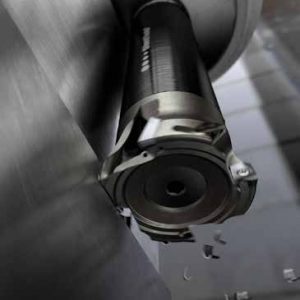 Lightweight CoroMill 390 can perform long-reach face milling, deep shoulder and side milling, cavity milling, and slot milling. The tool is available in 40mm (arbor 16 coupling) and 50mm (arbor 22 coupling) diameter variants. Three or four inserts (size 11) can be specified to suit the application. Differential pitch and internal coolant are provided on all cutters.