There is no doubt that there has been a growing presence of Chinese-manufactured products in South Africa and Chinese business leaders have invested in numerous sectors of the South African economy, including renewable energy, retail as well as the metals and engineering sector.
But how will the influx of Chinese-manufactured products impact on local businesses and employment and how should local manufacturers respond? Those are some of the questions that panelists and delegates to the 2019 Southern African metals and engineering Indaba will deliberate on.
Commenting on the Chinese factor, Steel and Engineering Industries Federation of Southern Africa Kaizer Nyatsumba said China is increasingly shaping global discourse and economic development and that the presence of Chinese-manufactured goods is set to increase even further in years to come. He said local Chinese projects often make use of Chinese workers, even on menial jobs, to the detriment of indigenous workers.
“Although Chinese investments bring a different flavour and level of enthusiasm in some industries, it is a catch-22 situation in the labour-intensive industries of the manufacturing sector where there is a negative effect on job creation,” Nyatsumba said.
Making an assessment of the implications of a growing presence of Chinese-manufactured products in South Africa and its implications for local businesses will be BRICS Business Council Chairperson Busi Mabuza, International Trade and Economic Development Division Deputy Director General Xolelwa Mlumbi- Peter, ANC Economic Transformation Committee Head Enoch Godongwana and Business Leadership South Africa CEO Busisiwe Mavuso.
Now in its fifth year, the Indaba is organized and hosted by SEIFSA. Its core objective is to provide a platform for policy makers, labour representatives and businesses operating in the metals, engineering and related sectors to discuss the challenges facing the sector and collectively to devise sustainable solutions aimed at ensuring its sustainability.
Air Seychelles, the national airline of the Republic of Seychelles, has taken delivery of Africa’s first A320neo on lease from CDB Aviation, becoming the first African airline to operate the A320neo aircraft.
The new aircraft will allow Air Seychelles to increase capacity on its network, while delivering significant fuel savings and reducing the airlines’ operating costs. Air Seychelles’ new A320neo is equipped with a new inflight product reflecting the latest trends in air travel industry, offering passengers greater level of comfort and an enhanced travel experience. With its widest single-aisle cabin, the A320neo allows Air Seychelles to offer unmatched comfort in all classes and Airbus’ 18-inch-wide seats in economy as standard.
The A320neo is the world’s most advanced and fuel-efficient single-aisle aircraft. Air Seychelles’ A320neo jetliner is powered by the new-generation LEAP-1A engine from CFM International and features large, fuel-saving wingtip devices known as Sharklets.
With the addition of 32 new Airbus operators on the continent since 2010, today 243 Airbus aircraft are flown by African airlines, out of which, 145 aircraft are A320 Family. This is a testament to the appeal and performance of the world’s best selling single-aisle aircraft family across the continent.
The A320neo and its derivatives are the world’s best-selling single-aisle aircraft Family with over 6,600 orders from more than 100 customers. It has pioneered and incorporated the latest technologies, including new generation engines and the industry’s reference cabin design, delivering 20% fuel cost per seat savings alone. The A320neo also offers significant environmental benefits with nearly a 50% reduction in noise footprint compared to previous generation aircraft.
Order Intake of the German Machine Tool Industry
Sharp decline in machine tool orders - Many sectors reluctant to invest
Orders received by the German machine tool industry in the second quarter of 2019 were 22 percent down on the same period last year. Orders from Germany fell by 28 percent. 18 percent fewer orders were received from abroad. Orders received fell by 21 percent in the first half of 2019. Domestic sales were down 19 percent in this period, with foreign sales 23 percent lower.
“In the second quarter, orders are once again more than twenty percent down on last year’s strong figures,” said Dr. Wilfried Schäfer, Executive Director of VDW (Verein Deutscher Werkzeugmaschinenfabriken – German Machine Tool Builders’ Association), Frankfurt am Main, commenting on the result. “The base effect can no longer disguise the global decline in investment in mechanical and plant engineering,” Schäfer continued.
The machine tool industry is not immune to the factors that are creating so much turbulence in the global economy as a whole and that are currently the subject of much discussion: “We are in the same boat as the other major international suppliers. Orders for machine tools have collapsed worldwide. Many countries are now having to pay the price for the almost daily international disputes being picked by politicians,” says Schäfer.
The machine tool sector is a pure supplier of capital goods and equipment to industry and as such is exposed to pressure from weak demand in the major customer industries, the engineering sector and the automotive industry. The latter is additionally undergoing a protracted period of uncertainty as a result of the tentative transformation process towards new drive technologies and is cutting back investment accordingly.
Within the triad of suppliers, the Europeans are still performing most strongly. Orders from eurozone countries only fell by 5 percent over the first six months, while those from non-eurozone countries were down by 28 percent.
Production of a turbine wheel by build-up welding. Photo: Gefertec
EMO Hannover 2019 showcasing wide range of additively manufactured work-pieces in the additive manufacturing circle
Industrial 3D printing has now become an integral part of metalworking. EMO Hannover 2019 is reflecting this development by launching a compact new section to provide a comprehensive overview of the current state-of-the-art in this field. Service providers, machine and tool manufacturers as well as software providers will be presenting their latest innovations in the 300m2 additive manufacturing circle show area. The aim is to sensitize production planners and investors to 3D printing and to show visitors the wide range of possibilities already available today. The joint stand in Hall 9 also contains an area for discussing the technology with experts and networking.
Additive processes are now on the threshold of breaking into mass production within the manufacturing industry. Nevertheless, the use of generative manufacturing processes is still in its infancy in industrial production and many metalworking companies are currently reluctant to invest in plant and systems because they find it difficult to gauge the effects and benefits of these processes. However, there are already many impressive examples of what is currently possible.
Numerous products are already being printed, especially in the automotive and aircraft industries, but now also increasingly in medical engineering. Further additive processes will be ready for series production in the coming years. Yet if the full potential of 3D printing is to be exploited, it is important to identify new product features and applications that justify the higher costs of additive manufacturing. Visitors will discover completely new ways of thinking and production strategies in the additive manufacturing circle. There they will be presented with an overview of the entire spectrum of generatively manufactured work pieces. Visitors will be able to benefit from the collective expertise of the technology leaders and not just inspect a number of isolated solutions.
“We very much welcome the founding of the additive manufacturing circle,” says Tobias Röhrich, Managing Director of Gefertec. “ EMO Hannover is simply the ideal biotope for engaging in professional discussions about the new industry standard 3DMP®. We are expecting to encounter a high-calibre group of customers and users, but are also looking forward to an inspiring exchange with the industry’s visionaries. This will lead to many new contacts, perhaps even partnerships, which will benefit us in the short, medium and long term.”
On a level with the experts
The exhibitors and experts come from Germany, the USA, Switzerland and Sweden. What they all have in common is their interest in innovative products and services that take the technology one step nearer to mass production in metalworking. They will be providing food for thought and interesting new ideas in the Expert Talks, for example. The presentations and discussions will take place in the Expert Talks Area at the centre of the round community stand. The area has deliberately been kept small in scale to promote communication between the audience and the speakers. There is no stage, the experts will give their 30-minute feasibility study presentations (including cost/benefit comparisons) on a level with the visitors. The aim is to encourage discussion and questions. Four presentations will be given each day, followed by a discussion with the experts.
At EMO Hannover several machine tool manufacturers will be contributing to the umati Showcase.
Photo: VDW/Chiron
Since 2017, umati has been on everyone’s lips in the international machine tool industry. What at first was designated rather vaguely as an interface standard is now being meaningfully firmed up.
With application-tailored implementation of the umati interface for the machine tool sector, since 2017 clear contents and technical key data for translation into hands-on reality have been drawn up. What this means specifically, and what visitors can expect to see at EMO Hannover, are explained by three experts: Götz Görisch is responsible at the VDW for the field of digitization and Industry 4.0 and is Chairman of the umati Joint Working Group. Bernd Zapf is responsible for Development New Business & Technology at Gebr. Heller Maschinenfabrik while Andreas Wohlfeld is Lead Architect Smart Factory at Trumpf heading the modelling group of the umati Joint Working Group.
Why did the companies and the VDW initiate umati?
Götz Görisch is responsible at the VDW for the field of digitization and Industry 4.0, and is Chairman of the umati joint Working Group. Photo: VDW
Görisch: Following a workshop in the VDW themed around the issues of Industry 4.0, held in early 2017, it clearly emerged that things were definitely moving in terms of standardization. After some market research, however, it also became clear that for the machine tool sector none of the proposals involved was usable. On occasion, standards had already been agreed between machine tool manufacturers and customers from the automotive industry, but only on a bilateral basis. This meant that very extensive resources in the companies were channelled into developing and maintaining the various customer implementations concerned. The intention is for the global interface umati to replace these, thus also creating capacities for developing new functions with customer benefits.
Why has OPC UA been chosen as the communication standard?
Görisch: This question was very intensively discussed and examined during the initial months of the project in 2017. In the past two to three years, OPC UA has been experiencing a veritable boom, and is tacitly acknowledged as the standard in industrial communication. OPC UA utilizes internet technologies and protocols. Basically, it specifies how communication is handled. At the same time, sectorally specific expertise enables users to define, in what are called Companion specifications, the details of what is communicated. This means: the specifications provide a kind of sectorally specific dictionary.
Why is standardization not being performed at other organizations, like ISO or IEC?
Görisch: OPC UA, as a fundamental specification, is already an IEC Standard (IEC 62541), meaning a standard published by the International Electrotechnical Commission (IEC). The Companion specifications are at present still so development-intensive, and are so urgently required, that traditional standardization procedures are not fit for purpose here. As soon as the Companion specifications have stabilized, the long-term aim is to adopt them in IEC/ISO Standards. The VDW is already actively involved in the preparatory work in ISO/TC 184 – a body at the ISO (International Standardization Organization) that draws up standards in the field of Automation Systems and Integration. In the shape of OPC UA, the basic implementations with the corresponding tools are already available, whereas in a normal standardization process lasting three to five years in the end you still don’t have any implementations with the corresponding tools.
How does the Showcase function?
Görisch: The Showcase at EMO Hannover 2019 demonstrates that machines from different manufacturers featuring umati can be securely, seamlessly and effortlessly connected to the customer’s IT systems. For this purpose, we have published a simplified version of the umati Companion specification’s draft, with the aim of reducing the amount of implementation work at the individual participants involved. The machines connect themselves to an aggregation server, which at companies is typically installed on the shop-floor level. On this server, the data from all machines are grouped together and made available to an OPC UA client in the destination application. Since we as the VDW cannot build a democase of this kind for the fair all by ourselves, we are being assisted by T-Systems. At the same time, many clients (applications) will link up to this server, a special feature, since most participants also themselves possess a digital product for utilizing the data. In addition, we have brought on board relevant added-value service providers like Adamos or Symmedia for participation.
How extensive is the Showcase’s data record?
Görisch: For the demonstration scenario, we took the draft version of the Companion specification, and defined a typical machine tool. This reduces the implementation work involved for the manufacturers concerned, and the scenario contains everything that has already been defined in the standardization work. The data enable most of the ten use cases specified for the first version to be handled – focused on the machine chosen for the Showcase.
When is the standard scheduled for completion and publication?
Görisch: If it were up to me, before the end of this year. However, we still have a lot of consultation work ahead of us, and at the same time, after submitting the release candidate to the OPC Foundation we have deadlines to comply with for comments and objections. So a realistic date for publication is early 2020. Which doesn’t mean that initial implementations can’t already be deployed. Always against the background, however, that modifications can and must be made.
When can actual products be anticipated?
Görisch: I am confident that the machine tool manufacturers will at EMO Hannover be discussing with their development customers initial specific pilot implementations. The delivery times involved, however, will indubitably extend into next year. At the same time, the requisite testing and certification preconditions have to be put in place by the umati project team – with a view to dependable quality. And not least, the umati product for machine tools and software products has to be given its final description. Against this background, I would assume we’ll be seeing the first products next year.
How the machine tool manufacturers Trumpf and Heller are contributing to the umati Showcase in Hanover is explained by Bernd Zapf and Andreas Wohlfeld.
What is your company’s input for the Showcase at EMO Hannover?
Bernd Zapf is responsible for Development New Business & Technology at Gebr. Heller Maschinenfabrik. Photo: Heller
Zapf: Heller will be providing a total of four data suppliers featuring the EMO umati data model: one five-axis machine on the Heller stand, two training machines, of which one will be exhibited on the VDW’s stand, and another five-axis machine that is installed at Heller’s production facility in Nürtingen. These machines will provide the data for the Showcase. In addition, Heller is a member in the VDW’s Core Group for designing and trialling the umati interface and for liaising with Siemens.
Andreas Wohlfeld is Lead Architect Smart Factory at Trumpf and heads the modelling group of the umati Joint Working Group.
Wohlfeld: We shall be connecting individual machines to the data hub as a showcase for the fair. Trumpf is, for instance, providing the VDW with a connected marking laser. Besides the machines in the Showcase, we are supporting the VDW’s umati-themed events in our role as a member of the VDW’s core group and the modelling group of the Joint Working Group. We are thus underlining our declared aspiration: it was important to the umati group to opt for a technology that offers maximized benefits for the new interface.
Thanks to semantic self-description of the data in the information models, the data are not only structured, but provided with meanings, and thus significantly upgraded. And not least OPC UA is the standard chosen for communication in the framework architecture for industry 4.0 (RAMI4.0).
What’s the status of the standardization work for your focus?
Zapf: The standardization work is very elaborate, complex and time-consuming. Numerous opinions have to be obtained from different companies. Basically, what’s needed is abundant willingness to compromise on the part of everyone involved. Furthermore, an up-to-the-future data record is being developed, which takes time and necessitates a lot of experience. From Heller’s viewpoint, the current modelling status covers about 90 percent of our requirements.
Wohlfeld: Trumpf has for several years now had its own in-house standard in terms of OPC UA. We see umati as the next logical step on the path leading to the cross-manufacturer smart factory. We’re working hard on this. Approval of the companion specification by OPC Foundation Products is the next major objective. We should then also be able to put products on the market. Among the vendors, the standard will be successively disseminated. The tempo here essentially depends on how quickly they integrate the standard in their products.
What specific pilot projects can be demonstrated at EMO Hannover?
Zapf: Heller will be demonstrating with the machines connected, the entire EMO umati data record. In our estimation, this already covers about 40 percent of the final data record. We supply this data record with MDA/PDA signals from our present MDA/PDA interface, and in addition have more signals available which we have so far not been able to deploy. These will be contributed by the umati interface. We will thus in future be creating a link from the present MDA/PDA interface at our machines to the new and future requirements. This can, for example, be the acquisition of machine status conditions.
Wohlfeld: At EMO, we shall in the framework of the showcase be exhibiting a pilot with the Trumpf machine apps, which among other things visualizes the machine status.
South Africa’s diversified manufacturing sector has grown to become a viable player with strong potential to compete in the global economy.
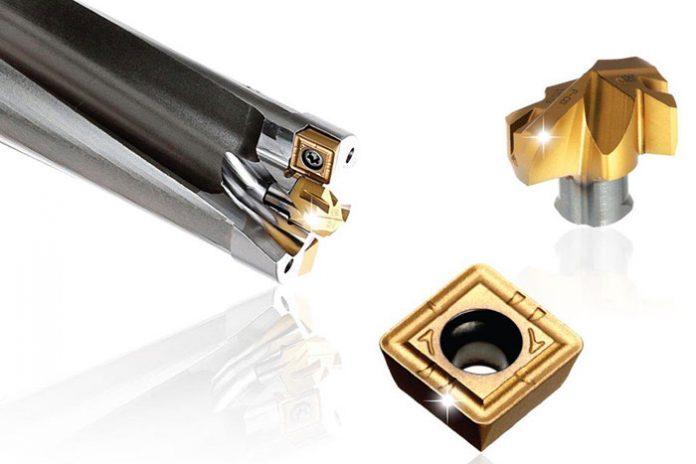
While TaeguTec has supplied the most advanced state-of-the-art cutting tools and tooling services to South African industries including automotive, mold and die, metals and electronics, the Asian metalworking giant offers a myriad of tools capable of cutting cost and increase productivity on any material.
One of the most important areas of manufacturing is hole-making and TaeguTec offers several options for companies looking to perform efficient drilling operations no matter if the factory relies upon the speed of production, the amount of savings shops are targeting, the materials being drilled or a combination of all these factors.
One of the industry’s favourite choices catering for drilling into everything from alloy steel to stainless steel is TaeguTec’s DrillRush – the versatile indexable drill that is constantly being expanded to provide dependable, optimal hole drilling performances on any material.
The various DrillRush geometries and sizes such as 1.5xD, 3xD, 5xD, 8xD and 12xD not only increase productivity but improve tool life due to its reinforced edges and coating, which are suitably designed for optimal chip control and hole quality on any material.
TaeguTec introduced two new sizes – the 12xD drill that produces deep holes accurately, repeatedly and economically and the DrillRush 6 millimeter to 6.9mm diameter range drill heads, which were designed to handle 1.5xD, 3xD and 5xD drilling depths.
All DrillRush products eliminate the need to remove the entire drill from the spindle in order to replace the head; a process that shortens cycle times and substantially increases productivity.
TaeguTec’s SpadeRush line generates higher productivity and outstanding performance due to its optimized cutting edge and unique rigid clamping system.
Available as a standard drill in 3xD and 5xD for a diameter range of 26mm to 41mm, the SpadeRush’s unique clamping technology enables operators to quickly change drill heads without removing the clamping screw from the holder.
For cost effective machining and higher pro ductivity, the TopDrill line has been built to satisfy a growing market demand for flexibility and excellent performance. Also, its true 4-corner inserts are suitable for both internal and external pockets, reduces inventory and promotes cost reduction.
From top to bottom, the TopDrill has been built for improved tool life and is equipped with a new insert grade for enhanced durability. Last but not least is the newest member of TaeguTec’s drilling family, the TwinRush – a product that guarantees excellent performance and high productivity on large diameter holes.
The noticeable feature of the TwinRush joins together a centering insert with a pair of precise square inserts on either side in order to combine two different drill types onto one drill body and protects them with TaeguTec’s TT9080 PVD multi-layered coated grade. By doing so, this double effective design increases productivity.
For more information please contact TaeguTec – Tel: 011 362-1500.
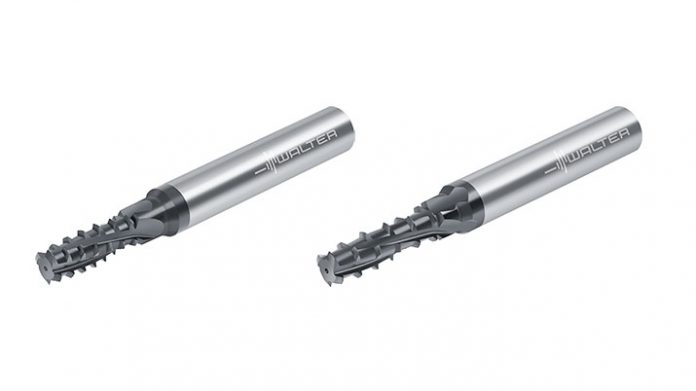
Walter AG is releasing the new TC620 Supreme thread milling cutter in diameters up to M20
High cutting pressure and tool deflection are the greatest challenges when it comes to thread milling. This results in restricted cutting parameters, necessary cutting passes and short tool lives or even tool breakage. With the TC620 Supreme universal thread milling cutter, Walter is now transferring the functional principle of its T2711 indexable insert thread milling cutter to smaller diameters, too. Tool wear is drastically reduced thanks to minimal cutting forces and the resulting high feeds per tooth. The multi-row concept not only reduces the machining time and wear, but also improves process reliability and handling – even when used with more demanding materials such as stainless steels or Inconel 718.
Reliable chip evacuation, thanks to internal coolant and simple handling of the TC620 Supreme guarantee maximum process reliability. Radius corrections are seldom necessary, and when they are required, it is often only once competitor tools have already reached the end of their tool life. Walter is launching the TC620 Supreme for thread depths of 2 and 2.5 × DN in the dimension range from M4 to M20 as well as UNC 8 to UNC ¾ – and is therefore seamlessly linking to the Walter T2711 indexable insert thread milling cutter.
For more information, please contact Spectra Carbide Tooling Technology – Tel: 0860 23 23 23.
The New Walter MC232 Perform solid carbide
milling cutters.
Milling cutters with corner radius introduced to the Walter Perform product range
With the launch of the new MC232 Perform solid carbide milling cutters, Walter is both rounding off its portfolio of products and opening up new possibilities. For the first time, the Tübingen-based tool specialists are bringing a milling cutter with a corner radius and reduced neck to the market as part of Walter’s cost-effective Perform product range. The Walter range in the MC232 Perform family now includes solid carbide cutters with or without a reduced neck and with or without a corner radius in a total of 126 dimensions, of 2–20mm in diameter. The milling cutters can be used for all typical milling applications (lateral milling, full slotting, pocket milling, helical plunging, ramping) and are suitable for a variety of materials and milling strategies.
Solid carbide milling cutters with corner radii meet an important demand of the market. This is because the corner radius allows the user to better approach individual component geometries. It also improves the tool life of the milling cutter, as the edge stability is increased. The reduced neck in turn makes the milling cutter more flexible, as the user can use it with an even wider variety of cutting depths.
Other features of the Perform line have been adopted – for example, the high level of cost efficiency for small and medium batch sizes, or Walter’s own WJ30ED grade, which provides a high level of wear resistance. ISO P materials are the primary application of the MC232 Perform, with ISO M and ISO K as secondary applications. The new milling cutters are likely to be of particular interest to job shops and manufacturers with frequently changing orders or quantities.
For more information, please contact Spectra Carbide Tooling Technology – Tel: 0860 23 23 23.
Walter presents its new TC410 Advance thread former
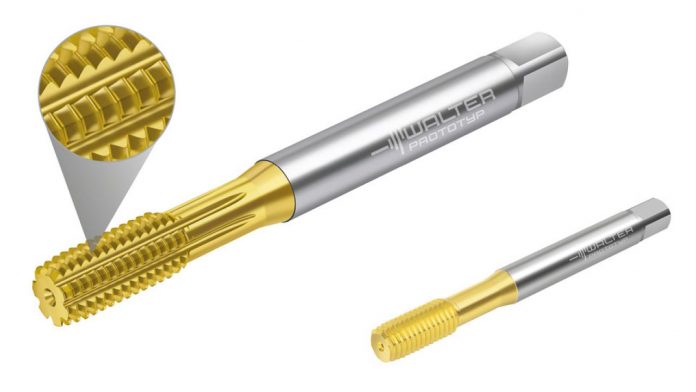
With the TC410 Advance HSS-E thread former, Walter is rounding off its range of threading tools – and can now offer its customers more than 200 thread dimensions and tolerances. The TC410 Advance with TiN coating can be used universally for blind and through-hole threads (metric, metric fine, UNC/UNF and G), all formable materials from the ISO material groups P, M and N as well as for ISO K and S as a secondary application. In addition to the general advantages of thread formers as well as non-cutting machining (no wedging of the tool due to trapped chips consequently higher process reliability), Walter is primarily bringing economic benefits to the fore with the new tools.
Decisive factors for this include the new geometry and special post-treatment. Innovative mould edges reduce the cutting time in the material. This reduces friction and consequently the amount of heat generated, which in turn reduces wear and ultimately increases the edge life of the tool. The posttreated, extremely smooth surface of the tool reduces the torque and additionally increases the tool life as a result. Walter offers the TC410 Advance in two variants. Without lubrication grooves or with lubrication grooves for deeper threads up to 3.5 × DN. The excellent price/performance ratio makes the TC410 Advance an attractive choice for users with medium to large batch sizes in particular. This is because it can produce more threads with the same tool.
For more information, please contact Spectra Carbide Tooling Technology – Tel: 0860 23 23 23.
Walter presents the new HU5 geometry for ISO M and S materials
With the new single-sided indexable inserts with HU5 geometry, Walter has the answer to one of its users’ key questions: How can more components be produced using the same number of machines? In comparison to the indexable inserts that can be used on both sides, the HU5 has a larger contact surface to the tool holder. This increases the stability and allows for greater cutting depths, feeds and a larger metal removal rate – specifically, in the practical test, this comes to 18.36 l/h instead of 10.71 l/h. In addition to the stable fit, the decisive factor behind this is the combination of the geometry and Walter Tiger·tec® Silver cutting tool materials.
This allows for increases in tool life of up to 75 percent. The geometry itself has been specially developed for heavy roughing of stainless steels and high-temperature alloys. It is typically used for applications in the oil and gas industry, e.g. for large valves made from AISI 316 material, or in the aerospace industry with Inconel 718 or titanium materials. The main cutting edge, which is protected by a negative chamfer, prevents fractures when machining hard edge zones and optimises the performance for hard scale, e.g. of forged parts. Components with interrupted cuts and other demanding machining operations are equally feasible.
The curved cutting edge and a deep chip breaker groove produce low cutting forces with high feed rates, consequently reducing the machining temperature. The variable rake angle in the area of the corner radius allows for soft chip reforming and increases the tool life. Available in the standard basic shapes of CNMM, DNMM and SNMM, Walter rounds off its vast product range in the areas ISO S and M with the HU5 geometry. As a result, Walter now offers a total of 12 geometries in six grades as well as tools with precision cooling and ceramic or CBN inserts.
For more information, please contact Spectra Carbide Tooling Technology – Tel: 0860 23 23 23.