

Home Blog Page 98

Continued Infrastructure Development Essential In Unlocking Africa’s Economic Growth Potential

This important topic will be one of those discussed at the 2016 Southern African Metals and Engineering Indaba, scheduled to take place at the IDC Conference Centre in Sandton. Special attention will be paid to the thesis that countries that boast highly-developed infrastructure tend to do better than their less-developed counterparts when it comes to attracting private sector investment and FDI. 

Speaking ahead of the conference, Steel and Engineering Industries Federation of Southern Africa (SEIFSA) Chief Executive Officer Kaizer Nyatsumba said that over the years South Africa’s world-class infrastructure, among other contributing factors, has played a crucial role in positioning the country as the entry point to the rest of the African continent.

“In order to fast-track economic growth in South Africa and the rest of the Southern African Development Community (SADC) region during the prevailing turbulent economic conditions where competition is rife, countries within SADC have to develop infrastructure and transport logistics that would enable them to compete globally.

“Accelerated growth necessitates road and rail links that are continually improving,” Nyatsumba said.

However, current difficult economic conditions make raising money to finance SADC’s huge infrastructure backlog difficult.

“African countries in general and countries within the SADC region in particular are in dire need of FDI. This is one of the contributing factors which saw Finance Minister Pravin Gordhan embarking on an international roadshow to lure foreign investment into South Africa. Infrastructure development has the potential to play a positive role in attracting FDI and private sector investment, but the difficulty in raising finance for infrastructure development poses a threat to accelerating economic growth,” Nyatsumba said.

He added that without reliable infrastructure, it is almost impossible for any developing economy, including South Africa, to prosper.

“It is, therefore, of crucial importance that various stakeholders from government, labour and business get together to deliberate on strategies aimed at unlocking SADC’s economic growth through infrastructure development, among other things,” he said.

Southern Africa and the Huge Infrastructure Backlog – How to finance it will be one of the topics which will be robustly discussed at the 2016 Metals and Engineering Indaba. Debating this crucial topic will be International Monetary Fund Senior Resident Representative Dr Axel Schimmelpfennig, Development Bank of Southern Africa Group Executive Manager Sinazo Sibisi and Industrial Development Corporation Head of Basic Metals and Mining Mazwi Tunyiswa, among others.
Tapping Into The Market With TaeguTec T-Tap

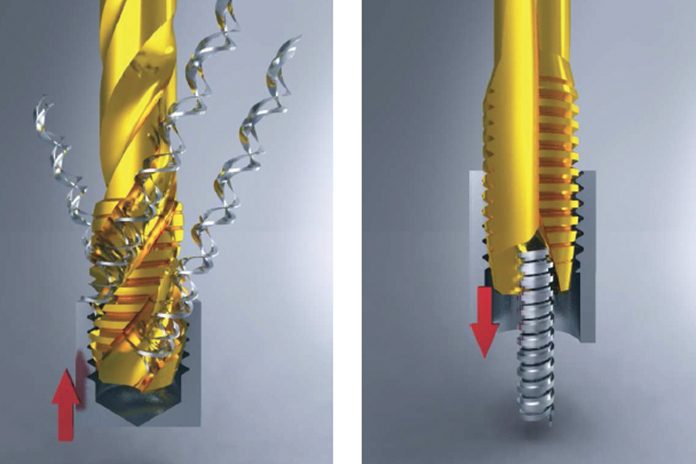
The HSSE-cobalt T-Tap new line expands TaeguTec’s threading range beyond milling and turning applications with carbide tools to high-speed steel. The high cutting speed with low cutting force taps’ universal application is ideal for steel, stainless steel and cast iron applications. Whether it is metric ISO standard or fine threads, the optimized cutting geometries of the new taps line ensures easy chip evacuation for precise and reliable machining.

The material used in the new T-Tap line is offered in three different grades– uncoated, steam tempered or titanium nitride. No matter the coating, the T-Tap HSSE line enables higher productivity and economy on a wide range of materials. Its longer tool life is credited by its innovative cutting geometry and the option of either TiN or steam tempering.

Tale of Two Geometries

TaeguTec’s straight flute with spiral point HSSE taps for through hole threading have a form B 4-5 threads chamfer, a dimension range of M2-M20 (MF8X1.0-MF16X1.5) and an ISO 2-6H tolerance. The innovative geometries of this new series forces the chips forward making tapping an easy, cost-efficient process while its optimal design credit to shallow flutes is only used in combination with cutting fluids (not chip evacuation).

The right hand spiral 40 degree flute’s features for blind hold threading comes with a helix angle, form C 2-3 threads chamfer, the same dimension range and ISO tolerance as the straight flute with spiral point. The difference is that the tap is designed with spiral flute grinding which forces the chips out of the hole and is designed for both cutting fluid and chip evacuation.

Grading Grades

The uncoated T-Tap grade is a perfect economical choice and is recommended for steel up to a maximum 800 newton per square millimeter while the steam tempered coating ferric oxide layer at the cutting edge makes it perfect for chip flow and reduces built-up edges for increased tool life.

For high hardness, chemical stability and heat resistance applications, the physical vapor deposition TiN coating offers a longer tool life due to its balanced characteristics of low heat conductivity and smooth operation at low cutting speeds and universal application on a wide range of materials.

Testing the Life Out of T-Tap

TaeguTec extensively tested the new T-Tap line on various materials and working conditions to make sure that it surpasses every customer’s needs. Its steam tempered tap on machining a sleeve made from carbon steel (AISI 1040, C40) was found to be optimal at a cutting speed of 14 meters per minute and lasted perfectly for 1,300 thread holes. On the other hand, the two TiN coating tests handled low alloy steel and tool steel with ease.

The case study of the TiN coating for a driving wheel made from low alloy steel (AISI 5115, 16 MnCr5) found that the application took 20 meters per minute to machine and lasted 1,800 thread holes while the tool life of a transforming stamp using tool steel (X36CrMo17) continued for 850 thread holes at a cutting speed of 15 meters per minute.

TaeguTec also tested two special coatings for companies that need tailor made tools. The first was on a supply pipe in which the material used was nodular cast iron (GGG40). The titanium aluminium nitride coating’s cutting speed was a mind blowing 25 meters per minute but its true eyebrow raising feature was its tool life of 3,500 thread holes.

But more impressive was the application on an aluminium alloy cylinder head. For this job, TaeguTec tailor made a DLC coating which has a cutting speed of 22 meters per minute with an incredible 8,000 thread hole life.

For more information, contact TaeguTec – Tel: (011) 362-1500.

No Major Revolution In Metal Working Due To Additive Manufacturing

Dr Wilfried Schäfer, Executive Director of METAV’s organiser VDW.

“Additive manufacturing processes are linked to high expectations,” comments Dr. Wilfried Schäfer, Executive Director of METAV’s organiser VDW. “In particular, the vision of entirely new value creation chains right down to customized production of parts or spares on site is arousing keen interest,” he explains. Reason enough for the VDW to commission an academic study of what this actually involves from the machine tool industry’s viewpoint.

KEX AG, in conjunction with the Fraunhofer Institutes for Production Technology (IPT) and Laser Technology (ILT), conducted the study in five stages, with a major focus on metalworking operations:

  • Market analysis for the development of additive processes
  • Meta-analysis of already-existing studies and an as-is survey of the current situation in terms of patent applications and the research status, based on academic publications
  • As-is survey of the additive processes available for the metalworking sector
  • Case studies that examine the requirements and possibilities of additive manufacturing, as exemplified by selected components
  • Prognosis for the development of the relevant technologies in the upcoming five to seven years
Dr Myron Graw, partner at KEX Knowledge Exchange

The most important result is this – assuming annual growth of 40 percent for additive processes, less than one percent of the existing technologies will be replaced by additive processes. This relates to the production volume of the international machine tool industry. “Overall, then, only minor shifts can be expected in the future production mix of the machine tool industry,” is Graw’s verdict. Which means that radical changes in the sector are rather unlikely.

The obstacles are costs and machining time

Obstacles to greater market penetration are encountered in the costs involved and the machining time required. In small-series manufacturing, and when producing complex customized and small components, the cost advantages of an additive process can be achieved by tool-less manufacturing. A special advantage ensues when substantial added values can be generated by additive manufacturing, such as lightweight structures in the aircraft industry, cooling ducts and undercuts. That way possible cost-related disadvantages in medium-sized and large series can be compensated.

When it comes to manufacturing large components, additive processes often have cost-related disadvantages. These result not least from the comparatively low build-up rates. Other relevant factors include the expensive machinery required and the high material prices for metal powder. “These cost-drivers will in the years ahead be changed by technological advances and the upsizing of capacities,” admits Graw. This, he adds, will speed up the dissemination of AM.

Potential for hybrid machines

The development of hybrid systems remains an exciting topic. These integrate functional quality for additive manufacturing, e.g. laser deposition welding, into conventional machinery concepts, like machining centres. This creates a potential for repeatedly performing targeted machining tasks during the build-up process. “To enable the options concerned to be efficiently utilized, however, the parts involved have to be completely redesigned. This is also true for the mere additive processes”, explains the KEX researcher. Furthermore, new approaches need to be established for production planning.

This leads to another open question – how AM systems can be integrated into the traditional production environment. Even nowadays, many work sequences are still being performed manually. For the efficient utilization of AM, questions have to be answered regarding automated powder feed, powder handling, powder removal, dust impact on the surroundings when “unpacking” the parts, automated process chains for removing supporting structures, and much, much more.

Additive manufacturing’s other shortcomings include the still-restricted choice of materials (powder) for the additive processes. Moreover, the quality of additively manufactured components has to be tested in non-destructive mode. Since the parts involved are always more or less one-off designs, their flawless reproducibility first has to be evidenced.

“We can say that additive manufacturing in the metalworking sector is being integrated into the existing value creation chain for metalworking as an additional production technology,” is the verdict of the VDW’s Executive Director, Dr. Wilfried Schäfer. AM, he adds, will thus become another building block besides CAD, simulation, reworking, production metrology and quality assurance. AM will also become of great importance to the machine tool industry itself. For example, when additive processes add value to components, such as extending the longevity.