
Bosch and Daimler are joining forces to advance the development of fully automated and driverless driving.
The two companies have entered into a development agreement to bring fully automated (SAE Level 4) and driverless (SAE Level 5) driving to urban roads by the beginning of the next decade. The objective is to develop software and algorithms for an autonomous driving system. The project combines the total vehicle expertise of the world’s leading premium manufacturer with the system and hardware expertise of the world’s biggest supplier. The ensuing synergies should ensure the earliest possible series introduction of the secure technology.
The car comes to the driver
By introducing fully automated and driverless driving to the urban environment, Bosch and Daimler aim to improve the flow of traffic in cities, enhance safety on the road and provide an important building block for the way traffic will work in the future. The technology will, among other things, boost the attraction of car sharing. It will allow people to make the best possible use of their time in the vehicle and open up new mobility opportunities for people without a driver’s licence, for example. The prime objective of the project is to achieve the production-ready development of a driving system which will allow cars to drive fully autonomously in the city. The idea behind it is that the vehicle should come to the driver rather than the other way round. Within a specified area of town, customers will be able to order an automated shared car via their smartphone. The vehicle will then make its way autonomously to the user and the onward journey can commence.
Future of urban mobility: Automated taxis as an individual transport option
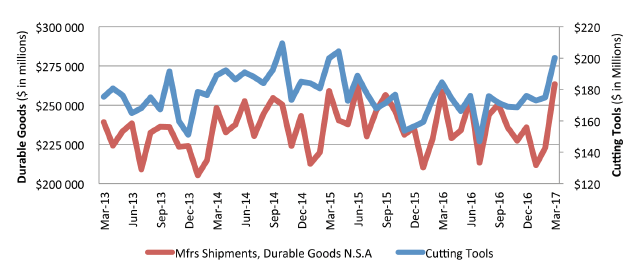
March U.S. cutting tool consumption totalled $200.05 million according to the U.S. Cutting Tool Institute (USCTI) and AMT – The Association For Manufacturing Technology. This total, as reported by companies participating in the Cutting Tool Market Report (CTMR) collaboration, was up 14.3% from February’s $174.98 million and up 8.4% when compared with the total of $184.57 million reported for March 2016. With a year-to-date total of $548.08 million, 2017 is up 5.9% when compared with 2016.
These numbers and all data in this report are based on the totals reported by the companies participating in the CTMR program. The totals here represent the majority of the U.S. market for cutting tools.
“The cutting tool industry reported numbers are supporting the positive feelings that exist in the Domestic Market,” says Brad Lawton, Chairman of AMT’s Cutting Tool Product Group. “This is a very welcome improvement and support for the Trump Administration’s pro manufacturing policies.”
Johan Israelsson, President of Sandvik Hyperion adds “It is clear that there is a much stronger customer demand across all sectors of the global market that we serve. Although there is some tendency to rebuild inventories as one driver, we are also experiencing an underlying market growth. It is especially encouraging to see optimism within the Oil and Gas industry after a very difficult period.”
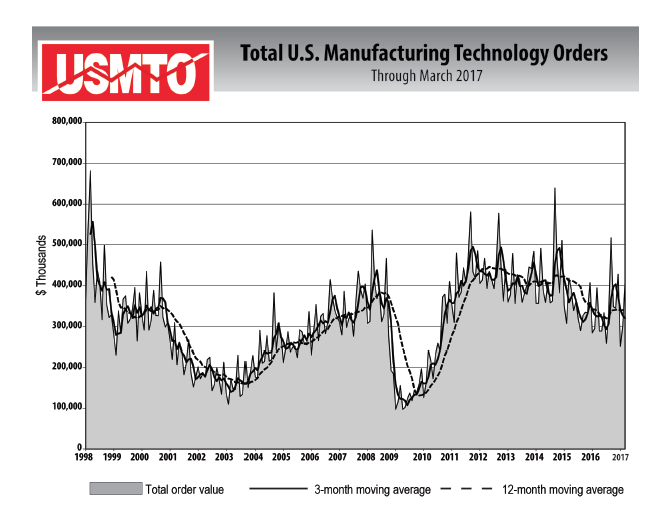
Manufacturing technology orders continued to make gains in March, according to the latest U.S. Manufacturing Technology Orders report from AMT – The Association For Manufacturing Technology. Orders were up 34.8 percent compared to February, and up 3.3 percent compared to March 2016.
“An increase for the month was expected, since it marked the end of the fiscal year for many companies, but it’s encouraging to see the last two months outpacing their 2016 levels – the possible start of an upward market trend,” said AMT President Douglas K. Woods. “When manufacturers make investments to boost their capacity and productivity, it’s a good sign for a strengthening manufacturing economy.”
Leading indicators show that promising gains for manufacturing are likely to continue. Consumer sentiment is on the rise, which will lead to more purchases of durable goods like cars, appliances, electronics and housing. Cutting tool shipments have grown, a marker of increased productivity. Machine shop spending for capital equipment has also been on the rise, indicating that manufacturers are using their services for excess capacity.
Orders for March 2017 totalled $407.53 million, up from $302.27 million in February. Yearto- date orders total $961.13 million, down 1.4 percent from the same point in 2016. USMTO is a reliable leading economic indicator as manufacturing companies invest in capital metalworking equipment to increase capacity and improve productivity.
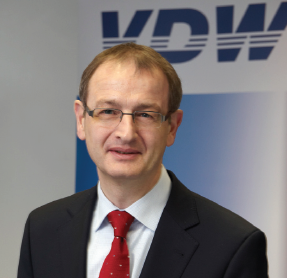
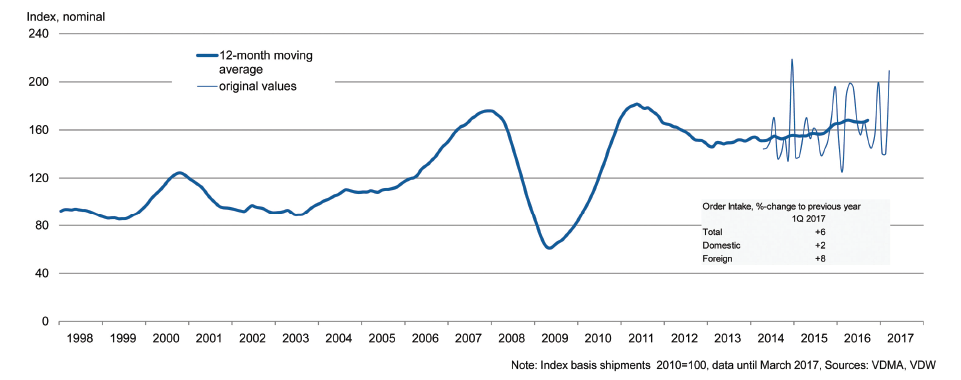
“Orders received by the German machine tool industry have therefore been stronger than expected,” said Dr. Wilfried Schäfer, Executive Director of the VDW (German Machine Tool Builders’ Association) in Frankfurt am Main, commenting on the result.
Dr. Wilfried Schäfer, Executive Director of the VDW (German Machine Tool Builders’ Association).
International demand remains consistently high. The euro countries represent a reliable market. There was a disproportionately high increase of 23 percent in orders for machine tools from there in the first quarter in comparison to the same period last year. “Furthermore, the increase in demand from the key Chinese market is now broader based,” reported Schäfer. Orders rose last year by more than twenty percent, primarily due to large international automotive industry projects in China. The strong development has continued, however, in the first quarter of 2017.
There was a 13 percent increase in metal forming technology orders. This rise in demand came both from home and abroad. Machining equipment orders, however, which represent about 70 percent of the total, only rose by 3 percent. The main source of growth here was foreign markets, which posted an increase of 6 percent. Domestic demand, by contrast, fell by 4 percent.
“The German machine tool industry continues to perform stably and at a high level, undeterred by the many crises and uncertainties affecting different parts of the world,” said VDW Executive Director Schäfer.
Airbus is developing a full spectrum of new Cabin Enablers for customers of its flagship A380 airliner.
The latest is the New Forward Stairs (NFS) option which was presented at the Aircraft Interiors Expo (AIX) in Hamburg. Together these cabin enhancements will make this very efficient and comfortable airliner even better. Overall cabin optimization is expected to result in the freeing-up more cabin floor space for around 80 additional passengers. This would bring airlines significant additional revenues.
Dr. Kiran Rao, EVP of Strategy and Marketing at Airbus Commercial Aircraft said, “continuous improvement of our products is our daily work. This new package for our A380 customers is a smart way to meet airline needs while improving the A380 economics with additional revenues and innovating in passenger comfort.” Rao added, “only the A380 has the economies of scale and development potential to efficiently solve the problem of increasing congestion at large airports while providing the best comfort for passengers. The aircraft can also serve fast growing markets and airlines regional airports, so we are adapting the aircraft to meet evolving market needs.”
With this latest proposal of the NFS option, the package of new cabin enablers for the A380 now comprises the following – New Forward Stairs – 20 more passengers (Business, Premium Economy & Economy Classes).
The NFS involves relocation of the forward stair from Door 1 to Door 2, and combining the entrance of the NFS to the upper deck (going up), with the adjacent staircase to the lower-deck crew-rest (going down). The NFS would make room for up to 20 additional passengers. Combined Crew- Rest Compartment (CCRC) – three more passengers (Premium Economy).
For the CCRC, the existing flight-crew-rest (behind the cockpit in the mezzanine area at Door 1) is moved down and combined with the cabin crew rest on the lower deck. This innovation frees space for three extra Premium-Economy passengers at the front of the main-deck. 11-abreast 3-5-3 economy layout on the main-deck – 23 more passengers (Economy Class).
Thanks to an innovative seating concept developed by Airbus and its seating partners, Airbus is able to maintain an 18inch seatwidth while offering airlines an 11-abreast Economy Class on the main-deck in a ‘3-5-3’ configuration. This enables an increase in capacity of 23 seats – adding significantly to the A380’s revenue-generating potential.
New Aft-Galley Stair Module (AGSM) – 14 more passengers + two food trolleys.
The AGSM involves the redesign of the rearstair from a spiral agreement to a straight/ square one. On the main-deck, this allows valuable storage volume for galley modules. Overall the AGSM provides space for 14 more revenue passengers plus two extra food trolleys. Upper-deck sidewall stowage removal – 10 more passengers (Business Class).
The option to remove the sidewall stowages on the upper-deck increases the wall-towall cabin width at foot-rest height – which makes space for up to 10 more business class seats / beds when an angled herringbone arrangement is used. Nine-abreast Premium Economy on the main deck – 11 more passengers (Premium Economy).
The A380’s generous main-deck cross section – significantly wider than any other commercial airliner – is allowing seat manufacturers to optimise their Premium Economy (PE) seat designs to create the industry’s most efficient and comfortable PE layout possible. This layout enables 11 more PE seats than in an eight-abreast layout.
EMO Hannover 2017 provides inspiring ideas for lightweight construction
Ultra-high-strength materials are highly popular not only in aircraft and automobile manufacturing, but also in the mechanical engineering sector, because they are often comparatively light and at the same time very sturdy. Machine tools, however, not infrequently come up against their physical limits when processing these materials. This can be remedied by using structural parts for machinery that are made of lightweight fibre-reinforced materials. This entails mastering some serious obstacles, as evidenced by an as-yet-uncompleted research project at the Fraunhofer Institute for Production Technology (IPT) in Aachen which will also be on show at EMO Hannover.
CFRP replaces steel for enhanced dynamics
The researchers in Aachen usually adopt a holistic approach to optimizing designs. In other words: they consider the machine’s design as a coherent whole, thus also including the development of important drive elements in the machine tool. They have currently joined forces with a machine tool manufacturer to examine how an innovative machine component for vertical movements (Z-axis) made of carbon-fibre-reinforced plastic (CFRP) behaves in a machine tool and how the Z-slide can be optimized.
To quote Christoph Tischmann, Branch Manager of MAP Werkzeugmaschinen, “so as not to have to compromise on the dynamics, we were looking for a way to compensate for the greater weight by using a CFRP variant.” Photo: MAP Werkzeugmaschinen GmbH
“We began development work on the CFRP slide in 2013,” relates Christoph Tischmann, Branch Manager of MAP Werkzeugmaschinen from Magdeburg. “We already possess plenty of experience with linear and rotary axes, for machining aluminium, for instance. But for high-strength materials like the titanium alloy Inconel they do not possess the requisite drive power.” So MAP decided to develop a machine tool with very powerful drives: for example, 55- and 72-kilowatt spindles (torque 210 and 273 Newtonmetres respectively in S1 or S6 mode) are now used, which are significantly heavier and larger. “So as not to have to compromise on the dynamics, we were looking for a way to compensate for the greater weight,” explains Tischmann. “That’s why we opted for the CFRP variant.” By way of comparison: the machine tool used to operate in the Z-axis with spindles rated at 28 to 36 kilowatts.
To quote Filippos Tzanetos, from the scientific staff of the Fraunhofer IPT in Aachen: “at the computer, we take a detailed look at the local points in the design that are the most yielding, in order to determine the causes involved.” Photo: Fraunhofer IPT
So what’s involved here is roughly doubling the drive power. At the same time, using CFRP reduces the mass by around 60 per cent compared to an axle made of steel. “However, we’re not aiming for any particular weight, we’re targeting an optimum ratio between weight and mechanical strength,” explains Filippos Tzanetos from the scientific staff of the Fraunhofer IPT.
The question arises here of how the changeover from a steel guide slide to a CFRP design with a drive weighing around twice as much will affect the design as a whole. The Fraunhofer IPT has for this purpose analyzed the thermal and dynamic reactions of the entire machine on the Z-guide slides. “The machine was subjected to an exhaustive scrutiny,” reports Tischmann. “We used these measurements to develop several solutional approaches, in order to improve the design.”
The entire design is modified to suit the new material
Because materials cannot be simply replaced on a one-for-one basis, the design needs to be modified to suit the new material concerned. Finite-element simulation has proved its practical worth in this context. “At the computer, we take a detailed look at the specific points in the design that are the most yielding, in order to determine the causes involved,” explains Tzanetos. “We then attempt to replace some of the existing components by their equivalents in aluminium or CFRP, or to improve the dynamic behaviour at certain critical points by means of reinforcements or ribs.”
Working with CFRP is a particular challenge for design engineers, since the material behaves anisotropically: anisotropy is a term describing the direction-dependence of a property or an operation. This means that in the case of fibre-reinforced materials the mechanical strength or rigidity will depend on the direction of the fibres. A CFRP component, however, behaves differently in a simulation to its behaviour in reality. Tzanetos lays out the details for specialists: “the meaningfulness of the simulation is estimated using the uncertainty propagation defined in DIN ISO 21748:2014-05. The uncertainty of the model’s parameters exerts a certain influence on the uncertainty of the model’s output variables. This is calculated using the Monte Carlo simulation method.”
In projects of this kind, the Fraunhofer Institute is often assisted by other institutes or spinoffs, but in this case the scientists found the support they needed in-house. “In our institute, we have a department for fibre-reinforcedcomposite and laser-system technologies”, reports Tzanetos. “This department has over the course of many years accumulated a lot of can-do competences in the field of dimensioning machine tool components made of fibre-reinforced plastics (FRPs), and provides us with proactive support in the shape of simulation expertise for fibre-reinforced component dimensioning.”
Success assured by synergised competences
Support of this kind is indispensable for solving questions encountered when it comes to using FRP components in plant and machinery construction, since these materials, by virtue of their anisotropic properties, are not often used here. “Up to now, there has been a notable reluctance to use FRPs because in contrast to conventional materials there is no recourse available to existing design and dimensioning standards and therefore it’s not that easy to predict an FRP component’s dynamic behaviour in conjunction with the rest of the machine’s structure,” explains the Aachen-based scientist. “Mistakes are made, for example, when a component is dimensioned in terms of its mechanical strength in just one axis direction, while ignoring the mechanical strength in the other axis directions. But if we use simulation tools to fine-tune the interrelationship between the FRP component and the machine tool’s own dynamics, nothing can go wrong. So to solve the problem, the requisite competences are brought together in our company within this project.”
Lasering, not bonding
Another critical consideration is joining CFRPs to metals. Up to now, an adhesive bonding process has been used, which according to Tzanetos has four disadvantages:
The CFRP surface has to be machined mechanically. This leads to unsteadiness and a weakening of the CFRP’s properties.
It guarantees only a low level of mechanical strength (per joint: 10 to 40 megapascal).
It is closely dependent on the ambient conditions (e.g. temperature, soiling, chips, cooling lubricant).
Bonded joints possess a low resistance to wear.
Replacing steel: using CFRPs reduces the mass of the Z-axis by 60 per cent. Photo: MAP Werkzeugmaschinen GmbH
All these disadvantages are eliminated by a lasering process. But it’s not only the joining technology that MAP’s Branch Manager sees as problematic. “In order to assure precise positioning and reproducibility accuracies in the machine even in the case of high dynamic response, we scrape off the layers on the linear guides by hand,” says Tischmann. “It’s now an enormous challenge for us to accomplish this with CFRPs as well.”
Despite all these difficulties, the changeover to CFRP has been worth it, opines the expert with a view to EMO Hannover. The machine tool manufacturer is thinking about a shared information stand with the Fraunhofer IPT, in order to showcase the advances and procedures involved with this new material. “Basically, at the end of this project we aim to be putting a dynamic, high-precision, and above all powerful machine on the market,” explains Tischmann. “We would like to see it becoming widely accepted in the aerospace sector, particularly.”
EMO Hannover is also inspiring the academic community
The IPT scientist, too, sees collaborative projects like that with MAP Werkzeugmaschinen as a good option for exploring new paths in a process of mutual feedback with the industrial sector. The project currently ongoing has encouraged the researchers in Aachen to press ahead with industrial partners in the field of CFRPs. Tzanetos and his colleagues from the academic community will be getting further input on comparable materialrelated questions and on lightweight construction in September at the EMO Hannover.
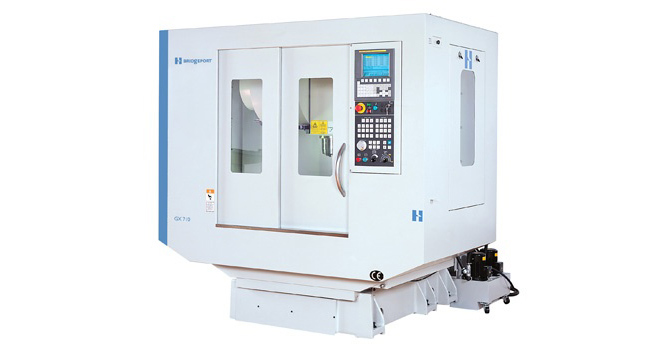
Thousands of GX-Series vertical machining centers are installed worldwide. These 40- 50 taper spindles VMCs include superior design characteristics to ensure many years of accurate and reliable performance.
GX-Series machines are ideal for mold and die manufacturers, aerospace, medical, defense, 3C, automotive and other industries, requiring high-value, complex parts from difficult to machine materials.
Superior design characteristics ensure Bridgeport 40-taper spindle GX-Series vertical machining centers deliver many years of accurate and reliable machining performance. These VMCs include a stiff and thermallystable spindle, a rigid C-frame fixed column design and fixed pre-tensioned double-nut ball screws on all axes. The unique Bridgeport-designed linear guide and guide truck configuration provides added stiffness, damping and surface contact area. The unit is configured with three guideways and five guide trucks on both the X- and Y axis, two guideways and six guide trucks on the Z-axis.
For more information, contact F&H Machine Tools – Tel: (011) 397 4050
The FANUC Roboshot has 9 models ranging from 15 ton to 300 ton and can be ordered with a wide range of screw diameters and injection speeds which can be selected to best suit your application.
The FANUC Roboshot utilizes the same highly reliable CNC technology that can be found in all FANUC products. As with all FANUC products, the Roboshot is backed by FANUC’s lifetime maintenance policy.
Precision molding repeatability is achieved through the low friction, highly rigid mechanism that utilizes FANUC Servo technology, thus making the machine fully electric driven. This also means that the machine is very economical to run as the servo system uses a regenerative function to conserve power.
Features
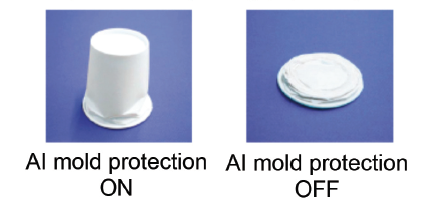
AI Mold Protection is a function designed to protect your mold by monitoring the torque of the servo motor during opening and closing motion of the mold. This allows obstructions to be detected before damage occurs.
Experimental example of AI mold protection by using paper cup
This function is also used on the ejector pins to monitor for abnormal ejector condition.
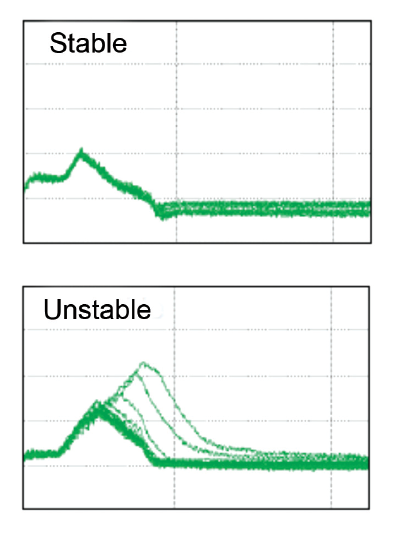
Backflow Monitor Function is used to monitor continuous production to check the stability of the molding process. Minor changes can be made to the settings on-the-fly to adjust stability and the results are displayed graphically on the backflow monitor screen.
Pre-Injection Function can be used to allow gasses to escape through the parting line before the mold fully closes. This allows for faster cycle times and better quality components as mold cavities will have less gas contamination.
The FANUC Roboshot comes standard with Euromap interface for easy connection to picker robots and can be easily connected to FANUC Robots. A hardware and software interface for connecting signal related equipment also comes as standard.
FANUC Roboshot-Linki is a software package that is separately available for the FANUC Roboshot. This allows the monitoring of multiple machines in an automated factory. This software also allows the user to check various statuses, power consumption and production volumes.

FANUC also offers a second injection unit on the 50 ton to 150 ton machines for two colour process molding. The SI-20iA unit fits on top of the FANUC Roboshot and the operation screen intergrates onto the Roboshot’s screen offering the same level of accuracy and repeatability.
FANUC Roboshot is made in Japan and comes with a 2 year mechanical and control warranty.
The FANUC Roboshot is available from FANUC South Africa.
For more information, contact FANUC South Africa – Tel: (011) 392 3910
CNC machining is quicker and certainly more accurate than conventional milling machines and there is no need for constant monitoring while in use. Taking this into account, MJH Machine Tools have a solution to suit customers’ needs. Featuring an entry level CNC control, our Ctek CNC milling machine is the first step to CNC machining.
Akira Seiki Milling Machine
As long as the operator has basic knowledge on using a DRO, he can, within a few hours, be taught how to program and run the machine. There is no need for G code knowledge as the control is conversational, using a question and answer format. The software is simple to use with graphic input in basic machinist language. The control has options for standard operation modes such as drill, tap, bore, contour and pocket programming, which is ideally suited to general engineering work without a need for external programming packages.
The latest Ctek’s come with linear guides on all three axes for better accuracy and speed, as well as a direct spindle drive motor and an improved Z axis motor with inline break which eliminates the need for a counterbalance. The Ctek can be fitted with a 4th axis within a matter of hours and programmed from the standard Ctek control.
Ctek CNC Milling Machine
The Ctek range has six x-travel sizes, 800mm, 1000mm, 1500mm, 1800mm, 2000mm and 2500mm. These machines are available in open type or fully enclosed depending on the customer’s requirements. All spares are available ex stock at a fraction of the cost compared to other controls. With hundreds of these machines sold throughout South Africa since 1997, it is not surprising that Ctek CNC milling machines have been the first step to full CNC machining in many workshops.
Should there be a requirement for a high performance machining centre for super fine finishing and accuracy, the Akira Seiki is the machine to consider. Spindle power ranging from 15HP on the Junior series to 42HP on the Super Vertical range and spindle speeds from 9000rpm to 15000rpm guarantee high quality surface finish.
Akira Seiki machines come standard with spindle oil chillers, inner spindle air chiller, coolant through spindle, pneumatic counter balance, chip screw conveyor, quick change ATC and 4th axis preparation.
The Mitsubishi Mi745 is the preferred control on these machines, however, Fanuc is an option but not always available ex stock Durban or Johannesburg. So, whether you need a machine for small batch jobs or production work, the Ctek and Akira Seiki machines are certainly to be considered.
For more information, contact MJH Machine Tools – Durban Tel: (031) 705 7514 or Johannesburg Tel: (031) 705 7514
Over the years, Hurco’s entry-level machining centre, the vertical-spindle VM1, evolved into the more capable VM10 and the manufacturer has continued to improve the specification.
Linear travels have been extended, a larger toolchanger is provided, spindle speed and rapid traverse are both faster and a spindle chiller and throughspindle coolant have been added. This progressive upgrade has left room for a new entry-level CAT/BT40 machining centre, the VM5i.
A notable feature of the machine is its compact footprint, despite it having generous axis travels of 457mm, 356mm and 356mm in X, Y and Z. A VM5i can enter a factory through a door just 1.64 metres wide by two metres high and occupies a small space when it arrives.
High quality build includes a rigid cast structure, linear guideways in all axes and Yaskawa digital drives. The spindle is rated at 7.5 kW / 8,000 rpm and is supplied with cutters automatically from a 16-station magazine via a swing-arm tool changer.
Hurco’s proprietary Max5 control rounds off the package, providing industry-leading conversational programming capability. It features a 19-inch LCD display with touch-screen navigation and a keypad that is adjustable by up to 90 degrees.
Worthy of special mention is that Ultimotion forms part of the standard software bundle. It controls axis movements using an advanced algorithm, rather than relying on hardware-based motion control, minimizing the need to decelerate when the cutter changes direction. As a consequence, cycle times are said to be up to one-third faster. Additionally, chatter, vibration and jerk are lower, resulting in improved surface finish on machined components.
For more information, contact Hurco South Africa – Tel: (011) 849 5600.