Outstanding organizations and companies in the sheet metal working industry are invited to enter the EuroBLECH 2018 online competition in five categories, now open here.
Recognition will be given for best practice, innovation, excellence and outstanding performance. Five winners, one in each category, will be selected by professionals in the sheet metal working industry via an online voting, starting in September.
This year’s “Step into the digital reality” competition engages the businesses in digital and automated processes. The five categories stand for late-breaking issues in the digital context of the sheet metal working industry: The first category Digital Transformation is open to businesses with excellent ability in applying smart manufacturing methods. The second one, 25 EuroBLECH shows, will select the funniest EuroBLECH story, either from visitors or exhibitors who participated in EuroBLECH over its long history. Cyber Security as the third category highlights the importance of secure data exchange within a production environment. The fourth category is Best Start-up and will reward new businesses for their outstanding performance. Pioneers in lightweight and component design for sheet metal working are invited to enter the fifth and last category, E-Mobility.
The five succeeding businesses will be formally presented with an award and certificate during a ceremony at EuroBLECH 2018. The winners will also be announced on the EuroBLECH website.
The online competition is open to all companies or organizations from all over the world in the sheet metal working industry if they match the requirements of at least one category and they are setting an extraordinary example in one of these categories.
The closing date for entries is 31 August 2018. After that, the entries will be published on the EuroBLECH website and the voting will start. The sheet metal working community can select their favourite entry in each category by an online voting system, with the voting closing on 30th September. At the award ceremony during EuroBLECH 2018 on 24 October, the winners will officially be announced and receive their prize. The entries from all participants will also be published on the EuroBLECH website which is used regularly as an information platform by professionals in the sheet metal working industry.
EuroBLECH is the world’s leading exhibition for the sheet metal working industry and takes place 23 – 26 October 2018 in Hanover, Germany. The exhibition functions as a global platform for professionals from the whole sheet metal working industry to meet and discuss late-breaking innovations, current developments and new products. The exhibition covers the entire sheet metal working technology chain: sheet metal, semi-finished and finished products, handling, separation, forming, flexible sheet metal working, joining, additive manufacturing, welding and surface treatment, processing of hybrid structures, tools, quality control, CAD/CAM/CIM systems and R&D. The show targets all sheet metal working specialists at every management level in small and medium-sized companies as well as large enterprises. Visitors include engineers, production managers, quality managers, buyers, manufacturers, technical directors and experts in associations and R&D. Around 1,500 exhibitors from 40 countries are expected to present their latest developments and systems for sheet metal working as well as conventional machines on a net exhibition space of around 89,000m2.
The first BelugaXL has rolled out of the paintshop unveiling a special livery making it look like a Beluga Whale.
The livery was one of six choices submitted to Airbus employees through a poll in which 20,000 people participated. With 40% votes in favour, the smiley livery won.
The BelugaXL will now undertake ground tests before first flight planned in summer 2018.
The decision to build the BelugaXL was taken in November 2014 to address the transport and ramp-up capacity requirements for Airbus beyond 2019. The new oversize air transporters are based on the A330-200 Freighter, with a large re-use of existing components and equipments. The first of five BelugaXLs will fly in summer 2018 and enter into service in 2019.
Aluminium has transformed the automotive industry, and it will continue to do so in future.
It offers a better cost-benefit ratio than any of the substitute materials on offer. By collaborating even more closely in future, aluminium producers, processors and vehicle manufacturers can unlock further potential for the use of aluminium here. The figures offer an impressive reflection of this trend. The average aluminium content of cars is steadily increasing. Whereas 60 years ago an average vehicle contained 19 kilograms of aluminium, between 1990 and 2014 the aluminium content of an average car nearly tripled, increasing from 50 kg to 140 kg. This figure is projected to increase to between 160 and 180 kg by 2020 as small and mid-size cars follow the trend set by luxury cars in the use of aluminium.
As the competition amongst materials intensifies, car manufacturers and aluminium suppliers have begun working together more closely. By investing in application-oriented research and development, the aluminium industry has succeeded in continually improving the properties of its materials, developing new products and optimizing production processes. Process and material innovations drive the development of efficient lightweight construction solutions and their implementation in series production, as with energy-saving components for chassis, engines, transmissions and gearboxes.
The use of aluminium in automotive manufacturing is also being driven by new joining technologies. Improved soldering methods, for example, have resulted in a situation where nearly all heat exchangers for automotive air conditioning systems and radiators are now made of aluminium. Innovative welding processes and bonding technologies make it possible to create complex structures that are not only better in a technical sense, but which are also more economical. Applications even extend to entire axle systems.
Aluminium conquers new application areas
In recent years, aluminium producers and processors have developed a series of new aluminium alloys (5xxx, 6xxx) with improved mechanical properties, including better strength, formability and corrosion resistance, allowing them to offer to ever lighter components with reduced wall thicknesses. Thanks to their good workability, high strength values and excellent weldability, innovative aluminium materials have made their way into new areas of application. The development of new roller surface geometries and lubricants for the improvement of tribological properties is also moving full speed ahead. Developments in the field of e-mobility are propelling use of this material, as power electronics, e-motors and especially batteries and the battery housings that protect them against external influences are creating further potential for the use of lightweight construction in vehicles. As a result of electronic vehicles’ different design requirements, there are many new products and applications for which aluminium profiles are the only sensible option, due to the possibilities for functional integration or cooling, for instance. Light metal solutions are winning out in battery housings, structural components and drive systems.
Automotive manufacturers define requirements for material developments
The automotive industry is one of the biggest drivers of material and process development for aluminium, whereby it is less the end customers themselves, but rather society as a whole and the regulatory framework that are pushing these developments forward. Increasing urbanization, such as in Asia, is forcing carmakers to come up with new concepts, while threshold values for the fuel consumption of each automotive manufacturer’s range of vehicles are also having an impact. As a result of all these factors, the demand for innovative lightweight construction solutions in the vehicle manufacturing industry will continue to increase.
Thanks to growing demand for sharp edged designs for automotive exteriors, 6xxx materials with excellent formability properties are urgently needed. As a result of lightweight construction and the reductions in sheet thickness that this entails, materials must offer high strength values. The specific requirements of automotive manufacturers vary. On the one hand, high strength and good crash performance, such as with ductility, are required, whereas only the highest stiffness levels can satisfy the rigidity requirements of the chassis. Depending on the use to which a component is to be put and expansion possibilities, good formability related to strength and geometry is expected in the various strength classes.
Aluminium industry looks to the future with optimism
Overall, the automotive sector offers the prospect of exponential growth for the aluminium industry, with demand and requirements for aluminium continuing to grow. Even if aluminium should lose market share in individual areas of application, it will find increasing employment in others, and its growth areas will remain larger than the areas in which substitutes are found.
In future, aluminium sheet will take the place of other materials, such as steel for the vehicle’s exterior and hang-on parts and OEMs have already made it clear that the use of aluminium will increase for bonnets, fenders and doors in the next generations of vehicles. Cast aluminium also remains an important and dynamic growth market. Aluminium founders have a wealth of materials expertise, and complex cast parts with high machining depth offer tremendous potential. The utilization of aluminium solutions in crashrelevant areas of the chassis also represents a field with outstanding potential for the future.
Automotive manufacturing at the focus of ALUMINIUM 2018
The future prospects of this material in automotive manufacturing will also be centre stage at this year’s No. 1 ALUMINIUM World Trade Fair from 9 to 11 October in Düsseldorf – both for many exhibitors and with such supporting events as the lecture forum and the guided trade fair tours.
This year’s Aluminium Conference – organized by GDA, the German Association of the Aluminium Industry will also pick up on this theme. Here the topics in focus include aluminium solutions for sustainable transport concepts, alloys, cooperations between aluminium and automotive producers, new developments in joining technology as well as additive manufacturing, to name but a few.
A total of 1,000 exhibitors and 27,000 visitors from 100 nations are expected to attend the world’s biggest trade fair for the aluminium industry. In six exhibition halls ALUMINIUM will showcase the complete cross-section of the industry – from aluminium production and machines and equipment for finishing and finished products through to recycling.
“Automation suppliers have made tremendous leaps with software, control and sensor technology that enable quantifying what the robot feels. If it feels anything out of the ordinary, it will stop before exerting too much force,” says Mike Cicco, President & CEO, FANUC America Corporation and a Board Member of AMT – The Association For Manufacturing Technology, which owns and produces IMTS.
“Where robots previously operated in restricted areas, we can now bring people and automation together to improve assembly operations.”
As cobot examples, consider a situation where a robot bin picks a heavy ball screw and holds it while an operator inserts bearings or an electronics assembly where a human performs the complicated chore of routing cables through a chassis and a robot performs repetitive tasks, such as driving screws.
“Collaborative robots, mobile robots, IIoT enabled systems, AI and automation careers will be some of the dominant automation trends at IMTS 2018,” says Tim Shinbara, VP – Technology, AMT.
Collaborative Robots: Automation demonstrations at IMTS 2018 include power and force limiting collaborative robots equipped with sensitive contact detection, which allows them to share workstations with people.
Cicco believes that machine tool owners and managers attending IMTS should explore collaborative and mobile robots, and that’s true for both high-volume and low- to medium-volume operations. He envisions a work cell where the robot could tend the CNC, such as for loading and unloading on long part runs. The cobot could function without requiring additional guarding and the operators could go about their routine without safety concerns (improvements to safety standards that reflect current technology now make this possible). For small batches or other instances where manually tending the CNC makes sense, the robot could be pushed to the side or moved to another cell.
“Automation mobility is moving forward. Equipment used to be bolted to the floor, but now there is a whole slew of what people are calling mobile robots, which pairs an automated guided vehicle with an articulated arm robot,” says Cicco. “We’ve also found interesting ways to deliver parts to robots and automated cells through mobile robot platforms.” Instead of investing in automation for each milling operation, a mobile robot can tend multiple machines, notably for operations with long cycle times.
Mobile robots can be self-propelled, manually wheeled or skid-mounted. In the past, relocating a robot would have required reteaching all of its movement points using a pendant control, a time-consuming task. The new generation of mobile robots eliminates this issue. Using fiducial markers — reference dots placed on the CNC — the mobile robot uses a vision system to capture images of the dots. As long as operators orient the robot relatively close to its original position, the robot can recalibrate all of its teach points, saving hours of programming time.
“We’ve seen quite an advancement with mobile robots that can be parked away when not in use and then be quickly and effectively deployed,” says Cicco. For job shops and manufacturers who want to save their human talent for high-value operations, using mobile robots for tedious tasks make sense.
As more than a side note, Cicco says that the industry is running into a shortage of robotic talent. Just as job shops and manufacturers cannot find people who want to become machinists, they are having a hard time finding people to program and maintain robots. Responding to this need, automation suppliers continue to work toward a goal of making operating a robot as intuitive as powering up a smartphone or PC.
MTConnect 10th Anniversary
IMTS 2018 marks the 10th anniversary of MTConnect, a set of open, royalty-free standards that fosters greater interoperability between controls, devices and software applications, which was launched at IMTS 2008. At the time, Cicco, an electrical engineer, served on the MTConnect Technical Committee for AMT.
He explains that the vision at the time was for the manufacturing world to develop a protocol that enabled controls, software and devices to communicate with the simplicity of connecting USB devices to a PC, e.g., a mouse, a computer and a printer, all from different manufacturers, that can work seamlessly simply by installing the appropriate drivers.
“AMT and IMTS were light years ahead of everyone else when it came to funding, leading the development and marketing of MTConnect,” says Cicco. “Fast forward a decade, and you can see a host of automation and machine tool providers demonstrating the benefits of connected devices at IMTS 2018.”
One of the premiere demonstrations will occur at AMT’s Emerging Technology Center (ETC) in the North Building. “For the first time at IMTS, we will demonstrate an MTConnect enabled ecosystem,” says Shinbara. The demonstration features a vertical CNC mill, a ROS-I (Robot Operating System- Industrial) interface and an articulated robotic arm that autonomously transfers the milled part to a CMM.
“This many-to-many interface enabled system could demonstrate how data sharing creates a closed-loop system,” says Shinbara. “Using data from the CMM, the CNC could compensate for tool wear by recalculating its offsets to maintain tolerances closer to the median of the specification.”
“As another MTConnect example, automation providers can run specific analytics that indicate the health of the robotic system and its individual components,” says Cicco. “Instead of unplanned downtime for checkups and maintenance, especially if a part still retains a high percentage of useful life, automation systems can communicate what needs maintenance and when, essentially achieving zero downtime.”
In short, connectivity is the key for companies that want to improve quality, hold tighter tolerances, push machine utilization rates to 90 percent or accomplish a host of other continuous improvement objectives.
Automation advances on display at IMTS 2018 include articulated robot arms with 3D area sensors (easy-to-use vision tools) that enable bin picking setup in a matter of minutes.
AI, Students and the Future
Looking back a decade and comparing that to exhibits at IMTS 2018, one of the more impactful technology advances will be the use of vision systems on robot arms for bin picking.
“Early attempts to use cameras on robots would have been deemed science projects instead of the basis for future commercial products,” says Cicco. “That has changed very rapidly. Today, industry puts robotic 3D bin picking and 3D inspection systems into use every day to increase productivity. Small- to medium-sized business owners might think such systems are too high tech, but that’s not necessarily the case.”
One of the over-the-horizon automation systems being demonstrated at IMTS 2018 will combine a vision system with artificial intelligence (AI) and a deep learning algorithm so the robot can teach itself to 3D pick an entire bin. The robot will use a camera to take a picture of what’s in the bin, but it has no idea what the part looks like or where and how to pick it up. The algorithm will gauge whether the pick succeeds or fails, enabling the system to learn how to make a good pick as it empties the bin.
“The cool thing about deep learning is that if two robots perform the same operation and share their successes and failures over a neural network, they will cut learning time in half because they will never repeat the same error,” says Cicco. “If hundreds connected AI robots perform the task, we could find answers to complex problems pretty quickly.”
Shinbara says that, “the beauty of AI and data science is that you can correlate events to causes that would not have been found naturally. A second area of AI is with process optimization. Imaging if we applied AI to the ETC demonstration. As the system learns its way through the process, it could automatically shift to rough profiling operations to obtain more life from the tool instead of sending a signal to replace a worn tool.”
The second area of AI capability focuses on very discrete tasks. A third and nascent AI capability, according to Shinbara, is a holistic approach, such as systems that learn to improve movements between the robot and the CMM or a CNC that adjusts feeds and speeds over particular time to achieve better quality or optimize tool life.
The high economic sentiment is gradually being transferred to consumption and industrial production. Demand for capital goods is at record-high levels and we have been seeing clear signs of sustained global manufacturing momentum at the beginning of 2018. Industrial strength is finally expanding beyond Germany, and our forecasts suggest a 3.9% gain in global industrial output in 2018 and 3.7% in 2019.
Global trade also boosted its growth in 2017 and is expected to increase further, but at a slower pace. For the same year, CECIMO-based machine tool builders exported about €20 billion worth of machine tools, showing a 9.1% increment compared to 2016. The main destinations outside CECIMO countries were China (15.4%), the US (10.6%), Poland (4.2%) and Mexico (3.4%). The increasing foreign orders point to a continuous improvement in machine tool exports in 2018. As a matter of fact, the demand for machine tools is expected to increase further in 2018, following the Business Confidence Indicator for Europe.
In 2017, CECIMO’s machine tool consumption reached €16.5 billion (5% higher than in 2016) and is foreseen to increase by 8.2% in 2018 and 4.9% in 2019. Nevertheless, geopolitical risks remain at stake. The US is a great source of uncertainty in foreign policy and international trade, potentially having a significant impact on our businesses, but markets are yet to react. Brexit is also posing additional risks to exporters. Mr Marcus Burton, the Chairman of the Economic Committee,asserts that “preserving competitiveness of European businesses should be a priority for EU policy-makers when facing these challenges. We must secure a positive trade and investment relationship for Europe”.
China, the main driver of machine tool consumption, will benefit from the trade recovery and further increase machine tool consumption, although investments seem to be fading out. The US tax reform is expected to strengthen business outlook and benefit our companies. Therefore, the forecasts for global machine tool consumption have been revised to 6.1% in 2018 and 4.4% in 2019. Increases in machine tool demand and older machine tool purchases reaching the end of their service life are creating significant capacity constraints and make new investments more crucial.
Artificial Intelligence – how do we keep Europe at the top
Artificial Intelligence (AI) has tremendous potential to unleash remarkable benefits for businesses. At the same time, the application of AI techniques and technology could result in a shift of workers between jobs and skills and the displacement of workers with moderate proficiency in literacy and numeracy. That’s why the CECIMO Spring Meetings in Mainz focused on AI and the future of work. Industrialists, EU officials, stakeholders and experts provided us with insights into the impact of AI on various sectors of the economy and employment.
Our debate matches the European Commission’s recent communication “Artificial Intelligence for Europe’’, which we consider a positive step towards the creation of an open environment to stimulate investments in AI and keep the EU at the forefront. Europe needs a common EU approach if it wants to compete at a global level, so we welcome the EU initiative to increase investments in AI research and innovation by at least €20 billion between now and the end of 2020. We need a systematic approach to innovation, research policy and investments in AI, in order to boost the EU’s technological and industrial capacity across the economy.
“The machine tool sector is going through a rapid digital transformation. The industry is developing and investing in new business models together with customers. For manufacturers to future proof their factories, technology, processes and people should be equipped and empowered to face the upcoming challenges and stay ahead of the competition,” states Mr Filip Geerts, CECIMO Director General.
Each era of industrialization has had an enormous impact on employment and the workforce, therefore CECIMO advocates for enhanced cooperation between governments and industry. New jobs in the future will demand new skills: we need to create a positive environment that will ensure our workforce is ready to reap the benefits of change. To meet demands of industries, there is a requirement to invest in re-skilling and life-long learning.
In this context, we had the pleasure to hear Marianne Thyssen, European Commissioner for Employment, Social Affairs, Skills and Labor Mobility. “CECIMO can be a strong ally in defending the added value of EU-funded initiatives on education and training issues by being actively involved in European-funded projects on entrepreneurial skills in the machine tool industry and developing vocational training and apprenticeships,” said Thyssen.
“In our view, the biggest manufacturing innovation, vital for the factory of the future is the collaboration of robots with humans: they will learn to work side by side to make processes along the assembly line more efficient, safe and accurate. The future of work is not about replacing humans with robots – it is about collaboration of skills,” states Dr Roland Feichtl, CECIMO President.
Carbon fiber-reinforced plastics are gaining importance as components of aircraft. The trend is increasing the need for sustainable recycling concepts. At the ILA in Berlin recently Fraunhofer presented a technology that converts recycled carbon fibers into materials for batteries and fuel cells. This saves costs, improves the CO2 balance and opens up new means of recycling in aircraft production.
Modern wide-body aircrafts today consist of over 50 percent carbon fiber reinforced plastics (CFRP). The material is installed, for example, over a large area in the wings or fuselage. With carbon fibers embedded in a plastic matrix, the composite is lighter than previously used materials, while still being very stable. The decisive advantage for aviation: due to their lower weight, airplanes need less fuel. “The manufacturing and processing of the CFRP is currently very time-consuming. The demand for sustainable recycling concepts is therefore steadily increasing,” observes Elisa Seiler, scientist at the Fraunhofer Institute for Chemical Technology ICT in Pfinztal, Germany. The amounts of CFRP recycling material are tremendous: for the Airbus 350, for example, they add up to over 65 tons. “In addition to this there are other relevant scrap quantities that already arise during production,” adds Seiler.
The Fraunhofer ICT has many years of experience in the development of technologies for fiber-reinforced plastics. At the ILA, the aviation and aerospace innovation trade fair, the scientists are presenting a concept that will be used to recover materials for batteries and fuel cells out of recycled carbon fibers. Together with partners, it has been possible to use recovered carbon fibers to produce a prototype of a bipolar plate – an electrode – on an industrial scale. The result is based on research from the “Graphit 2.0” and “RETRO” projects.
“Electric drives are now also a serious topic in the aviation industry. Manufacturers can directly perform value-preserving recycling by transferring materials from one application to the next,” says Seiler. The carbon fibers are electrically conductive and are suitable as a substitute for natural graphite, which also consists of carbon, a resource- critical raw material for the German economy that currently has to be imported from China at great expense. Recycled CFRP can be used for additive manufacturing processes such as 3D printing. “This is also a trending topic in the industry that makes production processes more efficient and saves costs,” says Seiler. After all, aircraft manufacturers also have to comply with the European Union (EU) requirements that have been in force since 2015; up to 85 percent of the average weight of a used vehicle has to be recycled.
Pyrolysis with microwave radiation
The CFRP experts have developed a special process with which carbon fibers can be recovered from the plastic matrix. To do so, they use microwave radiation to burn the plastic matrix that surrounds the fibers. So that the fibers do not burn up at temperatures of up to 900 degrees Celsius, the combustion has to be performed without oxygen. “In technical jargon, this is called pyrolytic decomposition,” Seiler explains.
The advantage of microwave radiation includes energy efficiency as a whole oven no longer needs to be heated, just the component itself. The colleagues of the Polymer Engineering department at the Fraunhofer ICT embed the recovered fibers in thermoplastic material. This composite material has similar properties to graphite and is suitable for the production of bipolar plates. “Our prototype passed all the tests for conductivity, density and corrosion resistance perfectly,” reports Seiler.
“We’ve proven that it’s generally feasible to use recycled CFRP fibers to produce bipolar plates for batteries and fuel cells. This shows that recycling works in a holistic approach. This is particularly interesting for the aviation industry,” says Seiler in summarizing the added value of the research work. The next steps are the characterization of the bipolar plates in the battery cell network and studies concerning the life cycle assessment. “Then, we want to tune the technology so that we can manufacture bipolar plates from recycled CFRP in series – for example, with an aviation partner,” concludes Seiler.
The National Association of Automotive Component and Allied Manufacturers (NAACAM) announced that the NAACAM Show 2019 will be hosted by eThekwini Municipality in partnership with the Durban Automotive Cluster (DAC). This will take place at the Durban International Convention Centre (ICC) (Inkhosi Albert Luthuli ICC Complex) on 12 – 14 March 2019.
The inaugural NAACAM Show in April 2017 was held at the Durban ICC and saw 1 304 delegates participate in a two-day conference and exhibition. Delegates engaged with 46 speakers on nine conference themes, including manufacturing best practice; black supplier development and transformation; the future of the automobile; and the South African Automotive Masterplan.
The NAACAM Show 2017 exhibition saw 183 automotive component manufacturers, government and support service agencies present their offerings to delegates and key automotive stakeholders – this included the profiling of 38 black-owned suppliers. A highlight of the 2017 Show was the facilitation of 122 prearranged buyer-supplier linkage meetings, as a key goal of the Show is to deliver significant localization benefits.
In 2019, with the support and endorsement of the Department of Trade and Industry, the Original Equipment Manufacturers (OEM) Purchasing Council, Automotive Supply Chain Competitiveness Initiative (ASCCI), as well as National Association of Automobile Manufacturers of South Africa (NAAMSA) and National Union of Metalworkers of South Africa (NUMSA), the NAACAM Show aims to be the premier automotive manufacturing growth, technology, transformation and stakeholder engagement forum in Africa.
Renai Moothilal, NAACAM’s Executive Director.
The NAACAM Show is an initiative wholly owned by industry, with senior component manufacturing leaders providing oversight to its delivery. Renai Moothilal, NAACAM’s Executive Director stated that “direct supplier oversight of the initiative is key to ensure that we deliver an event which reflects on the sector’s most relevant issues and opportunities, whilst also clearly showcasing the capability and capacity of the SA automotive value chain.
”The NAACAM Show 2019 will have an increased focus on Sub-Saharan African opportunities and alignment with the Automotive Masterplan objectives. The attraction and hosting of international technology suppliers and foreign direct investors is also a priority for the 2019 iteration of the Show.
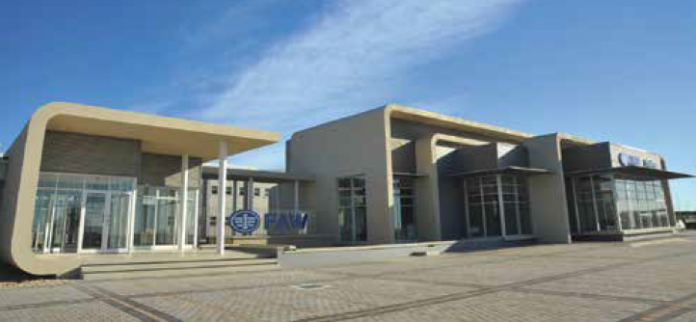
The fortune 500 company with a truck assembly plant worth R600 million and located at the Coega Special Economic Zone (SEZ) spent the greater part of 2017 raving up its export numbers to 212 units.
“Nothing gives us greater pleasure than to see the extent of success that accumulates with investments located at the Coega SEZ. It validates the findings of an independent study on the Coega SEZ, which found that 90% of operational investors described the SEZ and its logistics park as the ideal location for industries,” says Dr Ayanda Vilakazi, Marketing, Brand and Communications.
The success of FAW in the year 2017, is compounded by a further record year in terms of domestic sales having grown from 929 units in 2016 to 1 032 units in 2017.
“As the CDC we were very proud to hear of the company having rolled of its 3 000th locally built truck off the production line in 2017,” concludes Vilakazi.
BMW Group South Africa despatched the first BMW X3 cars for export recently, transporting more than 100 units on 27 wagons via train to the Port of Durban. This marks a significant day for BMW Group South Africa as the company’s manufacturing plant at Rosslyn continues to ramp up production of the BMW X3.
In terms of the Automotive Production and Development Programme (APDP), BMW Group announced a R6.1bn investment to prepare the Rosslyn facility and the associates who work there, for X3 production. It is one of the biggest single automotive investments in South African history. In February 2018, Plant Rosslyn produced the last of 1 191 604 BMW 3 Series cars built over five model generations and 35 years.
Upgrading the plant for X3 production has represented the largest infrastructure upgrade in the plant’s history, but it has gone ahead on time and without any unplanned disruptions. The BMW Vehicle Distribution Centre in Rosslyn can accommodate up to three train dispatches a week, with each transport capable of carrying up to 160 cars.
BMW Group Plant Rosslyn is a state-of-theart facility, with BMW X3 production initially planned with a maximum capacity of 71000 units a year. However, BMW under-estimated the phenomenal demand for the new BMW X3 and after a further R160m investment to increase linespeed, the maximum capacity of the plant was raised almost 10% to 76000 units a year.
Within this maximum capacity, BMW Group South Africa is confident that the plant will produce record volumes next year. This will add to the growing success of BMW’s X models across the world, which now make up more than 30% of BMW’s global volume.
The Steel and Engineering Industries Federation of Southern Africa (SEIFSA) is encouraged by the improvement in the Absa Purchasing Managers Index (PMI) released recently, with the data showing that businesses are slowly responding to a buoyant consumer, business and investor confidence.
SEIFSA Chief Economist Michael Ade said that, following Cyril Ramaphosa’s election in December as new ANC president, domestic economic data were expected to catch up with growing domestic sentiments resulting from the Nasrec conference. He said that was more so after Ramaphosa assumed the country’s presidency.
However, Ade cautioned that, in addition to positive consumer and business confidence, there was a need for an equal up-tick in demand and supply side dynamics.
SEIFSA Chief Economist Michael Ade.
SEIFSA is, therefore, encouraged by the improvement in the latest PMI numbers, which had previously dipped below the 50-neutral level, which separates expansion from contraction, in February 2018,” Ade said.
The latest seasonally-adjusted preliminary PMI data show that the composite PMI improved to 50.9 in April 2018, from a lower 46.9 in March 2018. However, the headline PMI data still exhibit a lot of uncertainty and the volatility is driven by volatile input prices, because of factors affecting supply, including the variable exchange rate. Enhanced volatility is also evident in the oscillating performance of the business activity, inventory levels and new sales orders sub-indices of the composite PMI index, which have been largely unpredictable.