Home Blog Page 45

RAPID PANEL BENDING WITH THE TRUBEND CENTER 7030

TruBend Center 7030
The latest generation of the TruBend Center 7030 bends parts up to 30 percent faster than its predecessor. This boost in speed stems from its new drives and other features.

RAPID PANEL BENDING WITH THE TRUBEND CENTER 7030 The new TruBend Center 7030 bends parts up to 30 percent faster than its predecessor – and its tool change cycles are up to 70 percent quicker. TRUMPF has included the option of equipping the panel bender with a loading and unloading station. Panel bending machines such as the TruBend Center 7030 are particularly adept at fabricating complex parts with radius bends, short side lengths, and narrow profiles.When it comes to producing parts with these kinds of specifications, this alternative bending technology is quicker than die bending machines. TRUMPF has focused on making the TruBend Center 7030 faster than ever. The engineers achieved this by splitting the machine’s drive unit into two parts. Instead of equipping the machine with just one central hydraulic cylinder, the new design features one cylinder on the left, and one on the right. That increases axis velocity, and boosts the machine’s productivity. The on-demand servo drive saves energy by only running the motor when the machine actually needs it.
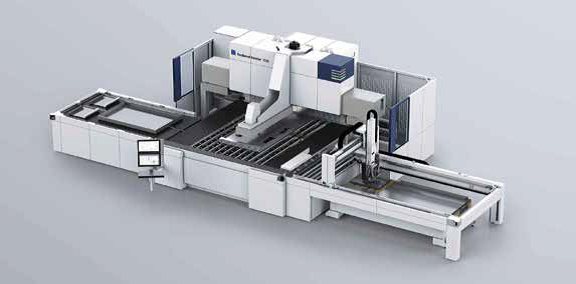
The new TruBend Center 7030 can optionally be equipped with an automated loading and unloading
station.

Automated loading and unloading

The operator can stack various piles of metal blanks on the right-hand side of the machine. A suction cup initiates the automated loading process by picking up a sheet whilst simultaneously checking that it has not taken two by mistake. This gripper device deposits the blank on a brush table, with a positioning bar ensuring it is aligned correctly. A loading carriage then moves the blank into the machining area, simultaneously removing the most recently bent part from the machining area, and transporting it to a conveyor belt. During this loading and unloading process, the TruBend Center 7030 continues to operate. Change tools faster – program parts within a matter of seconds The task of changing bending tools is handled by the ToolMaster. As well as increasing its axis speed, the TRUMPF engineers have also added a feature that allows it to change multiple small tools at the same time. These improvements reduce machine setup time by up to 70 percent. The TruBend Center 7030 features the offline TecZone Fold programming solution that enables operators to program many parts in just a few clicks of the mouse. TecZone Fold takes a matter of seconds to generate the bending program and 3D simulation of the parts, including collision monitoring.

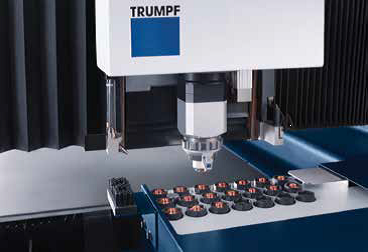
TRULASER SERIES 1000

TruLaser
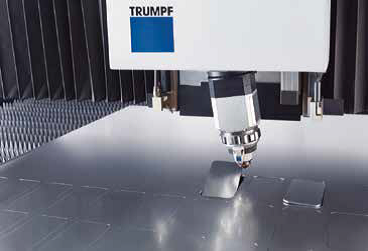
The TruLaser Series 1000 looks like the higher classes of TRUMPF 2D lasers. TRUMPF equipped this line with many features that were once exclusive to TruLaser Series 3000 and 5000 models.

The TruLaser Series 1000 handles many cutting-related processes autonomously to drive down part costs.

Equipped with a robust laser and proven functions such as collision protection, these machines cut sheet metal in a process-reliable way. And the intuitive operating concept reduces training time. Beyond that, TRUMPF added features such as protective glass monitoring and BrightLine fiber. Previously available only in higher 2D laser classes, they serve to optimize processes and boost machine efficiency. The series consists of two types of machine, the TruLaser 1030 fiber and the TruLaser 1040 fiber with work areas three and four meters long, respectively. The TruDisk solid-state laser operates at constant power and is insensitive to reflections off copper, brass and other materials that reflect when cut. TRUMPF ships these machines out with data for cutting many commonplace materials and thicknesses of sheet metal. It enhances their process reliability – they can even cut copper with nitrogen. Machines with a four-kilowatt laser are equipped with BrightLine fiber. With this function, they can cut thick mild steel in a process-reliable way. In the event of a collision with tilted parts, a special protective mechanism deflects the cutting head to prevent damage.

The TruLaser Series 1000 automatically changes nozzles to the correct type.

The TruLaser Series 1000 deposits slag and small parts in five pull-out drawers below the machine’s frame. This re-engineered line of TRUMPF machines is far more dynamic than its predecessor. Positioning speed is up from 85 to 140 meters per minute. This speed is down to the design of the machine’s body, which combines a rigid machine frame with a lightweight motion unit and powerful drives. The machine cuts all materials and sheet thicknesses with the same cutting head. It changes nozzles automatically thanks to the optional nozzle changer. Sensors monitor the optics’ protective glass and let the operator know when it is time for a replacement. Visual inspections are a thing of the past. All this reduces the machine’s set-up time. The TruLaser Series 1000 also saves time during the cutting process. The PierceLine feature reduces piercing time by up to 80 percent and protects the machine and material. These machines operate very energyefficiently with an average power consumption of 13 kilowatts for the 3-kilowatt laser and 14 kilowatts for the 4-kilowatt laser. They also come with more energy- conserving features, as do their periphery modules. The TruLaser Series 1000 features a 18.5-inch multi-touch control panel. It displays the most frequently used menu items at the top level. If the operator interrupts an operation, the control unit enables processing to resume at the same point. The monitoring capability is not limited to the protective glass: Other sensors track the condition of components that impact the machine’s cutting performance. A traffic-light readout on the control panel called the Condition Guide indicates the status. It also offers guidance when the operator needs to take action.

The cutting head deflects if it collides with a tilted part.

Flow charts make it easier to forecast actionable events and provides a more efficient way of scheduling maintenance work. A semi-automatic pallet changer is a standard feature. The operator can prepare new sheets, while the machines are operating and sort or unload cut sheets parallel to the cutting process. Users may opt to equip the TruLaser Series 1000 with automated LiftMaster components. They load raw sheets and remove the cut sheets. TruLaser Series 1000 machines may be connected to the compact TruStore storage system or to a large Stopa storage system. The MobileControl app serves to operate the TruLaser Series 1000 using a touchpad situated near the machine. TruTops Monitor software tracks the machine’s status continuously and notifies the operator in the event of a malfunction. The TruLaser Series 1000 affords users the opportunity to access the machine’s digital enhancement. It contains five apps that assess machine data and deliver the results to users. AXOOM, a TRUMPF subsidiary, provides the cloud platform for processing these data. The apps provide an insight into tool and material usage and display the current machine status to users on the go.

VERSATILE HIGH FEED MILL WITH STRONG 4 CUTTING EDGE INSERT

To meet market demand, TaeguTec has released an expansion to the CHASE- 4-FEED family – BLMP 04, 11 inserts and cutters.

They are, smaller double-sided four corner BLMP 04 inserts for small and high feed machining applications. The smaller size inserts mean more inserts can be mounted to the same diameter cutters, which will greatly improve productivity over the existing BLMP 06 type under similar conditions.

Available in Ø8(1z) and Ø10(2z) sizes, these are an alternative to solid end mills for roughing operations. While both the BLMP 11 and BLMP 13 cover a similar machining range, the BLMP 11 inserts give an advantage as they make it a finer pitch same diameter cutter for better productivity.

The cutters come in all types, including face mill, end mill and modular types. While, as part of the new campaign, the design for the new CHASE-4- FEED line highlights TaeguTec’s new direction, the new CHASE-4-FEED logo will be applied to the BLMP 06, 09 inserts and cutters as well.

DMG MORI CTX BETA 800 TC

CTX beta TC

Thanks to the possibility of 5-axis machining, the CTX beta 800 TC closes the gap to the classical universal lathes as far as the high-performance area in the direction of maximum flexibility for chuck components, such as in mechanical engineering or in the fluid or hydraulics industry.

Its automatic tool changer provides outstanding flexibility in classical turning operations involving workpieces up to Ø 500 x 800mm. The highlight of the CTX beta 800 TC is the turning-milling spindle. The Y stroke of 200mm and the new compactMASTER ultra-compact turningmilling spindle open up a wide range of applications to users of Turn & Mill complete machining to the extent of 5-axis simultaneous machining. The compact design of this spindle with integrated release cylinder for the tool clamp makes it possible to have torque of 120 Nm with an impressive length of just 350mm. In comparison with a conventional spindle the increase in work area is 170mm, with 20 percent more torque at the same time. The B-axis is also equipped with a direct drive, which makes highly dynamic machining possible with a swivel range of ±110° and rapid traverse speeds of 70 rpm.

For complex milling operations right through to 5-axis simultaneous machining, the HSK-A63 (optionally Capto C6) compactMASTER turningmilling spindle has performance data of 12 000 rpm, 120 Nm and 22 kW. A 20 000 rpm high-speed version is also available as an option. The DMG Mori high-tech modular building block system allows customers to equip the machine individually in line with their particular range of components. Among other things, this includes different tool magazines with a capacity of up to 80 pockets rather than the 24 as standard.

In the standard version the machine has a main spindle, designed with a liquid-cooled integral spindle motor (ISM76) with 380 Nm and 34 kW or optionally as ISM102 with 770 Nm and 38 kW and an NC-controlled tailstock. The machine can also be equipped with a counter-spindle instead of the tailstock for 6-sided complete machining. The ISM52 PLUS with 6 000 rpm and 170 Nm is provided for this purpose. Chucks up to 400mm diameter can be used on the machine in conjunction with the ISM102 spindle motor. Steady rests, available for workpiece diameters of up to 200mm, are recommended for the machining of long workpieces.

The sturdy travelling column design stems from the larger CTX beta 1250 TC and has long since demonstrated its quality. Maximum stability and accuracy are achieved by means of combining with the direct measuring systems in all axes of the travelling column. The machine concept also has impressive ergonomics. Whereas the CTX beta 800 TC has a large work area, its advantages with regard to accessibility and space requirement are also remarkable. The 350mm distance from the front of the machine to the centre of the spindle is the ideal prerequisite for easy loading and unloading. The footprint is just 8.5 m² or 10.7 m² including chip conveyor.

HEAVY DUTY MACHINING OF UP TO 600kg WORKPIECE ON 8.9m²

CLX750

The new CLX 750 impresses with its stability, a powerful spindle and forward-looking equipment options for digitalized production.

Designed for workpieces up to 600kg and a turning length of 1 290mm, the universal turning center is particularly suited to the machining of large shafts. With DMG MORI technology cycles, the IoTconnector as standard and modern 3D control technology, the CLX 750 is ready for any forwardlooking production. Customer-specific automation solutions complete the range of equipment.

Up to 1 290mm turning length and a maximum turning diameter of 700mm or 640mm in the version with the Y-axis make the CLX 750 a very versatile turning center in a wide range of industries. In the production of shafts, an optional steady rest supports turning operations up to a diameter of 430mm. A Y-axis traverse distance of an impressive ± 80mm is available for the eccentric machining of complex workpieces, while a sub spindle enables 6-sided complete machining. On spindle side, the CLX 750 impresses with regard to heavy-duty machining: 2 000 Nm torque and 46 kW power speak for themselves.

DMG MORI has made the CLX 750 future-proof in view of the growing digitalization in machining operations. Modern 3D control technology from SIEMENS or FANUC is available, while exclusive DMG MORI technology cycles like alternating rotational speed, the Easy Tool Monitor 2.0 or the Multi-Threading Cycle enable easy and efficient machining. The IoTconnector is part of the standard equipment of all CLX machines. It enables digital networking of the machines, provides the highest possible protection by means of integrated firewall and enables pioneering service solutions with SERVICEcamera and NETservice.

Future-oriented manufacturing is increasingly accompanied by automated production – a trend which is consistently followed by DMG MORI. This way, productivity of the CLX 750 can be improved lastingly with customized automation solutions – and in the well-known DMG MORI quality.

FS AND MK RHINORUSH CHIP BREAKERS

MK Chip Breaker

The process of properly controlling chip formations is important in order to prevent loss of production due to frequent halts in the machining process, as well as damage to the tools and work-piece.

The RhinoRush MK chip breaker is ideal for medium applications while machining stainless steel and heat resistant materials.

The MK chip breaker is a more stable insert that offers long tool life because of its sharp edge design that minimizes built-up-edges during machining operations.

Case studies prove the effectiveness of the MK chip breaker with tool life being increased by over 300 percent.

For example, during the product testing phase of a workpiece made from SUS 304, the MK chip breaker coated with TaeguTec’s TT9080 grade witnessed an increase of tool life by 343 percent during continuous cutting conditions with speeds of 160 meters per minute and same cutting conditions.

During another continuous cutting test, on difficult-to-cut Inconel 718, tool life was increased by 159 percent with all cutting parameters the same.

The RhinoRush FS chip breaker is specifically designed for excellent chip control on steel finish turning with superior evacuation under low feed and low depth of cut applications, while the insert’s sharp cutting edge drastically reduces machining load resulting in minimal vibration during operations.

RHINORUSH EASES MACHINING OPERATIONS

New Screw Clamping Type Boring Bar

TaeguTec’s range of boring bars with screw clamping function is available to suit C, T, V and W shape RhinoRush inserts.

With the screw clamping type boring bar, the current hook lever, T-Holder and wedge clamp types, the RhinoRush line of boring bars meets the needs of more demanding machining applications.

The screw clamping type boring bar has a simple clamping structure, minimizes chip evacuation interference during internal machining and is stable plus durable during demanding operations.

Advantages of the ground type ML chip breaker include reduced cutting force due to its very sharp cutting edge and extended tool life with improved surface quality due to minimal built-up-edge during machining.

Ground ML Chip Breaker Insert

By combining the chip breaker’s sharp geometry and polished uncoated grade, this addition makes the RhinoRush line the perfect choice for aluminium and super alloy machining.

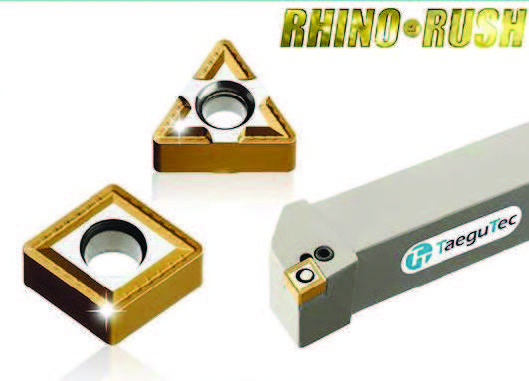
RhinoRush’s mini turning inserts are very popular across many sectors within the manufacturing arena as they reduce machining cost and increase output.

RhinoRush is characterized by a tough and smaller double-sided insert that enables improved machining time and better surface finish.

EUROBLECH 2020 – MORE THAN 95000m2 NET EXHIBITION SPACE ALREADY BOOKED

Euroblech 2020

The 26th edition of the International Sheet Metal Working Technology Exhibition, EuroBLECH 2020, will take place from 27 – 30 October 2020 at the Hanover Exhibition Grounds in Germany. The show organisers, Mack Brooks Exhibitions, have now announced the expansion of exhibition space for EuroBLECH 2020 with the addition of a ninth hall for the first time in its history. This reflects a further increase in exhibition space compared to the previous event in 2018, which covered a total of 89 800 square metres.

“Around nine months ahead of the show the demand for stand space continues to be very strong”, explains Evelyn Warwick, Exhibition Director of EuroBLECH, on behalf of the organiser Mack Brooks Exhibitions. “With the directly neighbouring hall 26, we are now able to offer additional stand space for the exhibition to meet the demand of exhibitors to display their latest machines in the various technology sectors. The additional hall will host exhibitors of joining technology, as well as surface and tool technology, which have previously been located in hall 13. The ninth hall is giving us the possibility to assign stand space to additional exhibiting companies within the entire sheet metal working technology chain represented at EuroBLECH. The growth to a ninth exhibition hall reflects the increasing demand for stand space at the leading industry event and offers even more capacity for businesses to present their innovations to an international audience”, continues Evelyn Warwick.

Currently, more than 95 000 square metres of net exhibition space have been booked or reserved at the world’s leading sheet metal working technology exhibition. This represents an increase of almost 6% in stand space compared to the previous show in 2018. The biggest exhibitor countries include Germany, Italy, Turkey, China, Switzerland, the Netherlands, Spain, Belgium, Great Britain and the USA.

For EuroBLECH 2020, the main topics represent the latest industry trends, including smart sheet metal working as well as automation and digitalisation of the manufacturing chain, with the objective to increase output and efficiency. For exhibiting companies in this industry sector, it is a vital time to present their machines, systems and solutions for networked manufacturing to an international audience.

Every two years, the world’s largest sheet metal working technology exhibition attracts top industry professionals from all over the world. The show targets specialists at all management levels in small and medium-sized companies as well as large enterprises from all key industry sectors. Featuring an enormous amount of live machine demonstrations, EuroBLECH is renowned with international sheet metal working professionals as the most important event to find smart solutions and the right machines, equipment and materials for their companies. A total of 56 307 international trade visitors attended the previous show.

The EuroBLECH exhibition profile is clearly structured and covers the entire sheet metal working technology chain: sheet metal, semi-finished and finished products, handling, separation, forming, flexible sheet metal working, joining, welding, tube/section processing, surface treatment, processing of hybrid structures, tools, machine elements, quality control, CAD/CAM/CIM systems, factory equipment and research & development. The organisers recommend companies interested in exhibiting to reserve their stand space as soon as possible in order to be placed within their respective technology sector.

The latest exhibitor list as well as further information on the exhibition is available at www.euroblech.com.

TIPPER BODY MANUFACTURER INSTALLS UK’S LARGEST TRUMPF BENDING MACHINE

TRUMPH TruBend 8600-80

The Thompsons Group, the UK’s number one manufacturer of tipper bodies, has taken delivery of a TRUMPF TruBend 8600-80 bending machine at its Blackburn facility. The machine, which is the largest TRUMPF TruBend in the UK, is being used to form tipper side panels from 4mm thick Hardox® abrasion-resistant steel.

Thompsons, which has UK sites in Croydon, Blackburn, Dover and Edinburgh, says that it builds and sells more tipper bodies than all of its competitors combined. Since 2000, the business has expanded five-fold.

Following its inception in East London 45 years ago, Thompsons has manufactured over 30 000 tipper bodies, of which around half are still in operation today. The bodies cover the full range of commercial vehicles, from 3.5 to 44 tonnes GVW (gross vehicle weight). Thompsons’ customers not only come from the construction industry, but sectors such as waste, environment, highways, utilities and rental. Top of the rigid range is the Loadmaster, some 15 000 of which have been delivered in the past 20 years.

“With order volumes rising there is a constant need to keep pace with production and invest in our future,” explains Director Neil Griffin. “We recently installed a robotic welding cell, which shifted the bottleneck to bending. In addition, even though our existing press brake offers a capacity of 400 tonnes, we needed more to help us process 4mm thick Hardox®, which is a tough, wear-resistant steel with a hardness of 450HB.”

Griffin and his team scrutinised three potential bending machine suppliers, but it was TRUMPF that impressed the most. “We went to the TRUMPF factory and saw the machines in action,” he says. “Once they assessed our application, the TRUMPF team recommended the TruBend 8600-80, which we knew immediately was the right machine. At the same time we purchased the TRUMPF TruLaser 3030 laser cutting machine.”

The TRUMPF TruBend 8600-80 impresses not just with its precise versatility, but its large open height, throat depth and press force. Users can process particularly large and heavy parts. Thompsons’ TruBend 8600-60 offers a 600 tonne press force, and to fulfil the customers’ requirements TRUMPF customised the machine with an additional 8m bending length option.

“After profiling, the side panels of the tipper bodies each require up to 12 bends, which is where the tonnage of the TRUMPF TruBend 8600- 80 really comes into its own,” says Griffin. “Having capability of this type in-house is a real market advantage as we don’t have to rely on subcontractors, and thus avoid all the associated costs and lead-time issues that strategy brings. Moreover, all Thompsons’ tipper bodies are manufactured specifically for each customer, who can specify the height, length and width of the tipper bodies they require. As we manufacture in-house, meeting these needs could not be simpler.”

Thompsons manufactures circa 25 Hardox® tipper bodies on a weekly basis, which means 50 sides to bend, plus floors and tailgates. The new TRUMPF TruBend 8600-80, located at the Blackburn factory, is currently working a single day shift but a night shift maybe required to keep up with demand.

“Having the higher tonnage machine makes light work of the Hardox® panels,” reports Griffin. “In addition, the machine is more accurate than our existing press brake. As a company, we are always looking to improve and innovate, so machines such as the TRUMPF TruBend 8600-80 serve to future-proof our business.”

Parts arriving at the TruBend 8600-80 for bending will likely have been profiled on the company’s TRUMPF TruLaser 3030 laser cutter. Importantly, the TruLaser 3030 features the optional TRUMPF Highspeed Eco function, which allows faster profiling with up to 70% less gas consumption. “Furthermore, the cut quality on all parts up to 25mm thick is better than anything we’ve achieved previously,” states Griffin.

When acquiring the TruLaser 3030, TRUMPF simplified the process by buying and removing the company’s old laser cutter. “We’ve had nothing but a very positive experience with TRUMPF, both from a machine and people perspective,” concludes Griffin. “As a result, we have high hopes for a successful partnership together moving forward. Any high-quality, market-leading product inevitably has leading-edge technologies behind it, and tipper bodies are no exception. Every year, over £1 million is invested back into our factories as we look to continuously improve on the service we provide to customers. The TRUMPF machines are a good example of this policy in action.”

AIRBUS DEMONSTRATES FIRST FULLY AUTOMATIC VISION-BASED TAKE-OFF

Airbus demonstrates first fully automatic vision-based take-off.

Airbus has successfully performed the first fully automatic vision-based take-off using an Airbus Family test aircraft at Toulouse-Blagnac airport. The test crew comprising of two pilots and two flight test engineers took off on 18 December last year and conducted a total of 8 take-offs over a period of four and a half hours.

“The aircraft performed as expected during these milestone tests. While completing alignment on the runway, waiting for clearance from air traffic control, we engaged the autopilot,” said Airbus Test Pilot Captain Yann Beaufils. “We moved the throttle levers to the take-off setting and we monitored the aircraft. It started to move and accelerate automatically maintaining the runway centre line, at the exact rotation speed as entered in the system. The nose of the aircraft began to lift up automatically to take the expected take-off pitch value and a few seconds later we were airborne.”

Rather than relying on an Instrument Landing System (ILS), the existing ground equipment technology currently used by in-service passenger aircraft in airports around the world where the technology is present, this automatic take-off was enabled by image recognition technology installed directly on the aircraft.

Automatic take-off is an important milestone in Airbus’ Autonomous Taxi, Take-Off & Landing (ATTOL) project. Launched in June 2018, ATTOL is one of the technological flight demonstrators being tested by Airbus in order to understand the impact of autonomy on aircraft. The next steps in the project will see automatic vision-based taxi and landing sequences taking place by mid-2020.

Airbus’ mission is not to move ahead with autonomy as a target in itself, but instead to explore autonomous technologies alongside other innovations in areas such as materials, electrification and connectivity. By doing so, Airbus is able to analyse the potential of these technologies in addressing the key industrial challenges of tomorrow, including improving air traffic management, addressing pilot shortages and enhancing future operations. At the same time Airbus is leveraging these opportunities to further improve aircraft safety while ensuring today’s unprecedented levels are maintained.

For autonomous technologies to improve flight operations and overall aircraft performance, pilots will remain at the heart of operations. Autonomous technologies are paramount to supporting pilots, enabling them to focus less on aircraft operation and more on strategic decisionmaking and mission management.