


Home Blog Page 35

FAS 7-AXIS SYNCHRONETTE CNC LATHES

 By Peter Frow, CEO of FAS Machine Tools

After a price-performance comparison against imported machines, FAS Machine Tools recently was awarded a contract by a Pretoria company for the supply of a 7-axis Synchronette CNC lathe to manufacture male and female pins for multi-pin plugs.

The specification of the Synchronette was a perfect match for the application as the machine boasts extremely quick cycle times, due to its ability to have as many as four tools working simultaneously on the workpiece. Also, the unique electromechanical chucking system allows bar feed-up times of less than a second.

The machine features an 8-station turret which moves in two axes, a dedicated turning slide and dedicated forming slide which both move in two axes and a dedicated parting slide. The turret is equipped with live tooling.

For this particular contract the parts are required to come off the machine complete with centring and drilling of the rear of the component. This is achieved by means of the rotating pickup head which transports the semi-finished part to the rear of the machine where a gang-tool array completes the machining of the part.

As the machine is intended to run twenty-four seven, it is equipped with an automatic magazine bar loader so that it can run unattended for extended periods of time.

Peter Frow, CEO of FAS Machine Tools.

FAS Machine Tools has larger Synchroturn CNC lathes running successfully in the field, which can handle bar sizes up to 60 mm and are supplied with either 26 mm or 36 mm spindles.

FAS Machine Tools 7-axis CNC lathes are significantly cheaper than equivalent imported machines, almost like a Porsche with a Volkswagen price tag.

For more information on the please see www.faslathe.com or contact FAS Machine Tools on 031 7027318.

HD-TC PROFILE-PIPE CUTTING LASER MORE STABLE WITH ADDED LASER SENSORS

DURMA shortened process time by improving centering with the newly added laser sensor centering option added to the HDTC machines. It is possible to control the size and irregular structure of the profile during cutting or before cutting with the help of sensors to ensure that the internal contours to be cut are at the right point. In existing HD-TC machines, the centering measurement is achieved by scanning the profile surface through capacitive sensors. The advantage of the laser sensor system is that it gives more precise results in a shorter time. The user can take measurements at the distance determined by the user, and precise results are obtained in a shorter period of time as the process of measuring by the sensor is shortened for parts requiring precise measurement with internal contours. The advantage being fast set-up time, less problems during cutting, best solution in a short time and measurement frequency is dependent on operator request.

For more information, please contact Spectrum Machine Tools – Tel: 011 865-4090

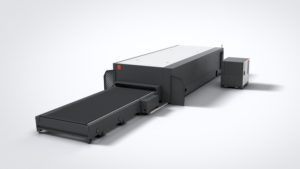
Durma HDF/HDFL 3015

An integrated shuttle table maximizes productivity and minimizes material handling times. The shuttle table and pallet change system allows convenient loading of new sheets or unloading of finished parts, while the machine is cutting another sheet inside the working area.

The available shuttle table is fully electric and maintenance free; there are no hydraulic oils to handle and table changes are fast, smooth and energy-efficient.

An optional lateral automatic scrap conveyor allows the removal of scrap pieces from the working area without the need to interrupt the cutting process. The sideways operation of the short conveyors allow for easy maintenance and trouble-free running.

The Durma HDF/HDFL 3015 fiber machine achieves highest dynamics and fastest laser processing cycle times thanks to the combination of rigid mechanics and a state-of-the-art numerical control and drive system. Programmes can be loaded easily into the machine with a USB stick or over a fast Ethernet connection with the company network.

In the high-pressure auto-focus cutting head for the fiber laser the cutting lens is shielded from the laser process by an exchangeable low-cost protection window. The 1μm wavelength light is very sensitive to dust or other contamination produced in the cutting or piercing process, therefore the cutting head is being well protected in an additional cover to ensure that all critical parts remain as clean as possible.

The integrated capacitive distance sensor is capable of having the head follow height differences in the sheet even at the extreme high cutting speeds that can be achieved with the fiber laser technology, while state-of-the-art linear motors promote accuracy and increase productivity.

The CAD/CAM software provided has all the tools to import or draw parts, prepare and optimize automatically different geometries for the laser cutting process and make efficient nests.

The all-solid-state fiber laser technology reduces maintenance requirements, and offers the lowest possible running cost with a wall-plug efficiency of 30% and without the need of any laser gas. When the application requires a broader spectrum of material types to be cut and the maximum thickness range is limited, the fiber laser is the ideal solution and it will cut faster at lower cost than any CO2 laser at the same laser power.

For more information, please contact Spectrum Machine Tools – Tel: 011 865-4090

FANUC TO SUPPLY FORD PLANT IN COLOGNE WITH 500 ROBOTS

Automation specialist supports conversion to e-mobility

Automation specialist and world-leading industrial robot manufacturer FANUC has received another major order in the field of e-mobility. Scheduled for delivery in 2022, the company will supply the Cologne plant of Ford with around 500 robots to assist in the construction of electric car bodies.

The Ford manufacturing facility in Cologne is currently undergoing transition into the Ford Cologne Electrification Center, a development and production site for electric vehicles that will serve the entire European market. In 2023, the carmaker expects its first purely electric high-volume passenger model to roll off the plant’s production line. Ford has also announced that it will only offer battery-electric passenger cars in Europe from 2030.

FAW TRUCKS COMMITTED TO KEEPING UP WITH MARKET TRENDS

Ongoing research and development (R&D) are key to the sustained growth and survival of any vehicle brand. The same goes for FAW Trucks which has, over its 27-year history in South Africa, become renowned for its quality products and ability to cater to the unique needs of the South African commercial vehicle market.

With the FAW Group Corporation – China’s oldest and largest vehicle manufacturer – as its majority shareholder, the local operation is able to provide South African customers with products that have been researched and developed to excel in even the harshest working environments, without compromising on innovation, technology and comfort.

FAW Trucks places a high premium on R&D in order to not only maintain its leadership in the Chinese market, but also to ensure that it keeps up with the rapid advances being made in technology. Its R&D facility is based at the FAW Trucks manufacturing facility in Qingdao, China.

“The R&D centre greatly enhances the brand’s technological research and development capabilities, accelerates development of new products, and strengthens its position in global markets,” says Jianyu Hao, CEO of FAW South Africa. “One such global market is South Africa, where FAW Trucks is consistently ranked amongst the top sales performers on the sales charts.”

The brand’s local popularity can, in part, be attributed to the fact that all models sold in South Africa undergo testing to prove that they can withstand the unique – and often harsh – working conditions associated with African markets. In order to ensure that products live up to their reputation of being trucks that are built in South Africa, for Africa, most of the current model range such as the 6.130FL and 8.140FL as well as newer models such as the JH6 28.500FT are Euro 3 compliant.

Adding further peace of mind for buyers in South Africa and in other countries on the subcontinent, FAW Trucks offer warranties of up to three-years/600 000 km.

“In the highly competitive South African commercial vehicle market, durability and quality are key factors,” explains Hao. “Customers expect their trucks to withstand a rough operational environment, but also expect the vehicles to be fuel efficient, lightweight and technologically advanced. They also want a wider choice. Thanks to the R&D facility in China, we are able to bring to market robust, high-quality vehicles.”

A prime example of this continued innovation and progress is the fact that FAW Trucks is on the verge of introducing a new automatic model in the heavy commercial vehicle (HCV) segment of the local market. A new model in the eight-tonne segment will also go on sale here before the end of the year.

“These new models will carry all the hallmarks that FAW products are renowned for, namely strength, reliability and ease of operation,” Hao explains. “They will also bolster our sales performance even further as we head into the second half of the year.”

FAW Trucks achieved a significant milestone in its local history by taking the top spot in the Heavy Commercial Vehicle (HCV) segment of the local market for the first time in the first quarter of this year.

SHARES OF BYSTRONIC AG NOW TRADED UNDER THE “BYS” TICKER SYMBOL ON SIX SWISS EXCHANGE

May 3, 2021 is a historic day for both, Bystronic and all its employees, customers, partners, shareholders and investors, because for the first time, the shares of Bystronic AG were traded under the “BYS” ticker symbol on the SIX Swiss Exchange.

Bystronic is establishing itself on the capital market as an independent and future-oriented company. At the Annual General Meeting of Conzzeta recently, shareholders approved the change of name from Conzzeta AG to Bystronic AG. Bystronic AG is traded on the SIX Swiss Exchange under the new ticker symbol “BYS”.

The change of name is the result of the strategic transformation focusing on the sheet metal processing segment (Bystronic) and the divestment of all other business operations announced by Conzzeta in late 2019.

While with immediate effect, the listed registered shares of Conzzeta AG were transferred to Bystronic AG, the Conzzeta Board of Directors is now the new Board of Directors of Bystronic AG.

“This is a historic moment. I am proud to share this special day with our customers, investors, and the entire Bystronic team around the globe,” said CEO Alex Waser.

CEO Alex Waser.

For more information on the please see www.bystronic.co.za or contact Bystronic on 010 410 0200.

Change at the top of TRUMPF Machine Tools

Long-time Group Managing Director and CEO Machine Tools (CEO MT) Dr.-Ing. Heinz-Jürgen Prokop is leaving the company upon reaching the contractual age limit. Dr.-Ing. Stephan Mayer will become the new CEO MT and a member of the Group Management Board on July 1, 2021.

A change in leadership in the Machine Tool Business Division of the high-tech company TRUMPF: Stephan Mayer (40) will become the new CEO Machine Tools (CEO MT) and succeed Heinz-Jürgen Prokop (63), who will leave TRUMPF at the end of the fiscal year after reaching the age limit for members of the Group Executive Board. Stephan Mayer has been with TRUMPF since 2012, initially as head of the Organizational Development and Production and Quality Management central departments.

On July 1, 2015, Mayer took on the management of TRUMPF Hüttinger in Freiburg and led the subsidiary back to success. On October 1, 2017, he returned to Ditzingen as Managing Director of Production and Purchasing at TRUMPF Machine Tools.

Since 2019, Stephan Mayer has been responsible as President China. Stephan Mayer is responsible for all TRUMPF activities in China and manages the two locations in Taicang/Jiangsu and Jinfangyuan CNC Machine Co., Ltd. (JFY) in Yangzhou.

A NEW DIMENSION WITH 15 KILOWATTS

Speed, precision, flexibility: Thanks to the new laser output of 15 kilowatts, the ByStar Fiber cuts steel, aluminum, and stainless steel with a thickness from 1 to 30 millimeters and brass and copper up to 20 millimeters with high precision. This increases the laser power by up to 50 percent, enabling sheet metal processing companies to further optimize their production processes.

In order to offer sheet metal processing companies even better support in an increasingly competitive environment, Bystronic is now advancing into a new dimension of fiber laser cutting, the 15 kilowatt ByStar Fiber. The high-end fiber laser stands for high-precision Bystronic technology, a reliable cutting process even with the highest laser outputs and a wide range of applications. The technological leap from conventional 3 to 12 kilowatt systems to the new 15 kilowatt level is tremendous.

Bystronic is advancing into a new dimension of fiber laser cutting, the ByStar Fiber with 15 kilowatts for extra-high speed and an extended cutting spectrum.

On average, thanks to the 15 kilowatt laser, the cutting speed of the ByStar Fiber increases by up to 50 percent (when cutting with nitrogen) compared to a 10 kilowatt laser source. This means that sheet metal processing companies can benefit from higher productivity at low unit costs, because thanks to its 15 kilowatts, the new ByStar Fiber cuts steel, aluminum and stainless steel precisely and reliably in thicknesses between 1 and 30 millimeters and brass and copper in thicknesses up to 20 millimeters. The 15 kilowatt laser output now also enables extended applications in steel and aluminum of up to 50 millimeters and thus offers maximum flexibility for large series and urgent customer orders. Regardless of whether cutting aluminum, non-ferrous metals or steel, the high-performance Bystronic cutting head excels with maximum precision in both thin and thick sheets and profiles. The new power level is available for the ByStar 3015 and the ByStar 4020.

Regardless of whether aluminum, non-ferrous metals or steel – The high-performance Bystronic cutting head excels with maximum precision in both thin and thick sheets and profiles.

High cutting quality in up to 30 millimeter thick steel, aluminum and stainless steel – The BeamShaper ensures particularly high cutting quality.

Perfect cuts thanks to the BeamShaper

The BeamShaper function ensures clean cutting edges and high operational reliability across the entire range of sheet metal qualities with thicknesses up to 30 millimeters. This function can be selected as an option when purchasing a new 15 kilowatt ByStar Fiber or added later as an upgrade. The “BeamShaper” enables the shape of the laser beam to be optimally adapted to thicker sheets and fluctuating sheet metal qualities. In thicknesses between 20 and 30 millimeters, the new function thus enhances the quality of the cutting edges and increases the cutting speed by up to 50 percent compared to conventional 10 kilowatt machines. Bystronic’s new high-performance flagship is controlled using the ByVision Cutting software via a 21.5-inch touch screen. Operating the machine is as simple as using a smartphone.

Automation optimizes the material flow

In order to provide an optimal material flow to the high speeds of laser cutting, Bystronic has a broad selection of automation solutions available for the ByStar Fiber. The offer includes loading and unloading systems, sorting solutions, and individually configurable storage systems. Based upon the existing manufacturing environment and available space, a seamlessly integrated automated laser cutting process is developed.

ByTrans Cross is the newest loading and unloading solution on offer from Bystronic. The automation can be flexibly adapted to changing order situations and production rhythms in the laser cutting. Various utilization scenarios are possible.

As an automation bridge, ByTrans Cross can be integrated between a laser cutting system and material storage in order to direct the material flow. ByTrans Cross can also be used equally well as a stand-alone solution without a storage connection, to provide the laser cutting system with raw sheet metal of differing strengths and materials. In its basic version, ByTrans Cross has two loading carriages that serve as material storage for stand-alone utilization.

ByTrans Cross becomes even more versatile during clean-up, with the BySort sorting solution, which Bystronic integrates as an add-on solution on request. Thus, users have the option to clear away sorted, completed parts into an attached storage area or to store them in an additional unloading position next to the laser cutting system.

The latter supports the processing of large series, for example, for which individual cut parts need to be sorted separately according to job. A big advantage of BySort is the repeated, precise storage of all parts in one location – a task that is difficult to complete manually, particularly with large cut parts. The parts, exactly positioned on a palette, can be processed more easily during manual and automated subsequent processes, as their location is precisely defined.

Automation optimizes the material flow – Matching automation solutions increase the machine utilization and process reliability.

For more information on the please see www.bystronic.co.za or contact Bystronic on010 410 0200.

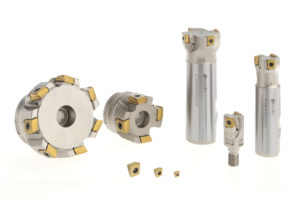
T-FACE – New Small Diameter Solid Carbide Face Mills with SP Spline Connection

ISCAR introduces the T-FACE family of assembled tools with interchangeable solid carbide heads for applications that require small diameter face mills.

The tools are comprised of heads mounted on steel shanks by means of a unique SP spline connection, one of ISCAR’s latest innovations that has already proved itself in the extremely successful T-SLOT line of slot milling cutters. The connection has been designed to ensure a very durable assembly that can carry significant loads in face milling and to withstand bending forces caused by high overhang in long-reach applications.

The unique general-duty cutting geometry of the heads makes them suitable for effective face milling of various engineering materials. A high-tooth density and greater accuracy provide better productivity than typical milling cutters with indexable inserts, while the design ensures that head clamping and replacement is user-friendly.

The new heads are available in 32 mm diameter with 8 teeth, an SP15 spline connection and a maximum 8 mm depth of cut, 40 mm diameter with 10 teeth, an SP17 spline connection and 10 mm depth of cut and in 50 mm diameter with 12 teeth, an SP19 spline connection and  12 mm depth of cut.

The cutters’ small dimensions allow them to be applied effectively to face milling operations in space-limited environments or with small-envelope machine tools, particularly on multi-function machines. The new shanks are available in cylindrical and Weldon-type configurations.


For more information, please contact ISCAR South Africa (PTY) LTD – Tel: 011 997-2700.

MACHINING EXOTICA 


What are exotic metals, why are they so rare, and how are they machined? To understand this subject, let’s start by defining it.

Mainstream engineering materials are iron-based alloys such as steel, stainless steel and cast iron. Another group of regularly used materials includes alloys based on nonferrous metals, such as aluminum alloys, brass and bronze.

In addition, there are exotic types of material that were developed to answer specific demands. These exotic materials feature a dedicated application, while they are rare, not commonly used and generally more expensive to fabricate.

A strict agreed definition of an exotic material does not exist.  Many experts refer to them as metals like Beryllium, Zirconium, etc. and their alloys, ceramics, composites and superalloys. When considering the use of structural materials, superalloys and composites should be distinguished first.  The metalworking industry mainly deals with these types of materials for several reasons, including the machining of exotic materials is problematic. Superalloys, or more specifically, high temperature superalloys (HTSA), are intended for operating under a heavy mechanical load in combination with high temperatures. They are largely used in gas turbines and in various valves and petrochemical equipment. The “exoticism” of superalloys is their metallurgical design, which provides high creep resistance to keep strength at high temperatures. According to the main component, HTSA can be divided into three groups: Nickel (Ni)-, Cobalt (Co)-, and Iron (Fe)-based superalloys. A superalloy chemistry, especially in case of Ni- and Co-based HTSA, results in poor machinability.

Composites are multicomponent materials. When compared with a traditional engineering material, such as steel or aluminum, composites workpieces are nearer-to-net shape and do not require significant material removal. Nevertheless, the components of a composite have different properties and when combined, they produce a heterogeneous structure that makes machining problematic. The process of machining composites differs from machining metals and it often looks more like shattering than cutting. High composite abrasiveness can lead to intensive tool dulling and various performance problems, such as a degradation of accuracy or non-repairable machining defects.

The metalworking industry has made significant progress in machining exotic materials. Advanced machining tools and effective machining strategies have already lifted the performance of machining operations to a totally new plane. An impressive leap forward in 3D printing, which may significantly diminish machining operations, looks very promising. But there is one “exception”, which still limits taking full advantage of the considerable increase of machine tool capabilities. This “exception” is the cutting tool. Despite the distinct progress, cutting tools remain the bottleneck for machining efficiency. Hence, the plans for a breakthrough in the productive machining of exotic materials have much to do with the cutting tool.

Cutting tool manufacturers keep up their efforts to find productive and reliable solutions for machining exotic materials. Sometimes, it may seem that traditional sources for a major advance are almost non-existent and that a great step forward is only connected to a real novelty. Regardless, cutting tool manufacturers still manage to provide interesting products that combine available means and resources with new ideas. Recent ISCAR developments are a good example of such products and ISCAR’s attempt to resolve the existing bottleneck, while finding new ways to move forward.

Exotic for Exotic: advantageous ceramics

Cemented carbide is still the main cutting material for machining. Introducing carbide tools revolutionized the metalworking industry ensuring a significant growth of productivity due to sharply increased cutting speeds. However, despite this, even today cutting speeds for difficult-to-machine Ni- and Co-based high-temperature superalloys (HTSA) are low, typically within the range of 25-50 m/min (80-160 sfm). How do we expand the speed boundaries?

Exotic ceramic materials have already found themselves as cutting materials. Using exotic ceramic material ensures a totally different level of cutting speeds. For example, machining the superalloys by ceramic tools, the cutting speed 1000 m/min (3300 sfm) is completely real. Therefore, ceramic tools become more and more common in machining HTSA.

Recently, ISCAR developed a family of indexable shell mills carrying double-sided inserts made from ceramics. The mills are intended mostly for rough and semi-finish machining of planes and 3D surfaces at extremely high cutting speeds. The economical double-sided insert design provides high ceramics utilization. The inserts are made from several ceramic grades such as “black” ceramics, whisker reinforced ceramics and SiAlON (a type of silicon-nitride-based ceramics). Applying the new mills is directed on maximizing metal removal rate (MRR) and dramatic reduction in cycle time.

One more example of successful usage of cutting ceramics is another of ISCAR’s latest products – a family of solid endmills from SiAlON. The endmills were designed specifically for productive rough machining Ni-based superalloys, such as various grades of Inconel, Incoloy, Haynes, etc. in the aerospace industry. In comparison with typical solid carbide endmills, SiAlON endmills allow an increase in cutting speed of up to 50 times!

It should be noted that ceramic tools behave differently from carbide tools. Generally, the end of a tool life is determined by the acceptable level surface finish or generated burrs and not by tool wear size.

Cutting Diamond

In manufacturing parts from composites, drilling is widely regarded as the major cutting operation. Improving capabilities of drilling tools has had a direct impact on the effectiveness of machining composites and composite stacks.

Most recently, ISCAR introduced a series of new solid drills, in the diameter range of 3.3-12 mm (.130-.500″), which are specially designed for composites. The common feature of these tools is the use of polycrystalline diamond (PCD) or diamond coating to ensure high abrasion wear resistance. There are several types of these new drills; one of them is based on using a PCD nib as a central point of a drill, and another type has a diamond wafer. Both drill types offer a large area for multiple regrinding.

The third type of drills is solid carbide tools with a diamond-coated cutting area. Their wavy cutting edge facilitates reducing burr formation, specifically when drilling carbon fiber reinforced plastics (CFRP) and CFRP-Aluminum stacks.

Coolant Solver

In machining exotic superalloys, effective coolant supply is a cornerstone of success. Pinpointed high-pressure cooling (HPC) can be a significant tool to improve cutting performance. It is a real source for greater tool life, better chip control and higher productivity.

One of the latest ISCAR’s developments is a family of turning tools with ISO-type indexable inserts. The tool design utilizes an upper clamp for reliable securing of the inserts even during heavy and interrupted cuts. The previous turning tools with the HPC option had a lever clamping mechanism as an upper clamp would obstruct a jet of coolant from reaching the cutting edge.


The newly developed tools integrate a hollow upper clamp that allows for solving two problems:

–  strong and rigid insert clampin

– eliminating any obstacle for the coolant jet on its way to the cutting edge

Hence, the clamp, which serves in the new tools as a coolant nozzle, received an additional important functional feature.

The new products with through-tool coolant supply are beneficial not only in machining with HPC. Their applying to turning with conventional external “low” pressure cooling (10-15 bars) also provides better performance.

In parting and grooving, especially in deep grooving, efficient chip forming has crucial significance. Pinpointed high-pressure cooling of a cutting edge significantly diminishes chip jamming and reduces built-up edge. Within the past year, ISCAR expanded the range of its HPC products by introducing new face grooving tools with HPC option. These tools are suitable for coolant pressure of up to 140 bars.


Geometry Innovation Never Stops

Improving cutting geometry does exhaust all possibilities.  Good evidence of such a conclusion is the variety of new solutions that have upgraded existing indexable inserts. Usually, such solutions relate to advanced chip forming, reinforced cutting edge and progressive edge preparation.

ISCAR’s new chipformer F3S for finish turning exotic superalloys was designed for popular ISO-type inserts (CNMG, WNMG etc.).  A typical finishing operation is characterized by shallow depth of cut and low feed. Therefore, the success of a chipformer lays in a small area that adjoins the insert cutting edge. It will take real engineering “art” and a lot of effort to redesign this area for much better performance when compared with the existing inserts.

F3F gives an example of how to do this successfully. It has a reinforced cutting edge to prevent notch wear as well as a specially designed deflector for efficient chip control in finish turning HTSA. In combination with a positive rake, these features ensure a smooth and easy cut, notable chip breaking capabilities and significant reduction in cutting forces.

Machining exotic materials places tool manufacturers before different challenges. In developing a cutting tool that will lead to a breakthrough, tool manufacturers try everything. Sometimes their solutions are really “exotic”, and other times innovative thinking allows going ahead in the traditional direction. In the case of ISCAR, it can be clearly seen that progress towards finding the right response to the needs of the metalworking industry for exotic materials has not stopped.

For more information, please contact ISCAR South Africa (PTY) LTD – Tel: 011 997-2700.