The machine’s increased productivity is due primarily to the highly dynamic rotational changer and the new rotary indexing table, which features three workstations.
The ObserveLine function reliably detects slugs, increasing process reliability. It is the fastest system currently on the market.
The areas for machine loading and unloading are completely separate from each other, facilitating semi-automated solutions. For example, an operator and an optional robot could work simultaneously while the laser cuts the component. This substantially increases the machine’s productivity.
In conjunction with the TruDisk 2000 with 2-kilowatt laser power, the energy efficiency of the TruLaser Cell 8030 improves. The disk laser’s beam quality has doubled to 2mm mrad, and its winning combination of low power consumption and low investment costs also brings down costs per part. When greater power is required, however, the new TruLaser Cell 8030 is also available with the trusty TruDisk 3001 and TruDisk 4001 disk lasers, with 3- and 4-kilowatt laser power, respectively.
The second-generation TruLaser Cell 8030 has a compact footprint and is easily accessible from all sides.
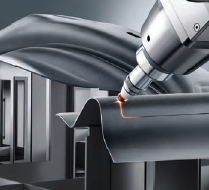
Laser-cutting of a B-pillar using the new TruLaser Cell 8030
TRUMPF has also improved the process reliability and stability of the TruLaser Cell 8030 with functions such as ObserveLine visual slug detection, which has very fast and dependable sensors. The complete cycle lasts a mere 135 milliseconds, making it more than twice as fast as other systems currently available on the market. Another new feature is the residual runtime display built into the front of the machine, which shows how much processing time remains for the current component along with further information about the status of the respective production order. This helps operators keep a close eye on the production cycle and efficiently sequence their tasks, increasing the machine’s output. Meanwhile, shift managers can visualize the current production situation and refine their plans for the remaining production steps accordingly.
Occupying less than 50 square meters, TruLaser Cell 8030 has a decidedly compact footprint. Because the electrical control units are built into the body of the machine, the system can be swiftly and easily integrated and commissioned even within existing production environments. TRUMPF has successfully reduced installation costs for the new TruLaser Cell 8030. Whereas the old system required three supply cables to the machine, the centralized power supply now requires only one.
For more information, contact Retecon – Tel: (011) 976-8600.
With their enormous pulse peak powers of several gigawatts and extremely short pulse durations of approximately one trillionth of a second, ultra-short pulse lasers are the perfect tool for high-precision machining of virtually any material. These sources are now well established not only in various fields of research, but also in industrial applications such as drilling and texturing of metal parts for the car industry, or ablative cutting of transparent materials such as the high-strength cover glasses used for optical displays.
Surrounded by mirrored prism retroreflectors, the YAG disk generates multi-kilowatt laser output. Photo: TRUMPF
However, today the volume of material that can be modified or removed with each laser pulse – and therefore the resulting process throughput – is limited by the available laser pulse energy. This limitation sets the starting point for the new ScULPT project where the partners will be aiming to accelerate process throughput at least proportionally in relation to the increase in laser power.
New beam sources aside, transforming increased laser power into faster machining processes requires additional developments which also form part of the ScULPT project. These include the construction of application-specific machining modules with suitable, fiber-based beam guidance and beam shape adaptations for individual processes, as well as optimized synchronization between laser and beam scanning systems.
Using a TruMicro ultra-short pulse laser to cut glass minimizes the mechanical stress on the material. This method does not produce any cracks on the edges – and that means it is no longer necessary to grind the components after cutting. Photo: TRUMPF
Combined expertise of project partners
The project team is formed by corporate partners TRUMPF, SCHOTT and BOSCH as well as the Universities of Jena (Institute for Applied Physics) and Stuttgart (Institut für Strahlwerkzeuge). Between them the project partners combine the necessary expertise to cover the entire value chain from basic research, ruggedization of beam sources, to laser machining of glasses and metals on an industrial scale.
For more information, contact Retecon – Tel: (011) 976-8600.
Increased participation by black owned suppliers in the country’s automotive sector and greater use of local components will be major themes of National Association of Automotive Component and Allied Manufacturers (NAACAM) Show incorporating the Durban Automotive Cluster’s National Localisation Indaba in Durban on April 5-6 2017.
NAACAM Executive Director Renai Moothilal said that working with its value chain partners, including the SA based OEMs, the Department of Trade and Industry and supporting agencies such as the AIDC, the NAACAM Show would be a practical tool to progress these issues.
Besides an exhibition focus of bringing in and highlighting black supplier companies, there are two conference sessions, dedicated to Black Supplier Development and Transformation, which would reflect on industry’s commitment while also showcasing existing success stories. The mainstream automotive economy, represented by an estimated 400 executive level delegates, including OEMS, tier 1s, tier 2s (including black-owned manufacturers) and stakeholders will gather to engage on these and other pertinent issues relevant to this crucial South African manufacturing sector.
“There are opportunities to drive transformation. Especially within the tier two space, it will be possible to develop a cache of black industrialists, reshaping the owner dynamics within this sector”, Moothilal says. “The entire sector is committed to transformation objectives and is taking proactive steps to foster and accelerate this development.”
Given the levels of government support for the automotive industry through the current Automotive Production and Development Programme (APDP) and other supporting instruments, such as the Black Industrialists Scheme, it is accepted that government will continue to push the automotive sector towards an ownership profile that matches demographic representation, with the most realistic way for this to happen being through the lower-tiered component segments, says Moothilal.
The inaugural NAACAM Show will take place in conjunction with the Durban Automotive Cluster’s National Localisation Indaba at the Durban ICC from April 5-6. It will be held every two years rotating across South Africa’s major automotive hubs.
Moothilal believes the Show will be a great platform for the sector to showcase its true capability. “We would like to see a deepening of the use of parts manufactured in South Africa, with many parts being imported by OEMs and component manufacturers. We must deepen our value chains.” Moothilal said The National Localisation Indaba delivered through NAACAM Show would connect qualified suppliers to buyers where these opportunities are known to exist.
The NAACAM Show conference will also deal with topics including Manufacturing Best Practice, The Automotive Vision and Masterplan, The Future of the Automobile, Leadership and Logistics and Supply Chain Management, delivered by industry, government and academic leaders in these fields.
In his budget speech, Finance Minister Pravin Gordhan earmarked R95-million for the establishment of a Steel Development Fund over the Medium-Term Expenditure horizon. This fund will be controlled by the Industrial Development Corporation (IDC) for the benefit of the sector.
SEIFSA Senior Economist Tafadzwa Chibanguza.
SEIFSA Senior Economist Tafadzwa Chibanguza welcomed Gordhan’s announcement, saying the Fund could improve the competiveness of foundries and steel fabricators in the metals and engineering sector, contributing to efforts to reverse the crisis that has long beset the sector.
Chibanguza said the Minister’s announcement was a product of numerous engagements between various stakeholders in the metals and engineering industry, including SEIFSA, with the IDC, the Department of Trade and Industry and the Finance Ministry about the importance and need for a dedicated fund for the sector.
“We believe that this allocation for the Fund takes those engagements significantly forward, indicating the Government’s commitment to assist the sector,” said Chibanguza.
In his speech, Gordhan indicated that over the 2017/2018 fiscal year, the Finance Ministry is expected to spend R1.56 trillion but forecasts to collect only R1.41 trillion, leaving a budget deficit of R149 billion, which equals 3.1% of GDP at a consolidated level. However, revenue compared to non-interest expenditure yields a R21 billion surplus.
Chibanguza said that there is no doubt that preparing the current budget was a very challenging exercise for the Minister, his colleagues and the Treasury team. “It was a delicate balancing act between maintaining spending commitments, particularly in higher education, health and social obligations, while ensuring responsible management of public finances,” he said.
In his toughest budget speech yet, Gordhan seemed to tighten control as the expenditure celling will be reduced by R10 billion in 2017/18 through reducing national departments’ operating budgets, lower transfers to entities, provinces and local government and real locations.
In order to induce additional revenues of R28 billion needed for the 2017/18 period, income taxes for individuals earning more than R1.5 million will be increased to 45% and dividend withholding taxes will be increased from 15% to 20%. The fuel and road accident fund fuel levies will also be increased by 30c/l and 9c/l respectively.
Chibanguza said that of importance to the metals and engineering sector was the fact that, broadly, manufacturing incentives will receive R9.6 billion over the medium term expenditure framework (roughly R3.2 billion per annum), which includes roughly R433 million per year dedicated to boosting competitiveness. He said that the sector will either directly or indirectly benefit from a medium-term R4.2 billion that has been allocated for industrial infrastructure projects over the medium term. This budget includes 32 strategic projects expected to be approved for special economic zones and industrial parks.
The Federation, which launched the SEIFSA Awards for Excellence in 2015, has invited manufacturers operating in the metals and engineering sector with the Southern African region to submit their entries for the 2017 Awards. The entries are for companies that will be assessed on their performance in the period 1 January 2016 to 31 December 2016.
Winners of the 2017 SEIFSA Awards for Excellence will be honoured at a ceremony that will take place in Sandton on 25 May 2017. Born out of the need to encourage growth and celebrate excellence in the metals and engineering sector, the SEIFSA Awards for Excellence offer a great opportunity for companies operating in this vital sector to receive well-deserved recognition by industry peers for their capabilities, expertise and innovation.
SEIFSA Chief Executive Officer Kaizer Nyatsumba.
SEIFSA Chief Executive Officer Kaizer Nyatsumba said although the metals and engineering sector was faced with many challenges and uncertainty, there were companies that still managed to excel under these difficult circumstances.
“It is during crisis times that innovation and sustainability become paramount. We have seen companies that have managed to excel and retain operations in the sector, in the process not only saving jobs, but also ensuring that the industry still provides its goods and services,” Nyatsumba said.
Nyatsumba said these companies need to be highlighted and celebrated so that it is demonstrated that there are other ways to keep the sector going until the crisis period lapses.
The SEIFSA Awards for Excellence have seven different categories – The Most Innovative Company of the Year, which will be awarded to a company which showed the highest level of innovation in research and development or production in 2016; The Health and Safety Award of the Year will be offered to a company with the best legal compliance record in Health and Safety or the lowest Lost-Time Injury Frequency Rate in 2016; Entries are also invited from companies whose Corporate Social Investment (CSI) programme/s in 2016 had a major impact on the lives of their beneficiaries;
Companies rated the highest in customer service performance in 2016 will receive the Customer Service Award of the Year; The Most Transformed Company of the Year Award will go to a company that showed the highest transformation level in the composition of its Board of Directors, Executive Management and Managerial Team in 2016 (this award category pits companies employing fewer than 100 people against those of similar size, and companies employing more than 100 companies against others of similar size).
This is the Decade of the Artisan and an award will be made to the company that trained the highest number of artisans in 2016 and The Environment Stewardship Award will go to a company that has made the biggest or best strides towards conserving the environment or mitigating the impact of its operations on the environment in 2016. Nyatsumba has encouraged manufacturers operating in the metals and engineering sector to submit their entries for the seven categories as soon as possible. The Awards are open to both SEIFSA members and non-members.
Scaw Metals, ABB Group, Hazelton Pumps International and Voith Turbo, were among the winners last year.
The Steel and Engineering Industries Federation of Southern African (SEIFSA) welcomed Statistics South Africa’s announcement that the producer price index (PPI) for intermediate and final manufactured goods increased by 6,7% and 5,9% respectively in January 2017, saying this boded well for profit margins in the ailing metals and engineering sector.
SEIFSA Economist Roberta Noise.
SEIFSA Economist Roberta Noise said the 6,7% increase in the January PPI for intermediate manufactured goods and the 6,4% increase in the January composite input cost index tracked by SEIFSA indicated that profit margins are likely to show an improvement in the sector.
SEIFSA compiles the composite input cost index by tracking a basket of input costs related to the metals and engineering sector. The index (6,4%) reduced by 53% in January 2017 when compared to January 2016 (13.6%). “Within the metals and engineering sector, PPI for intermediate manufactured goods tracks price movements better than PPI for final manufactured goods since the sector represents 60% of the weight in the index. Therefore, the increase in PPI for intermediate manufactured goods directly affects the sector and shows slight recovery prospects for producers, given the 6.4% composite input cost index recorded in January 2017,” Noise said.
Statistics South Africa (StatsSA) announced that the PPI for final manufactured goods increased by 5.9% when January 2017 is compared to January 2016. This is down from the year-on-year 7.1% recorded a month earlier. Noise said that contributions to the January 2017 reading included, in order of magnitude, food, beverages and tobacco products (3,1%) and coke, petroleum, chemical, rubber and plastic products (1,6%).
According to the StatsSA data, the PPI for intermediate manufactured goods increased by 6.7% when January 2017 and January 2016 are compared, down from the 7.3% recorded a month earlier. Contributors to the January 2017 increase include chemicals, rubber and plastic products (2.8%), sawmilling and wood (1.5%) as well as basic and fabricated metals at 1.2%.
Noise said the fact that the PPI for both final and intermediate manufactured goods showed an upward trajectory was a welcome development for the metals and engineering sector, which had experienced a terrible 2016 because of exchange rate volatility and a slowdown in commodity price increases, among other factors. She said the relative stability that has since taken place in the exchange rate and the recent uptick in commodity prices have had a significant impact on the PPI and its direction.
“Therefore, the current movement in PPI for both final and intermediate manufactured goods will help in the metals and engineering sector’s growth expectations relative to the easing in the composite input cost index,” Noise concluded.
Acclaimed London-based, global thought leader and charismatic futurist Sarwant Singh, who consults with many of the world’s leading companies, will address the sector on the Future of the Automobile. A member of the World Economic Forum Transportation group, he sits on advisory boards of Nissan, ATI, Leeds University Business School and others, while his book New Mega Trends has since been sold in over 30 countries. Toyota, Ford and BMW are also high profile automotive companies he has consulted to.
NAACAM Executive Director Renai Moothilal
Singh will share the stage with KPMG’s German-based Global Automotive leader Dieter Becker, renowned for producing the annual Global Automotive Executive Survey and leading research on emerging issues that impact the automotive and manufacturing industry.
South Africa’s OEMs will also be well represented in the line-up of speakers, who will address industry in eleven sessions over two days. Speakers confirmed are Volkswagen SA CEO Thomas Schaefer, Nissan SA CEO Mike Whitfield, Gladstone Mtyoko Divisional Manager at Mercedes Benz, Toyota CEO Andrew Kirby and Senior Vice President for Manufacturing Nigel Ward, Ford CEO Jeff Nemeth and the South African OEM Purchasing Council Chairman John Astbury. SA based OEMs will be amongst the exhibitors, in some cases highlighting localization success stories or opportunities, whilst also being part of a dedicated black supplier profiling process.
NAACAM President – Dave Coffey
Topics at the conference include South Africa’s Automotive Vision and Masterplan, The Future of the Automobile, Manufacturing Best Practice, Transformation, Leadership and Logistics and Supply Chain Management.
National Association of Automobile Component and Allied Manufacturers (NAACAM) President Dave Coffey said the conference, featuring presentations, case studies and panel discussions on April 5 and 6 at the ICC in Durban, was scheduled to have keynote addresses from South Africa’s Minister of Trade and Industry, Dr Rob Davies as well as Minister of Economic Development, Mr Ebrahim Patel.
“The Conference is an essential part of the industry’s ability to engage with current happenings informing the trajectory of the automotive sector and the exhibition will be a unified expression of the South African value chain’s manufacturing capability,’’ Coffey said.
Other high-profile participants include Ethekwini Mayor Councillor Zandile Gumede, SP Metal Forgings MD Ken Manners, Sumitomo Rubber CEO Riaz Haffajee, National Union of Metalworkers of South Africa (NUMSA) Secretary General Irvin Jim, Schaefler MD Marshal Myburgh, Automotive Industry Development Centre (AIDC) CEO Dr David Masondo, Automotive Masterplan Lead Dr Justin Barnes, Automotive Supply Chain Competitiveness Initiative (ASCCI) Chair Alex Holmes, NAACAM President Dave Coffey, Metair CEO Theo Loock, Transnet Chief Customer Officer Mike Fanucchi and Professor Anthony Black of University of Cape Town.
The Department of Trade and Industry (the dti) will host three-day export training workshops in three provinces next month as part of its efforts to nurture the culture of export and increase the number of the country’s exporters.The workshops, which will be held in Polokwane, Pretoria, Cape Town and Johannesburg, are part of the Integrated National Export Strategy (INES) which is the country’s blueprint towards ensuring export promoting industrialization to spur economic growth.
According to the Minister of Trade and Industry, Dr Rob Davies, the strategy aims to increase South Africa’s capacity for exporting diversified and value-added goods to various global markets.
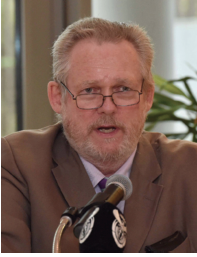
Minister of Trade and Industry, Dr Rob Davies.
“One of the pillars of the National Export Strategy is the National Exporter Development Programme (NEDP) through which the department aims to promote the export culture and to increase the number of exporters in the country. The main goal of the NEDP is to increase exports, particularly of value-added products that contribute to employment creation,’’ says Davies.
He adds that the programme will go a long way in creating a vibrant export culture in South Africa, developing a pool of export ready companies, and ensuring that new markets and export products are developed.
The NEDP has an extensive capacitybuilding component, the Global Exporter Passport Programme (GEPP). It is a training programme that ensures that companies acquire export-ready status and sustainability in the international market. It also assists in enhancing the market competitiveness of exporters. About 3 000 companies have received training in different phases of the GEPP since its introduction in 2013. “Interventions proposed in the National Development Plan to ensure that 11 million jobs are created by 2030 and for stimulating economic growth include improving skills and innovation, enhancing competitiveness of our businesses and increasing the country’s export earnings,” emphasizes Davies.
He adds that the training which the dti is providing to business people equips them with the knowledge and skills that they require to access international markets and produce products that have the capacity to compete with the best in the world.
“Companies which open markets in other parts of the world will consequently increase their production in order to service the new markets, thereby increasing our exports and contributing in job creation and growing the economy. The training assists us to expand the pool of companies that we fund to participate in international missions and trade fairs,’ says Davies.
TaeguTec’s large product selection machines any material quickly and efficiently.TaeguTec supplies the most advanced state-of-the-art cutting tools and tooling services to South African key industries including automotive, mold and die, metals, electronics, and others.
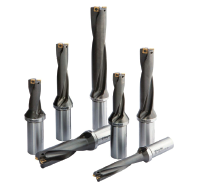
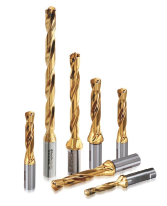
One of the industry’s favourite choices when it comes to drilling into everything from alloy steel to stainless steel is TaeguTec’s DrillRush – the versatile indexable drill that is constantly being expanded to provide dependable, optimal hole drilling performances on any material.
The various DrillRush geometries and sizes such as 1.5xD, 3xD, 5xD, 8xD and 12xD not only increase productivity but improve on tool life due to its reinforced edges and coating, which are suitably designed for optimal chip control and hole quality on any material. TaeguTec recently introduced two new sizes – the 12xD drill that produces deep holes accurately, repeatedly and economically and the DrillRush 6mm to 6.9mm diameter range drill heads, which were designed to handle 1.5xD, 3xD and 5xD drilling depths.
All DrillRush products eliminate the needto remove the entire drill from the spindle in order to replace the head – a process that shortens cycle times and substantially increases productivity. For producing cost effective large diameter holes, TaeguTec’s SpadeRush, a recently introduced line of high productivity head changeable drills for large diameter hole making that stays within the cycle times necessary to be competitive due to its optimized cutting edge and unique rigid clamping system, generates higher productivity and outstanding performance.
Available as a standard drill in 3xD and 5xD for a diameter range of 26mm to 41mm, the SpadeRush’s unique clamping technology enables operators to quickly change drill heads without removing the clamping screw from the holder.
Advertorial
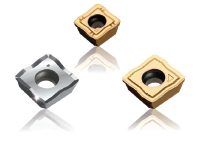
For cost effective machining and higher productivity, the TopDrill line has been built to satisfy a growing market demand for flexibility and excellent performance. Also, its true 4-corner inserts are suitable for both internal and external pockets, reduces inventory and promotes cost reduction.
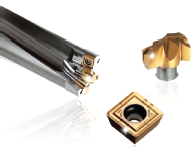
From top to bottom, the TopDrill has been built for improved tool life and is equipped with a new insert grade for enhanced durability.Last but not least is the newest member ofTaeguTec’s drilling family, the TwinRush – a product that guarantees excellent performance and high productivity on large diameter holes.The noticeable feature of the TwinRush joins together a centering insert with a pair of precise square inserts on either side in order to combine two different drill types onto one drill body and protects them with TaeguTec’s TT9080 PVD multi-layered coated grade. By doing so, this double effective design increases productivity.
For more information, please contact TaeguTec – Tel: (011) 362-1500.
According to news reports, AMSA is appealing to the steel downstream to join it in a united lobbying effort for higher levels of tariff protection on both primary and value-added steel products.
Gerhard Papenfus, Chief Executive (NEASA)
The fact that AMSA even contemplates obtaining support from the steel downstream for any of the protectionist measures mentioned in the news reports, just illustrates the extent of AMSA’s arrogance, their disconnect from what is happening within the ranks of their downstream customers and the anger amongst downstream manufacturers – for both the 10 percent customs duty already granted (which serves as a slow poison causing the gradual demise of the Steel Industry), aggravated by the ill-conceived attempt to secure a further 30 percent safeguard duty (which, should it ever be introduced, will ensure the rapid demise of the Steel Industry).
There must be no uncertainty with AMSA that there won’t be any support from the downstream for any of the protectionist measures AMSA has in mind.
Since, by AMSA’s own admission, the advantages of the 10 percent customs duty (to AMSA) were insignificant, and in light of the preliminary indication by the International Trade Administration Commission of South Africa (ITAC), that there is no justification for a safeguard duty (AMSA applied for 30 percent safeguard to be introduced), AMSA now canvasses for downstream support as part of their increased efforts to secure further protection.
AMSA would be well advised that, if they want to engage with the downstream on this issue, they should start off by entering into discussions with NEASA, the only organization openly against the AMSA protectionist initiatives, and the largest representative organization of downstream steel manufactures. NEASA has already obtained the support of over 2000 companies who rebelled against both the 10 percent customs duty as well as the 30 percent safeguard duty. If AMSA’s new strategy is one of canvassing support for its downstream hostile protectionist agenda, NEASA is ready to further mobilise the steel downstream.
AMSA’s concern about the effect of imports on the downstream is merely a matter of window-dressing in an attempt to divert attention from its own, downstream hostile protectionist effort. For reasons, briefly listed below, protection of imports to the downstream is simply impossible and will never be supported:-
Many downstream products are already protected at the bound-rate. (The bound-rate is the maximum protection allowed by the World Trade Organization, to which South Africa is a signatory. For example, a steel downstream finished product that has a tariff of 15 percent, had protection of 15 percent until the 10 percent protection on primary AMSA steel was introduced, the result being that the 15 percent has effectively been reduced to five percent. Therefore, the introduction of duties on primary steel produced by AMSA, almost decimated the protection the downstream industry previously enjoyed.)
In canvassing government’s support for the 10 percent, AMSA did the downstream a tremendous disservice and thereby illustrated their absolute insensitivity for the interests of the steel downstream.
Protecting the downstream is an administrative impossibility. There are thousands of products and the time, effort and money, even if subsidized, will never be sufficient and will therefore not be feasible.
Custom control of so many products will be practically impossible and it will foster a haven for corruption, which will only benefit criminals and further enhance the demise of honest downstream manufacturers.
AMSA’s offer to assist the downstream in this regard, comprising thousands of companies, is therefore nothing short of being ridiculous and cannot be taken seriously.
AMSA admits that the 10 percent customs duty only had an insignificant effect on imports. However, while it brought no benefit to AMSA, downstream importers were severely prejudiced by it. The preservation of the 10 percent customs duty therefore makes no sense and NEASA hereby officially requests AMSA to withdraw their support for this duty and to request ITAC to advise the Minister of Trade and Industry to scrap it. This is the only manner in which AMSA can illustrate real concern for the steel downstream.
AMSA is right in saying that if there is no steel downstream, that there will be no steel upstream and vice versa. However, if in using the term ‘upstream’ AMSA refers to itself, this statement is not entirely correct. For the steel downstream to prosper it needs access to the cheapest available high quality steel and AMSA, by being successful in convincing government to protect its antiquated steel mills by means of duty protection, is denying the downstream that opportunity. In that sense AMSA’s interests are directly opposed to that of the steel downstream, and the downstream may well prosper without AMSA.
For the downstream it is imperative, for its own survival, that AMSA invests in the construction of a modern steel mill in South Africa in order to effectively compete with steel imports. Failing this, AMSA will simply not survive in the long term. The ‘winds of change’, confronting the global steel trade, will simply eventually bring about AMSA’s demise.
The danger of any protectionist measures, those already introduced as well as those AMSA is continuing to canvas support for, is simply delaying the inevitable, and in the process causing irreparable harm to the steel downstream. NEASA will do whatever it takes to prevent this from happening.














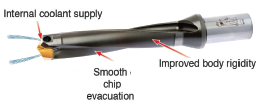 Available as a standard drill in 3xD and 5xD for a diameter range of 26mm to 41mm, the SpadeRush’s unique clamping technology enables operators to quickly change drill heads without removing the clamping screw from the holder.