The laser marker MCFA – 30, available from Duncan Macdonald takes full advantage of the power of the fibre laser to achieve great improvements in both, processing time and quality.
Go Tapping S.L. has developed and manufactured the MCFA – 30 based on unique oscillation methods. While the Lasermark is designed, featuring innovative technologies, other benefits include long life, ease of use and cost effectiveness.
For more information, contact Duncan MacDonald – Tel: 011 865 4090.
The MESTAB equipment from GOTAP in Spain represents the result of years of development work, trials and tests in the company’s own production of hydroforming presses. What was born as an internal treatment to guarantee the stabilization of residual stresses in frames, has advanced to become a cutting-edge technological solution.
Discovered in the 1940s, accidentally by the American Society of Naval Engineers in the USA, vibration stress relief has come a long way to become the standard of large aeronautical and industrial companies MESTAB, the intelligent alternative in tension stabilization.
Integrated and portable system
Just two cases, you can use it in field services, in remote locations and in extreme industrial environments. The robustness of the equipment stems from GOTAP’s own experience in the boilermaking sector.
The compact weight of both units allows for easy transport, even in-flight check-in for agile and unlimited handling and use.
Report as a guarantee of the process
The MESTAB system generates a comparative report of the stress state before and after treatment. The inclusion of a photograph of the actual part allows for easy identification and future traceability.
This way, you can guarantee the effectiveness of the process for your customers, avoiding production downtime, due to external suppliers.
For more information, contact Duncan MacDonald – Tel: 011 865 4090.
With its innovative head-indexable feature and overall outstanding advantages, the SFEED-TEC MAXI-RUSH end mill replaces most of the existing conventional solid carbide end mills in its class.
Along with its exceptional accuracy and optimum grades, the line’s quick and simple head replacement makes it a perfect solution for today’s machining needs and a superior performer that boosts productivity on a range of applications.
MAXI-RUSH is available in a variety of head types and shank holder lengths, such as flat, ball, corner radius, chamfer and slot, to mention a few, while providing the greatest versatility in tooling solutions.
Its rigid and precise double contact fastening system houses a flat contact surface area for precise axial runout accuracy, has a conical taper contact for self-centring and precise radial runout accuracy and is highlighted by its quick and rigid unique threading.
TaeguTec has added oval and lens-shaped solid carbide heads that are 3D profiling capable in order to solve industry-wide disadvantages, such as excessive machining time and poor surface finish, which plague profiling operations.
The MAXI-RUSH 5-axis profile heads are designed for high-pitch, semi-finishing and finishing profiling parts used in the aerospace, power generation, medical and mould and die industries.
Even in high-pitch conditions, the same surface finish can be obtained compared to solid carbide ball type end mills, making the MAXI-RUSH 5-axis profile heads capable of high-productivity machining.
Machine shops of all sizes have taken a special interest in the metalworking giant’s highly rigid MAXI-RUSH line because of its excellent machining precision, simple indexable head replacement and shorter setup time. The line now includes a wider variety of tools that are capable of handling a broad range of operations.
The expanded features include a wider cutting edge contact area for improved machining stability and longer tool life, and are ideal for machining difficult-to-cut materials such as titanium alloys, Inconel, and stainless steel.
Recently, TaeguTec added the TT5513 grade to the technologically advanced MAXI-RUSH line. The ingenious grade has an ultra-fine substrate with optimum toughness features and excellent abrasion resistance. It has a nano-crystalline structured AlTiN layer, an anti-abrasion and cracking-resistant PVD-coated layer and is ideal for mould steels and pre-hardened steels.
The MAXI-RUSH’s versatility and range are only matched by its incredible machining prowess.
A range of shapes and lengths are available, including straight shanks with necks and tapered necks made of different materials. These are available in steel, carbide and tungsten and are internal through coolant capable.
For more information please contact TaeguTec – Tel: 011 362-1500.
“A good tool improves the way you work. A great tool improves the way you think.”(Jeff Duntemann)
Learn how ISCAR’s innovations in direct cooling and chipbreaker geometry are reshaping tool performance, process stability and surface quality. In the world of metal cutting, the key to efficient, high-quality machining lies in two critical factors, such as thermal management and chip control. At ISCAR, engineers have tackled both challenges simultaneously by developing advanced internal coolant delivery systems alongside high-performance chipbreakers. The result is a cutting-edge (literally) solution that delivers smoother operations, longer tool life and superior surface finishes, even under the demanding conditions of mass production.
Direct Cooling – Born from a Real Need
The challenge was set for ISCAR’s Turning and Groove-Turn development teams – design tools that offer smoother cutting, greater process stability, extended tool life and improved surface finish, particularly in mass production environments. The solution centred around an innovative approach to coolant channel design by optimizing outlet angles, exact positioning and flow rate to achieve exceptional results in targeted, high-efficiency cooling.
Advantages of Direct Cooling to the Cutting Edge
Significant Heat Reduction on the Insert
Excessive heat causes plastic deformation of the insert, altering its geometry and negatively impacting machining accuracy, surface finish and tool life. Direct cooling maintains a stable temperature at the cutting edge, preventing these effects.
Efficient Chip Evacuation
Improper chip evacuation leads to part damage, built-up material and unnecessary cutting forces. Focused cooling facilitates continuous chip flow, improving process stability and surface quality.
Prevention of Built-Up Edge Formation
Difficult-to-machine materials tend to stick to the cutting edge, forming a built-up edge. Direct cooling significantly reduces this tendency, keeping the cutting zone clean and effective.
Maintaining Dimensional Stability of Long Parts
Direct cooling lowers overall temperature, helping prevent thermal distortion and bending in long or slender components.
Coolant Channel Design – A Precise Science
Though internal coolant channels are hidden from view, their impact is dramatic. ISCAR develops smart coolant geometries that deliver fluid precisely to the cutting zone. This targeted cooling extends insert life, reduces machine downtime, shortens setup time and optimizes the overall machining process.
Chipbreakers – The Critical Link to Machining Success
The chipbreaker is a fundamental component with a direct impact on cutting performance. Despite its vital role, its importance is often overlooked. One of the most common challenges in machining is poor chip control, especially during finishing, semi-finishing, or operations involving variable cutting depths.
ISCAR has taken the lead in this domain by developing new chipbreaker geometries suitable for a wide range of materials, including steel, stainless steels and superalloys.
How a Chipbreaker Works
Chipbreakers with an arched groove near the cutting edge force the chip to curl and break into a short length. This prevents chip entanglement, reduces vibrations, extends tool life and minimizes tool breakage. Effective chip breaking also lowers resistance, decreases heat generation and slows insert wear. A well-designed chipbreaker contributes directly to longer insert life and improved process reliability.
Choosing the Right Chipbreaker – Material, Conditions, and Application
When selecting a chipbreaker, several parameters must be considered:
Material type (e.g., steel, stainless steel, superalloys)
Required surface quality: Finishing or roughing operations
The proper combination of chipbreaker design and direct cooling is the key to machining accuracy, consistency, and efficiency.
Conclusion
ISCAR remains committed to developing intelligent solutions that deliver real value to its customers. Direct cooling at the cutting edge, combined with application-specific chipbreaker geometries, represents a technological leap that enhances every critical performance metric—from tool life to surface quality. Coolant channel design and chip control are no longer optional, they are the foundation of modern metal cutting.
For more information, please contact TaeguTec – Tel: 011 362 1500.
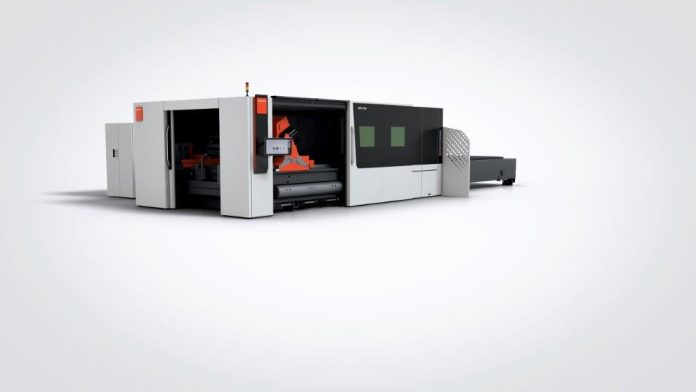
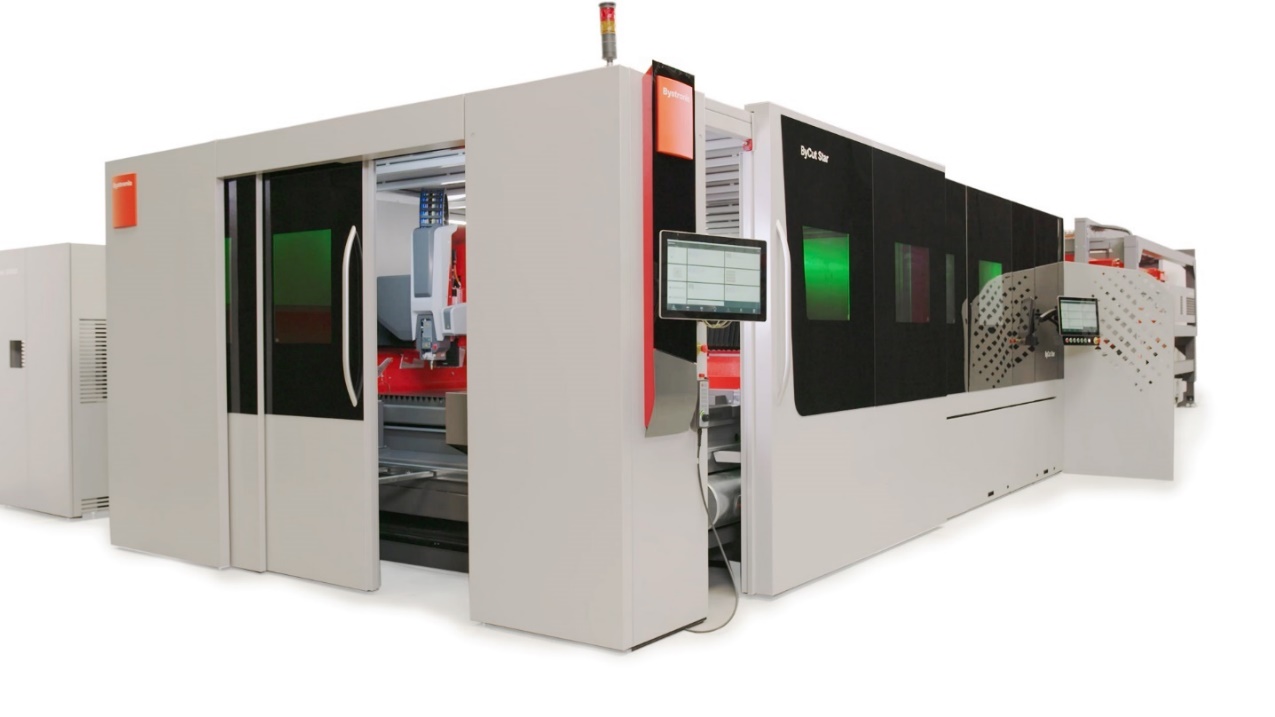
Featuring ultra-fast speeds and an expanded cutting spectrum, the ByCut Star now cuts with 30 kilowatts of laser power.
Impressive high cutting speed, intelligent cutting process and a new design – this is how the new ByCut Star presents itself. With 30 kilowatts and an optimized cutting process, it now cuts steel, aluminium, stainless steel, brass and copper precisely and reliably for even more quality.
Higher cutting quality and productivity is provided thanks to more laser power and smart features. Bystronic has advanced into a new dimension of fiber laser cutting, the ByCut Star with impressive 30 kilowatts of laser power. The high-end fiber laser stands for high-precision Bystronic technology, a stable cutting process up to the highest laser powers and for a wide range of applications.
However, sheet metal workers not only need a lot of laser power, but also intelligence, reliability and sustainability; this combination makes the laser cutting process really satisfying and successful.
Thus, at Bystronic, customer success is built on a concept of three pillars, namely Power, Intelligence and Cutting Process Improvement, including MixGas technology.
Smart features, such as the “Intelligent Cutting Process (ICP)”, the “Nozzle Control Tool (NCT) with KerfScan” or the “Parameter Wizard” optimize the entire cutting process, while ensuring that it stays on track. Users enjoy optimum capacity utilization and remarkable production uptime.
30 kilowatt of laser power
The technological leap from the previously available 3- to 20-kilowatt levels to the new 30-kilowatt level is considerable and opens new possibilities for Bystronic customers to optimize production and thus remain at the forefront of the ever more fiercely contested competition.
The “Advanced Applications” option enables expanded applications in steel and aluminium of up to 50 millimetres (15 kilowatts laser power and above).
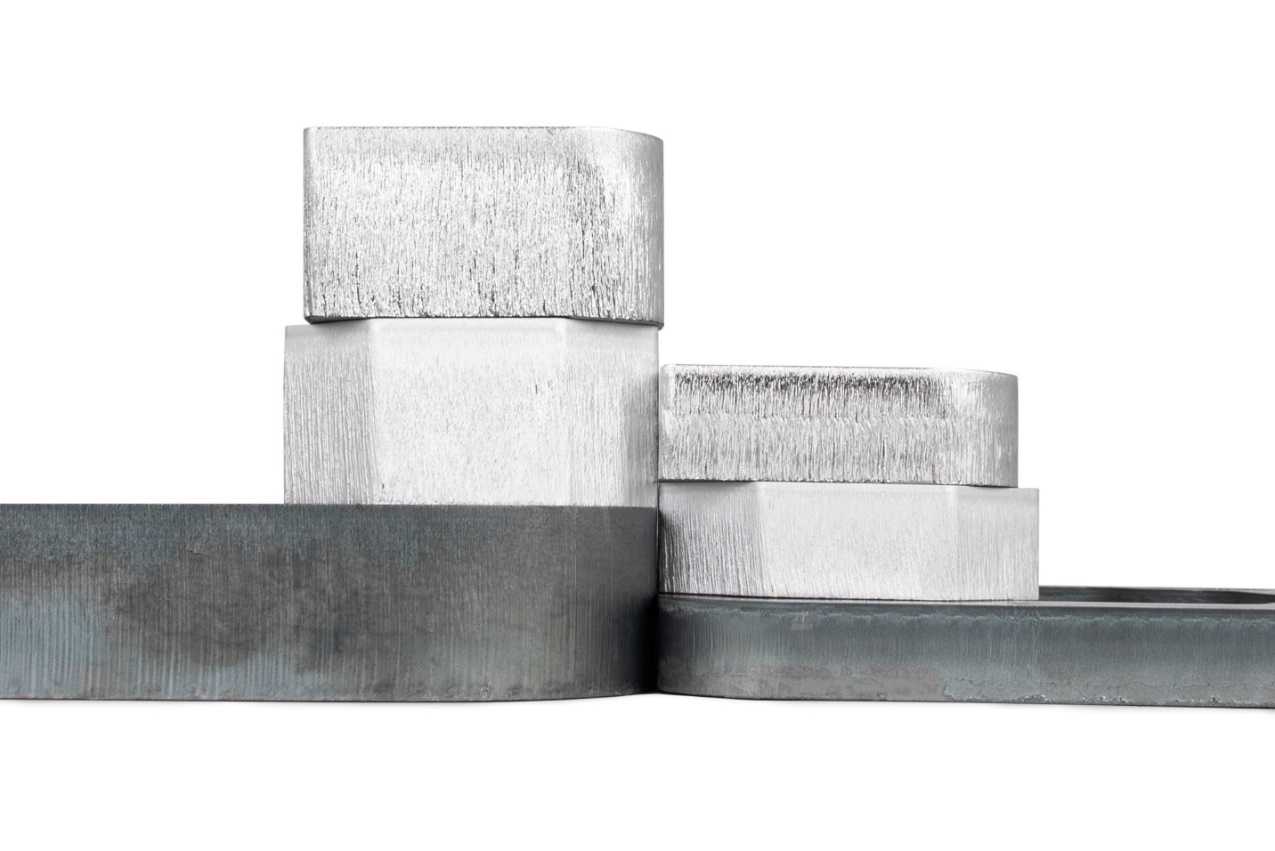
Cutting speeds on the ByCut Star increase twice as fast compared to 15 kW and MixGas with sheet thicknesses between 6 mm and 15 mm, and more than twice as fast with thicknesses starting at 20 mm. Piercing times are shorter for sheet thicknesses of 15 mm and above. Sheet metal processors thus benefit from higher productivity at low unit costs, because with 30 kilowatts, the new ByCut Star cuts steel, aluminium and stainless steel precisely and reliably. The 30-kilowatt laser power enables maximum flexibility for large series and spontaneous customer orders. Whether aluminium or steel, the powerful Bystronic cutting head impresses with maximum precision in thin and thick sheets. In addition, with the “Advanced Applications” option, high laser power (starting from 15 kilowatts) now also enables expanded applications in steel and aluminium of up to 50 millimetres. The new power level is exclusively available on the ByCut Star 4020.
Smart features make the difference
NCT & KerfScan is a smart feature package for oxygen cutting which increases process reliability, even in low-manned operations. This feature offers process monitoring, problem solving and continuation of the cutting process in a fully automatic way.
The “Parameter Wizard” ensures that the correct quality of the cut parts is always selected within minutes. This feature determines the perfect parameters with N2 and MixGas for steel from 4 to 15 mm in thickness.
Intelligent Cutting Process ICP is a new feature, where a coaxial camera is filming through the nozzle and looking directly into the cutting process. This feature currently offers the following functionalities:
Cut Quality Detection – The system automatically detects cut interruptions during the cutting process and re-cuts the area where it occurred.
Cut Quality Protection – AI-controlled cutting process maintains reliable quality throughout low manned production.
Nozzle Loss Detection – Down time and material waste caused by nozzle loss are significantly reduced.
While Bystronic customers benefit from outstanding cutting results with clever features, the new powerful Bystronic flagship is also controlled from a 21.5-inch touchscreen. Handling is as simple as operating a smartphone.
The new ByCut Star’s modern, sharp contours provide a striking appearance and match the performance of the machine.
Significantly increased user-friendliness and outstanding flexibility are major advantages provided by the new ByCut Star. Thus, there is front and/or side access as well as several windows with a view directly to the cutting process. In general, the new design offers better accessibility to the interior, and the machine is easier to place on the store floor thanks to more flexible layout.
Additional accessibility with the all new, sharp designed ByCut Star thanks to several gates.
Fiber laser cutting with mixed gas ensures better cutting quality and higher productivity
In laser cutting, cutting gas (especially N2 and MixGas) is used to keep both the laser and the sheet free of impurities and remove molten material. Nitrogen is used for so-called fusion cutting and oxygen for flame cutting. Gas mixing combines the benefits of O2 and N2 and thus is an alternative to pure nitrogen or oxygen cutting. Cutting with MixGas (a specific blend of Nitrogen/Oxygen) ensures perfect quality on steel at increased cutting speed. This helps even an inadequate steel to achieve a good result after the cutting process.
For in-house gas production with a N2 generator, Bystronic has a solution ready that is attractive from a cost perspective and environmentally friendly. The advantages are obvious: There is no need for transports by trucks when gas is delivered. One produces only as much nitrogen as is needed, and all the previous additional costs are eliminated – from filling the cylinders to replacing them. The sheet metal processor works completely autonomously and – independent from any gas supplier – is doing something for the environment in the process.
For more information please see www.bystronic.co.za or contact Bystronic on 010 410 0200.
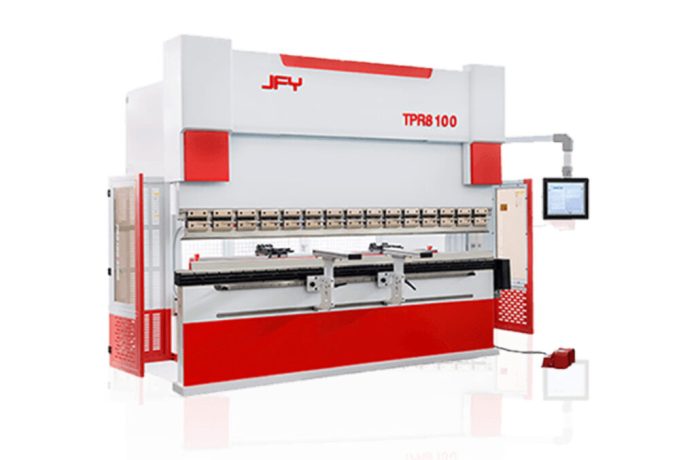
Cost-effective bending machine from JFY sold to more than 5.000 customers – Proven technology with high stability and reliability.
The machine body is optimized by finite element design to ensure high strength and high rigidity during operation. Compared with traditional CNC bending machines, the frequency of the Y-axis movement is 25% higher.
A broad range of options and bending tools allow the processing of large and complex workpieces, while the high-performance CNC control TJS-90 as standard configuration ensures maximum workflow efficiency and operating convenience.
The automatic mechanical crowning compensation system as standard configuration solves the influence of ram deformation on the workpiece during bending and Push-Pull Quick clamping as a standard configuration avoids part interference when bending at a small angle.
For further information, please contact PUMA MACHINE TOOLS – Tel: (011) 976 8600.
A high-performance mid-price laser machine equipped with TruFiber Cut Laser up to 6 kW.Smart design and material flow ensure maximum productivity at minimal investment costs.
The EFC ll laser cutting machine from leading Chinese manufacturer JFY, a member of the Trumpf Group, is locally available from Puma Machine Tools.
The machine’s CNC control system is based on the Windows platform and has been proven to be extremely reliable and high-performing.
The cutting head is designed with built-in protective glasses, ensuring reliable and optimized cutting quality. These protective glasses safeguard the optics from potential debris or damage that may come from the process zone. Overall, this results in a significantly higher durability of the cutting head, as well as higher cutting precision.
TruFiber is the ultimate fiber laser solution for all cutting needs. In fact, TruFiber delivers excellent process stability and consistent process results. Furthermore, the technology requires a minimum of maintenance.
Using offline programming software can improve material utilization and process efficiency. On the one hand, programming software can optimize the nesting process to reduce material waste, and on the other hand, it can simplify the programming process by converting simple and complex part drawings into processing programs, which results in faster production times. The Lantek programming software is a proven solution based on latest technology.
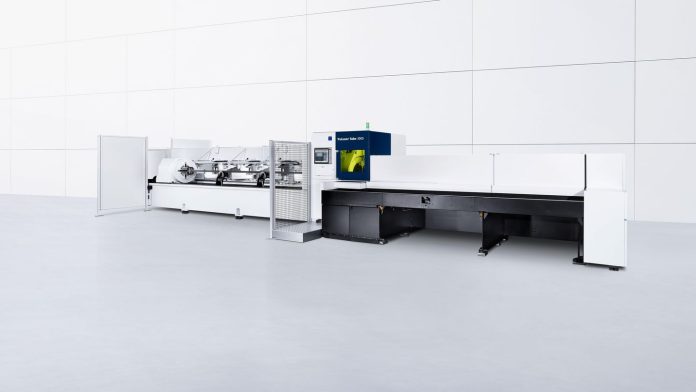
The TruLaser Tube 3000 fiber is suitable for companies that want to enter this technology and for companies that want to expand their manufacturing capacity.
A TRUMPF machine for getting started with laser tube processing or as an addition to existing machinery – Cost-effective even with low capacity utilization – Easy to operate thanks to numerous automated features
TRUMPF introduced a new laser tube cutting machine, the TruLaser Tube 3000 fiber, a cost-effective choice even at low to medium capacity utilization. It is therefore equally suitable for companies that are entering this technology as it is for companies seeking to expand their production capacity. The machine enables the versatile processing of tubes and profiles and replaces conventional tube processing steps such as sawing, drilling and milling.
Starter kit to enter the world of tube processing
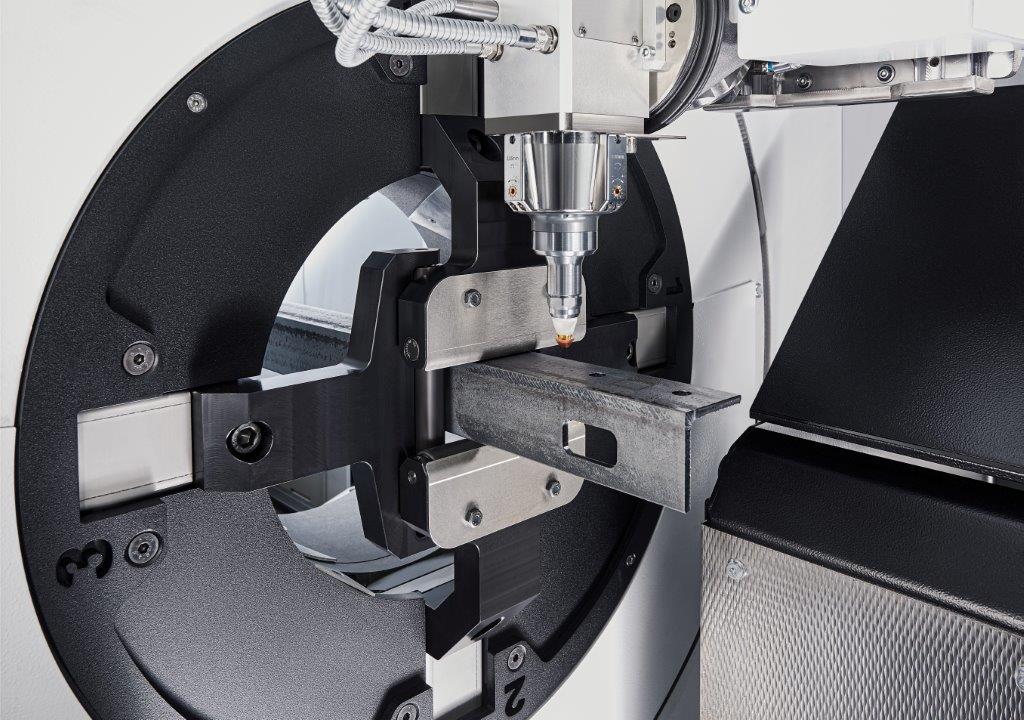
The TruLaser Tube 3000 fiber covers a broad range of applications including profiles, round tubes and flat steel bars. It also offers the option of L and U profiles. The two-kilowatt solid-state laser performs high-speed cutting of mild steel, stainless steel, aluminium and nonferrous metals such as copper and brass. An extensive set of cutting data is already stored on the machine. The TruLaser Tube 3000 fiber can cut tubes with diameters of up to 152 millimetres and profiles with an outer circumference of up to 170 millimetres. The self-centring clamping technology, which is designed to hold the tube in place and position it correctly during machining, adapts automatically to the tube dimensions without requiring manual setup by the operator. The TruLaser Tube 3000 fiber also configures other important settings automatically.
The self-centring clamping system fixes and positions the tube, thus ensuring optimal finished part quality.
The AdjustLine function modifies cutting parameters at the touch of a button to ensure reliable cutting of lower-quality materials. SeamLine Tube detects weld seams and markings on the inner and outer surfaces of the tubes, helping operators check that the tubes are correctly aligned in the machine and that the weld seam is in the desired position in the finished part. With its easy setup and high degree of automation, the TruLaser Tube 3000 fiber is a user-friendly machine that represents a cost-effective option for small batch sizes.
Reliable and precise parts handling
The TruLaser Tube 3000 fiber cuts tubes weighing up to 18.5 kilograms per meter with material thicknesses of up to 8 millimetres. It is available in two lengths that accommodate either 6.5 or 8 meters of material. Thanks to the optional LoadMaster Tube automated loading system, the machine is also a cost-effective choice for high-volume production runs.
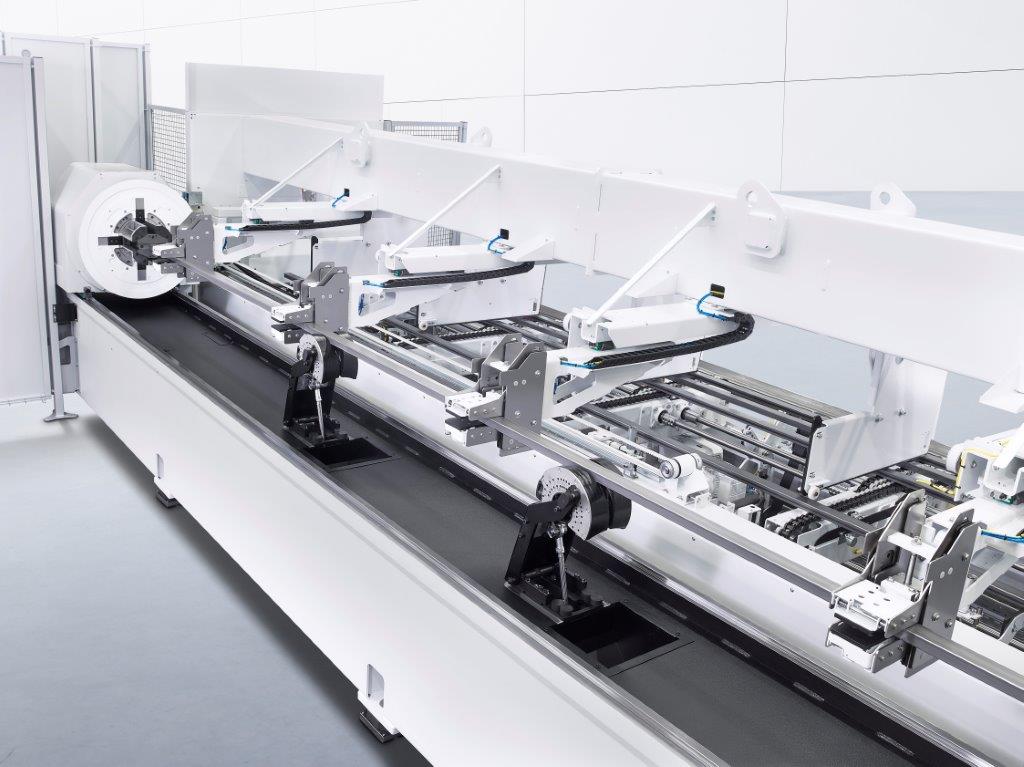
Thanks to the LoadMaster Tube loading automation, the machine can profitably perform large-scale production as well.
An integrated materials store known as the “bundle space” provides a buffer store that can hold up to 4 metric tons of raw material, or up to 5 tons with the machine version designed for an 8-meter loading length. The LoadMaster Tube system separates and measures the tubes parallel to production and transfers them to the machine. To ensure top-quality parts, step rollers support the tubes and guide them to the machining station.
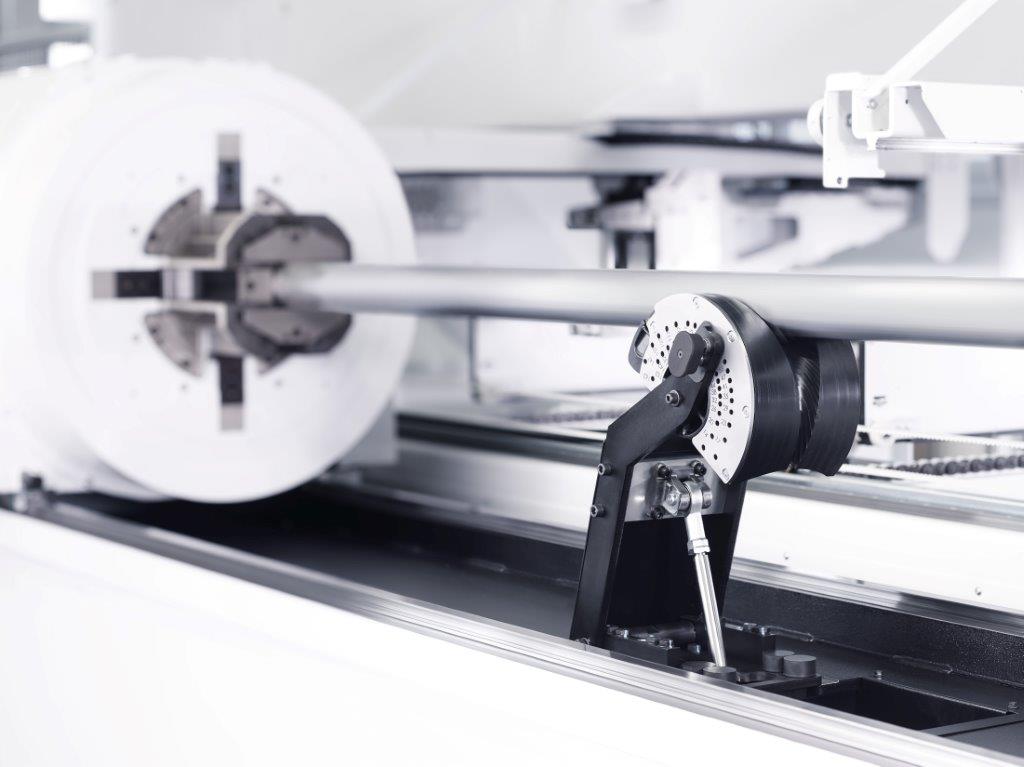
Step rollers support and guide the tubes to the processing station. They can be manually adapted to the respective tube diameter in no time.
These rollers can be adjusted to the current tube diameter in one simple action. The machine also features guide rollers on the unloading side which provide more support to long tubes during processing. The TruLaser Tube 3000 fiber ejects finished parts onto a rack. Set to the correct ergonomic height, this allows the operator to remove them comfortably while the machine continues working. Shorter parts can be ejected straight into a box. The TruLaser Tube 3000 fiber automatically separates cutting slugs and scrap metal from the finished parts and disposes of them in containers.
Key components easy to access at any time
Thanks to the design of the machine’s beam guard, the operator can easily access the loading and unloading sides of the machine at any time – for example to load individual tubes into the machine to process a smaller job between bigger ones. There is no need for a complete housing. A large, laser-safe viewing window makes it easy to keep an eye on the machining process.
Ready for the smart factory
Users can make changes to the machine’s production schedule or keep an eye on the machine using an app, making it even easier for the operator to keep track of the entire machining process in the TruLaser Tube 3000 fiber. A secure, OPC UA-based data interface is included to connect the machine to an ERP or MES system or to a cloud application, for example. TRUMPF machine apps provide information on program runtimes and machine capacity utilization.
For further information, please contact RETECON – Tel: (011) 976 8600.
It is now possible to own an affordable and utterly reliable laser, which is built by Amada in Japan. The newly launched Amada “ORSUS” fibre laser cutting machine is a 3 meter x 1,5 meter (3015) shuttle table machine, available in a 3kW, 6kW or 8kW power derivative.
Amada realized that those who are in the laser cutting game should understand the importance of having all the fundamentally important aspects in a machine package in order to be successful and profitable, with reliable equipment and guaranteed after-sales service. The Amada ORSUS offers all of this under the name that has become a worldwide market leader in the industry.
Equipped with the new Amada AMNC4ie control, easy control interaction is realized through simple tasks like moving or placing parts manually on the sheet by dragging across the touch screen, or soft joint creation to hold components inside a sheet without a physical micro joint. This is unique to Amada’s newest laser controls. The bar code reader system simplifies program transfer from the drawing office to the machine. Full maintenance schedules are displayed and interactive videos even display the method of doing correct preventative maintenance – continually.
Mode Converter
Equipped with a “mode converter system”, optimum beam mode shape is acquired through 2 pre-set shapes and based on the specific cutting application. This automatic system adjusts the beam mode shape according to processing requirements.
Different cutting methods are standard features on the ORSUS models, such as oxygen cutting – using oxygen, air cutting – using compressed air, clean cutting – using nitrogen, Eco cutting – with small diameter nozzles and (low) oxygen pressure, and even WACS cutting – water assisted cutting on thicker materials to reduce heat dispersion in the sheet.
Additionally, the Amada Hyper EZ Cut II system can be retrofitted to any of the Amada laser cutting machines, both Co2 and fibre. This Hyper EZ unit is connected to the compressor air system and filters the air, retrieving lower grade nitrogen, which is used in the cutting process, drastically reducing assist gas costs.
The unit is powered by a 24 volt circuit on the laser machine and supplied with long life filters, which ensure many hours of maintenances free nitrogen generation. The Hyper EZ Cut gas is fed to the machine through the air line and is selected by a simple selector lever system.
Amada V-Factory monitoring system
i-Process monitoring is standard on the ORSUS, which monitors the cutting condition as well as pierce penetration. The constant monitoring of light during the piercing and cutting process i-Optics Sensor is another standard feature, which monitors the condition of the protection glass, giving warnings before the cutting process is hindered. Contamination levels are indicated on the control screen to encourage cleaning or replacement.
With fibre lasers being on average 50% more efficient than the Co2 predecessors, additional savings can be realized through the employment of the various cutting methods and checking systems.
Mobile HMI, a standard feature, allows for the monitoring of the machine in the factory on a smart device. The operator can now monitor and operate multiple machines by starting and stopping programs remotely. This HMI system will keep you updated on the machines’ status constantly.
One step further than this is the complete factory monitoring system called “My V- Factory”. This is an optional package, able to monitor production operations in your factory. It will show when machinery is in a stopped state, alarm state or operational. It allows the full monitoring of what is being processed, when it was processed, alarm time history, production time history, idle time history and setup time.
Interruption during processing is a constant problem in our industry thanks to erratic power supply. Resumption and recovery is simple on the Amada system with the aid of the “resumption” function. The machine will automatically resume cutting from the point, where it was last interrupted.
The ORSUS is supplied with the standard shuttle table system, which ensures continuous production, facilitated by the automatic table change-over function. The table exchange takes 24 seconds to complete, and the shuttle can be unloaded or re-loaded without interfering with production in the machine.
Various automation options are available as retro-fit systems. These vary from the basic MPL sheet manipulator carrying up to 6 tons of material, to the single ASFH tower systems offering 6, 8, 10 or 12 shelves – each holding 2 tons of material, the double tower system and even part picking, removal and stacking to ensure sorting of nested parts on various stacking pallets.
The ORSUS comes supplied standard as a fully enclosed machine (Full cover partition). Due to health and safety regulations around the world and in South Africa too, it is illegal to operate a fibre laser without proper and adequate protection in place. Amada ensures that this aspect is covered fully as they understand the risks and hazards of exposure to the invisible fibre laser radiation.
Amada is an accredited and licenced importer and seller of fibre technology and adheres to all safety requirements as specified by the South African Health Products Regulatory Authority.
For more information, please contact Amada – Tel: 011 453 5459.
The rapid advancement of digitalisation in industrial manufacturing has made it crucial for businesses to stay ahead of the curve. The KwaZulu-Natal Industrial Technology Exhibition (KITE) 2025 is set to be the ultimate hub for industry professionals looking for cutting-edge solutions. If your business is on the path to digital transformation, this event is a must-attend.
KITE 2025, taking place at the Durban Exhibition Centre from 22–24 July 2025, is the premier platform for industrial technology, connecting suppliers with organisations that need tailored solutions. With over four decades of industry experience, KITE has solidified itself as the go-to event for innovation, networking and knowledge-sharing in industrial technology.
Digitalisation is transforming industrial operations, offering increased efficiency, automation and data-driven decision-making. However, there is no one-size-fits-all approach. Each business requires specific solutions, making events like KITE 2025 essential for finding the right technology and expertise.
Key Highlights of KITE 2025:
Cutting-Edge Exhibits & Live Demonstrations – KITE 2025 brings together leading suppliers showcasing the latest industrial technology. Live demonstrations allow attendees to see these solutions in action before making investment decisions.
SAIMechE Seminar Theatre – Learn from the Experts. Attendees can gain valuable insights from industry experts through free-to-attend sessions at the SAIMechE Seminar Theatre. These sessions cover key trends, regulatory updates, and the latest advancements in industrial technology.
One-Day LEEASA Conference – The Lifting Equipment Engineering Association of South Africa (LEEASA) conference will be a major draw for professionals in the lifting equipment sector. Expect in-depth discussions on safety, compliance, and technological advancements.
Unparalleled Networking Opportunities – Beyond technology and learning, KITE 2025 offers a unique chance to connect with industry peers, share knowledge, and build partnerships that can drive long-term business success.
“If your organisation is undergoing digital transformation, KITE 2025 provides a direct line to industry-leading solutions. Not only are the exhibitors eager to impart their experience and expertise, but you will also be able to network with industry peers and share important information that will ultimately assist in the sustainability of your operations.” says Charlene Hefer, Portfolio Director at Specialised Exhibitions.